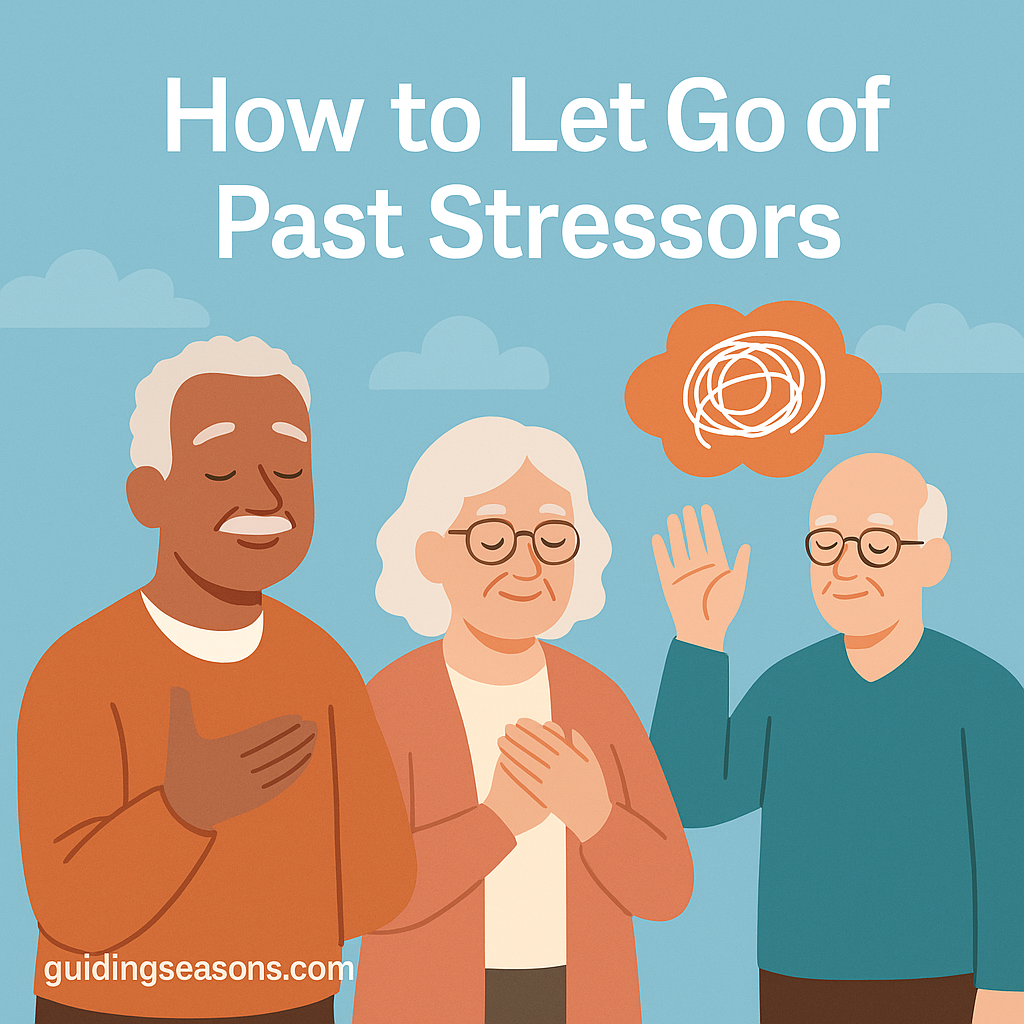
Moving into a new chapter of life can create unexpected opportunities for reflection. Retirement, children leaving home, changes in relationships, or simply having more quiet time may bring memories and experiences back to the surface that you haven’t thought about in years.
Some memories are comforting. Others aren’t.
You might find yourself replaying a career decision you regret, thinking about an old disagreement, wishing you had handled a relationship differently, or worrying about choices that can no longer be changed.
Occasional reflection is normal. But repeatedly returning to situations you cannot change can make it harder to appreciate what is happening in your life today.
Letting go doesn’t mean pretending something never happened. It doesn’t require forgiving everyone, forgetting painful experiences, or deciding that something hurtful was acceptable.
Instead, letting go can mean reducing the amount of emotional space the past occupies in your present life.
It’s the gradual process of recognizing what happened, learning what you can from it, and deciding where you want your attention to go next.
Here are practical ways to begin.
1. Identify What You’re Still Carrying
It’s difficult to release something you haven’t clearly identified.
Sometimes stress from the past appears indirectly. You may become irritated when a particular subject comes up, repeatedly replay the same conversation, or find yourself thinking about how differently life might have turned out.
Give yourself a little quiet time and ask:
- What situation do I repeatedly think about?
- Is there someone I’m still angry with?
- What do I wish I had done differently?
- What am I still blaming myself for?
- Is there something I never had the opportunity to say?
- What part of this situation continues to bother me?
You don’t need to solve anything immediately.
Simply identifying the source of the stress can help you understand what you’re dealing with.
For example, imagine someone who retired five years ago but still becomes angry whenever they remember being passed over for a promotion late in their career.
The promotion can no longer be changed.
But the frustration surrounding it may still be affecting the person’s life.
Recognizing that difference—between the original event and the stress you’re experiencing today—is an important first step.
2. Separate What Happened From What You Can Change
The human mind is remarkably good at creating alternative versions of the past.
“If only I had taken that job.”
“I should have said something.”
“I shouldn’t have trusted that person.”
“If I had invested differently, things would be better now.”
Sometimes those observations contain useful lessons.
But there is a point where reflection becomes repetition.
Try dividing the situation into two categories:
What cannot be changed
and
What can still be influenced.
Suppose you regret losing contact with an old friend 20 years ago.
You cannot change the previous 20 years.
But perhaps you can contact that person today.
If reconnecting isn’t possible, you may still be able to use the experience as motivation to protect the relationships you currently have.
The past itself is fixed.
Your response to it isn’t.
3. Give Yourself a Limited Time to Reflect
Trying to force yourself never to think about something usually isn’t realistic.
Instead, consider giving reflection some boundaries.
For example, set aside 15 minutes to write or think about what’s bothering you.
During those 15 minutes, allow yourself to explore the situation honestly.
What happened?
Why does it still bother you?
What do you wish had happened instead?
What have you learned?
When the 15 minutes are finished, deliberately move into another activity—make lunch, go outside, call someone, work in the garden, or take a walk.
This doesn’t mean your thoughts must disappear exactly when the timer ends.
The purpose is to avoid allowing one stressful memory to consume an entire afternoon.
You are creating a boundary between reflection and the rest of your life.
4. Accept That Some Questions May Never Have Answers
One reason people remain attached to old situations is the desire for closure.
Why did someone behave that way?
Why didn’t they apologize?
Why didn’t something work out?
What would have happened if you had made another choice?
Sometimes you’ll eventually find an answer.
Sometimes you won’t.
Waiting for another person to provide closure can leave your peace dependent on something outside your control.
You may need to eventually accept:
“I don’t know why that happened.”
“I may never receive the apology I wanted.”
“I’ll never know what would have happened if I had chosen differently.”
Acceptance isn’t approval.
It simply recognizes reality as it currently exists.
Once you stop demanding an answer that may never arrive, you can begin deciding what happens next.
5. Practice Mindfulness When Your Thoughts Return to the Past
Mindfulness involves bringing attention to what is happening in the present moment without immediately judging or reacting to it.
The American Psychological Association describes mindfulness as awareness of internal experiences and surroundings and notes that mindfulness-based approaches can help people observe thoughts and emotions rather than automatically reacting to them.
This can be useful when an old stressor suddenly enters your thoughts.
Try a simple grounding exercise.
Place both feet on the floor.
Take several slow breaths.
Then notice:
- What you can see
- What you can hear
- How your feet feel against the floor
- The temperature of the room
- The sensation of breathing
You don’t need to fight the memory.
Simply notice:
“I’m thinking about that situation again.”
Then redirect your attention toward what is happening around you now.
Practiced regularly, this can help create some distance between having a thought and becoming absorbed by it.
6. Use Breathing to Interrupt Stressful Moments
Stress isn’t experienced only through thoughts. Your body can respond too.
You may notice your shoulders tightening, your breathing changing, or your heart beating faster when thinking about something upsetting.
Slow breathing can provide a simple pause.
Try this:
Breathe in gently.
Breathe out slowly.
Repeat several times without forcing unusually deep breaths.
The National Center for Complementary and Integrative Health (NCCIH), part of the National Institutes of Health, reports that meditation and mindfulness practices have been studied for managing stress, anxiety, depression, and other concerns. Evidence suggests mindfulness meditation may help reduce some symptoms of stress, although research quality varies and these practices shouldn’t be treated as universal solutions.
Even a brief pause can help you move from automatically reacting to deliberately deciding what to do next.
7. Replace Self-Criticism With a More Balanced Perspective
Regret often comes with harsh self-judgment.
“I should have known better.”
“How could I have made that mistake?”
“I wasted so much time.”
But you’re evaluating an earlier version of yourself using information and experience you have today.
That’s rarely a fair comparison.
Imagine talking to your 40-year-old self.
What did that person know at the time?
What pressures were they facing?
What information was unavailable?
What responsibilities influenced the decision?
Would you judge a close friend as harshly for making the same choice?
Self-compassion doesn’t require pretending every decision was correct.
You can acknowledge:
“I made a mistake.”
And also say:
“I understand why I made that decision at the time.”
Both statements can be true.
The goal is not to excuse the past. It’s to learn from it without repeatedly punishing yourself for it.
8. Write Down What You’ve Learned
Writing can turn vague thoughts into something more concrete.
Take a piece of paper and divide it into three sections:
What happened
Write a short, factual description without trying to explain everything.
What it taught me
Identify any lessons that came from the experience.
What I want to do differently now
Turn those lessons into something useful.
For example:
What happened:
I allowed work to consume too much of my time.
What it taught me:
Relationships need regular attention.
What I’ll do now:
I’ll make time to see my children or grandchildren more consistently.
Suddenly, an old regret has become information you can use.
That’s one of the healthiest purposes reflection can serve.
9. Talk to Someone You Trust
Some thoughts become heavier when they’re carried alone.
Talking with another person can provide perspective.
That might be:
- A spouse or partner
- A trusted friend
- An adult child
- A sibling
- A spiritual adviser
- A counselor or therapist
- A support group
You don’t necessarily need the other person to solve the problem.
Sometimes saying something aloud helps you understand it differently.
A friend might also see the situation more objectively than you can.
If past experiences are causing persistent distress, interfering with sleep or everyday functioning, or involve trauma, grief, depression, or anxiety that feels difficult to manage, consider talking with a qualified mental-health professional rather than relying solely on self-help strategies.
Seeking additional support is simply another practical way of addressing something that continues to affect your life.
10. Decide Whether a Conversation Is Still Needed
Sometimes letting go involves having a conversation you’ve been avoiding.
Perhaps you owe someone an apology.
Maybe a misunderstanding can still be cleared up.
Perhaps there’s something you’ve wanted to say to a family member for years.
Before reopening an old issue, however, consider what you hope to accomplish.
Ask:
- Will this conversation help resolve something?
- Am I trying to understand or simply prove I’m right?
- Is the other person likely to engage constructively?
- Could reopening this issue create unnecessary harm?
Not every old conflict needs another conversation.
Sometimes resolution comes through communication.
Other times, peace comes from deciding that you no longer need to participate in the conflict.
11. Establish Boundaries When Necessary
Letting go doesn’t always mean reconciliation.
If a person or situation repeatedly brings unnecessary conflict into your life, healthier boundaries may be appropriate.
Boundaries might involve:
- Limiting certain conversations
- Spending less time with someone
- Refusing to participate in recurring arguments
- Avoiding subjects that never lead anywhere productive
- Clearly communicating what behavior you will accept
- Protecting periods of quiet and rest
Boundaries aren’t about controlling another person’s behavior.
They’re about deciding how you will respond.
For example, instead of saying:
“You need to stop bringing that up.”
A boundary might be:
“I’m not going to continue conversations about that subject.”
You control your participation, not the other person’s choices.
12. Stop Rehearsing Arguments That Are Already Over
Many people continue old disagreements privately.
You replay the conversation while driving.
You think of the perfect response several years too late.
You imagine finally proving your point.
This mental rehearsal can keep an old conflict surprisingly active.
When you notice it happening, ask:
“Is there anything useful I can still do about this?”
If the answer is yes, decide what action to take.
If the answer is no, redirect your attention toward something happening today.
You may have to do this repeatedly.
Letting go is often less like flipping a switch and more like practicing a new response every time an old thought returns.
13. Put More Energy Into What You Can Control Today
The past tends to lose some of its influence when the present becomes more meaningful.
Ask yourself:
What could I do today that would make today slightly better?
Maybe you can:
- Take a walk
- Call a friend
- Cook something you enjoy
- Work on a hobby
- Organize part of your home
- Exercise
- Volunteer
- Spend time outdoors
- Read
- Plan a small trip
- Learn something new
These activities aren’t ways of pretending the past didn’t happen.
They’re reminders that your life is still happening.
You have a limited amount of attention each day.
Where you repeatedly direct that attention matters.
14. Create New Experiences
One powerful way to loosen the grip of the past is to continue creating a future.
Retirement can provide opportunities that weren’t available during decades of working and raising a family.
You might:
- Learn photography
- Join a walking group
- Volunteer locally
- Take a class
- Visit somewhere new
- Start gardening
- Reconnect with friends
- Learn a musical instrument
- Help younger family members
- Begin a creative project
You don’t need a dramatic reinvention.
Suppose you dedicate just two hours every Saturday to something you’ve always wanted to explore.
Over one year, that’s more than 100 hours devoted to building a new interest, skill, relationship, or experience.
That’s significant.
Your history remains part of you, but you’re continuing to add new chapters.
15. Recognize How Much You’ve Already Overcome
When thinking about the past, don’t remember only the mistakes and disappointments.
Remember the difficulties you survived too.
Think about:
- Problems you eventually solved
- Losses you endured
- Career challenges you navigated
- Family responsibilities you handled
- Financial difficulties you worked through
- Relationships you repaired
- Major changes you adapted to
You are not simply the person who experienced difficult things.
You are also the person who continued afterward.
That distinction matters.
Your past contains evidence not only of stress, but also of resilience.
Give Letting Go Time
One final misconception is that letting go should happen quickly.
You identify the problem.
You forgive yourself.
You move on.
Real life is rarely that tidy.
An old memory may stop bothering you for months and unexpectedly return.
A familiar place, anniversary, photograph, conversation, or song might bring it back.
That doesn’t necessarily mean you’ve failed to move forward.
When the thought returns, acknowledge it and practice the same process again:
Notice it.
Accept that it happened.
Take whatever useful lesson remains.
Return your attention to the present.
Over time, the memory may still exist while carrying considerably less emotional weight.
That’s often what letting go actually looks like.
Final Thoughts
Letting go of past stressors doesn’t mean erasing your history.
Your experiences helped shape the person you are today. Some brought happiness and pride. Others brought disappointment, anger, regret, or sadness.
You can acknowledge all of them without allowing the most difficult moments to dominate the years ahead.
Start by identifying what you’re carrying. Separate what can still be changed from what cannot. Question harsh judgments about your past decisions. Use mindfulness or breathing when old thoughts become overwhelming. Talk with people you trust. Establish boundaries where necessary. Most importantly, continue creating experiences that give your present life meaning.
You don’t have to resolve your entire past in order to enjoy today.
Sometimes progress begins with a much smaller decision:
This happened. I learned from it. I don’t need to spend today reliving it.
Then you take a walk.
Call someone you love.
Work on something meaningful.
Make plans for next week.
And gradually, your attention begins moving away from what cannot be changed and toward the life that is still yours to live.