Mindset and Purpose: How to Find Direction, Clarity, and Meaning at Every Stage of Life

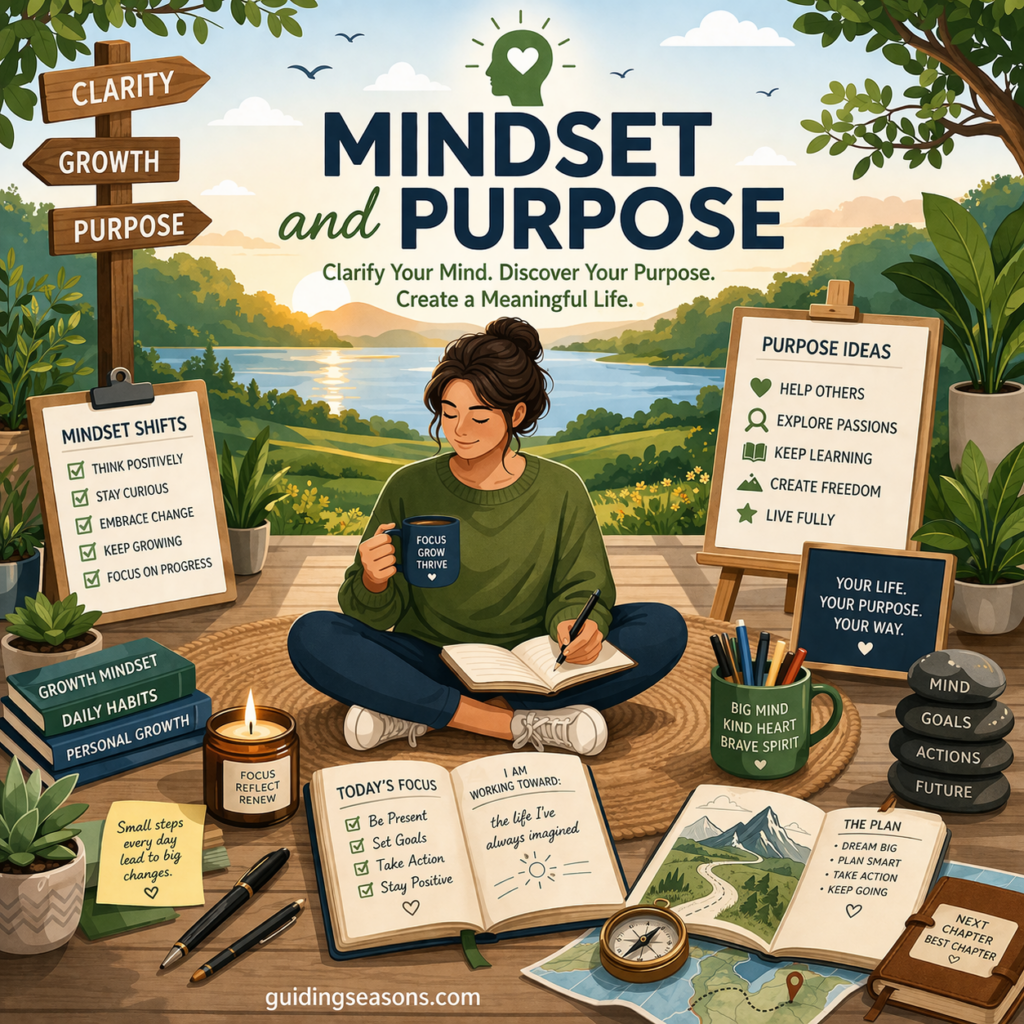
Flat illustration of a woman reflecting and journaling outdoors surrounded by symbols of growth, goals, and purpose representing mindset development and life direction.
Flat illustration showing mindset growth, personal reflection, and purpose-driven living in a calm outdoor setting. guidingseasons.com

At some point in life, almost everyone begins asking bigger questions.

What am I doing with my life?

Am I on the right path?

What actually matters to me now?

What do I want the next stage of my life to look like?

These questions can appear during young adulthood, in the middle of a career, after children leave home, following a major life change, or during retirement. Sometimes they arrive gradually. Other times, a change in circumstances suddenly makes old routines and priorities feel less meaningful.

Questioning your direction does not necessarily mean something has gone wrong. Often, it means you are paying closer attention to how you are living and whether your current life still reflects what matters to you.

Mindset and purpose influence how you respond to these questions. Your mindset shapes the way you interpret your experiences, while your sense of purpose gives those experiences direction.

Neither needs to be perfectly defined.

You can build a meaningful life gradually through your relationships, interests, responsibilities, personal growth, contributions, and everyday choices.

This guide explores how to develop greater clarity, strengthen your mindset, and create a sense of purpose that can evolve with you through every stage of life.

Continue reading “Mindset and Purpose: How to Find Direction, Clarity, and Meaning at Every Stage of Life”

How to Improve Your Daily Outlook

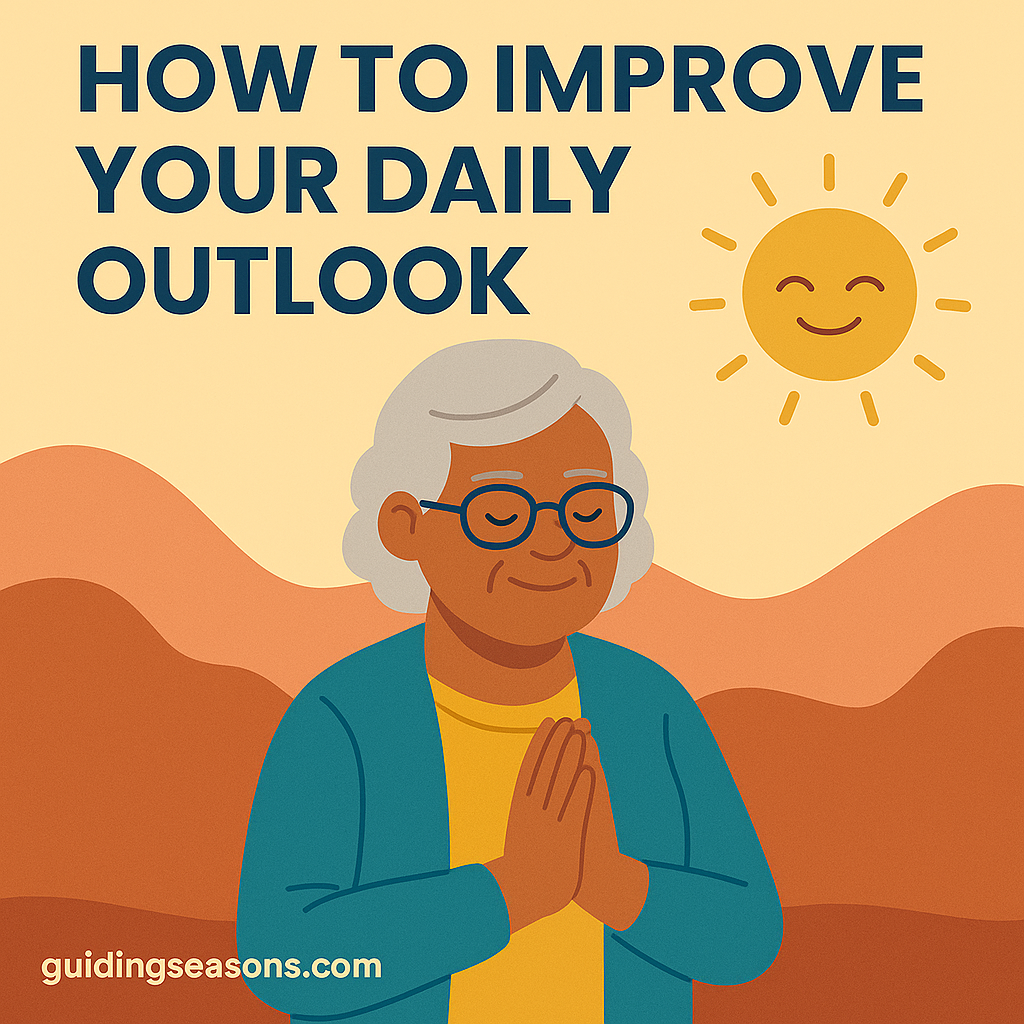
Flat illustration of a senior woman with hands together in a calm, prayer-like pose, with a smiling sun icon above her and warm-colored hills in the background, plus a small guidingseasons.com watermark in the bottom left.
Senior woman practicing calm reflection with a smiling sun above her.

Your daily outlook influences how life feels—not only during major events, but during the ordinary hours that make up most of your days.

As you move into retirement or another later stage of life, your daily rhythm may change significantly. The alarm clock may no longer ring at 6:00 a.m. There may be fewer deadlines, meetings, school schedules, or responsibilities determining what happens next. At first, that freedom can feel wonderful.

But having more control over your time can also create an unexpected question:

What do I want my days to look like now?

Without the external structure that once organized your life, some days may begin to blend together. Motivation can fluctuate. You might wake up without a clear reason to get moving or find yourself spending more time watching television, scrolling online, or thinking about problems.

Improving your daily outlook doesn’t mean forcing yourself to be cheerful.

It doesn’t mean ignoring grief, health concerns, financial worries, family problems, or other legitimate challenges. A healthy outlook allows difficult emotions to exist while also recognizing that one frustrating moment doesn’t necessarily have to determine the rest of the day.

The goal is balance.

With a few intentional habits, you can create more structure, connection, curiosity, and meaning in ordinary life.

Continue reading “How to Improve Your Daily Outlook”

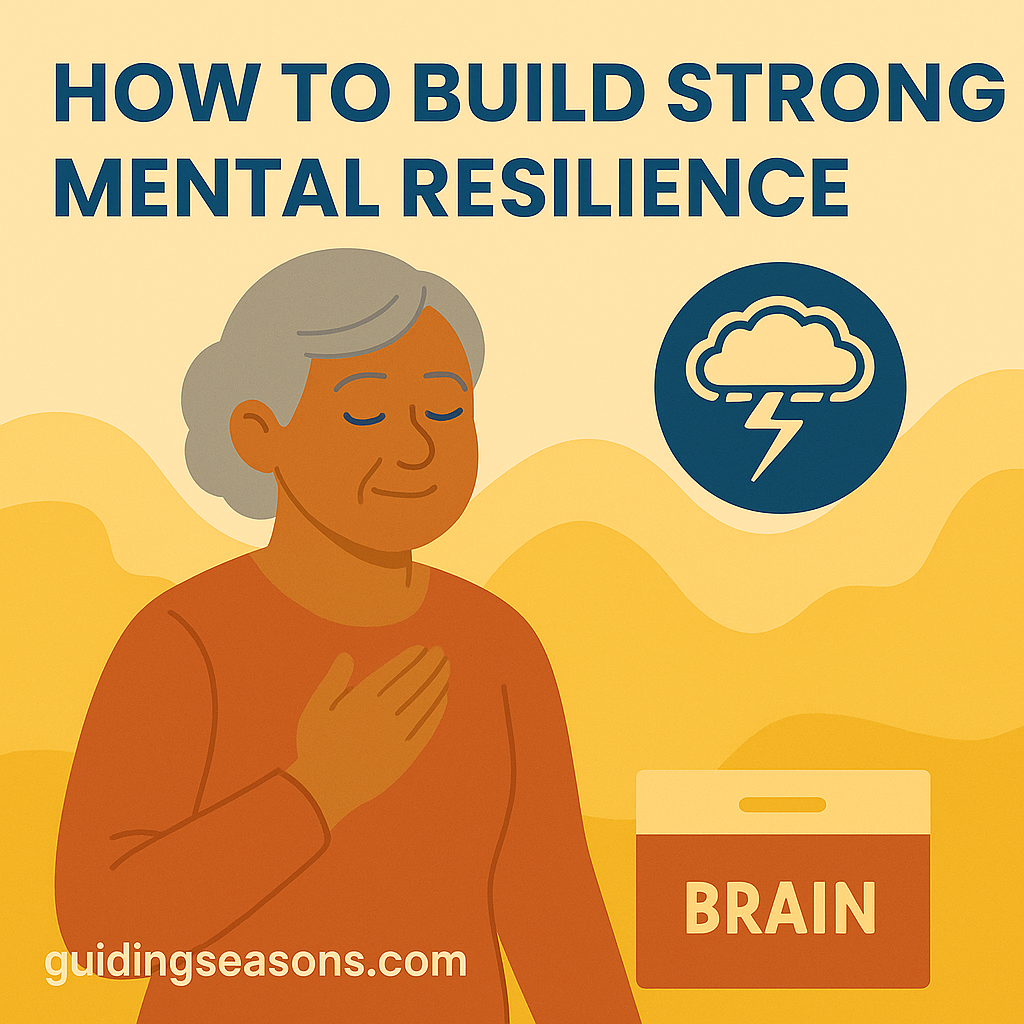
How to Build Strong Mental Resilience

Flat illustration of an older woman with her hand on her chest practicing calm breathing, with a storm-cloud-and-lightning resilience icon above her, set against warm yellow tones and a small guidingseasons.com watermark in the bottom left.
Senior woman practicing calm breathing with a resilience icon in the background.

As you move through different stages of life, challenges can appear in many forms—health changes, financial uncertainty, retirement adjustments, caregiving responsibilities, grief, or unexpected changes within your family.

Mental resilience is your ability to adapt to these challenges, recover from difficult periods, and continue moving forward even when life doesn’t go according to plan.

Resilience doesn’t mean that difficult experiences won’t affect you. It doesn’t require you to remain positive all the time, hide your emotions, or handle every problem alone. Instead, resilience involves developing healthy ways to respond when circumstances become difficult.

And resilience isn’t necessarily a fixed personality trait. Coping strategies, supportive relationships, healthy routines, and experience can all contribute to your ability to navigate stressful situations.

In fact, AARP research on resilience and aging highlights evidence that older adults can recover and rebuild well-being after difficult periods. Resilience can continue developing throughout later life.

This guide offers practical ways to strengthen mental resilience so you can approach life’s challenges with greater confidence, flexibility, and emotional steadiness.

Continue reading “How to Build Strong Mental Resilience”

How to Stay Open to New Experiences

Illustration of a senior man smiling and gesturing with an arrow icon representing openness to new experiences, created for the article “How to Stay Open to New Experiences,” with a small guidingseasons.com watermark at the bottom.
Senior man gesturing toward an arrow icon symbolizing openness to new experiences.

Staying open to new experiences is a valuable way to keep life feeling meaningful, engaging, and fulfilling—especially during later life stages. With greater self-awareness, years of life experience, and often more flexibility in your schedule, this season can offer unique opportunities to explore what genuinely interests you.

Being open to new experiences doesn’t mean forcing yourself into situations that feel uncomfortable or overwhelming. Instead, it means developing a thoughtful, self-respecting approach to curiosity and growth. When openness is guided by intention, it can feel energizing rather than stressful.

By the end of this article, you’ll have a simple decision filter to help you choose which new experiences may be right for you, along with practical examples based on common life situations.

Continue reading “How to Stay Open to New Experiences”

How to Navigate Grief and Healing

Illustration of a grieving senior woman sitting at a table with a candle, a framed photo, and a journal, created for the article “How to Navigate Grief and Healing,” with guidingseasons.com shown at the bottom left.
Senior woman reflecting during a quiet moment with a candle and photo nearby.

Grief is one of the most difficult experiences we face in life. Whether you’re grieving the loss of a spouse, a family member, a close friend, a pet, or even a life chapter that has changed forever, the emotions can feel heavy, confusing, and unpredictable.

There is no single “right” way to grieve, and there is no specific timeline for healing.

As a senior, grief may come in many forms—losing loved ones, adjusting to health changes, or navigating major life transitions. While grief may remain part of your story, it is possible to gradually find moments of comfort, connection, and meaning again.

This guide offers gentle, supportive steps to help you move through grief with patience and compassion for yourself.

Continue reading “How to Navigate Grief and Healing”

How to Strengthen Your Inner Confidence

Illustration of a confident senior woman standing with folded arms and a calm smile, created for the article “How to Strengthen Your Inner Confidence,” with guidingseasons.com shown at the bottom.
Confident senior woman smiling calmly with arms folded.

Confidence is often associated with being bold, outspoken, decisive, or certain of yourself. We may picture a confident person as someone who walks into a room without hesitation, takes charge of situations, and rarely worries about what other people think.

But confidence doesn’t always look like that—especially later in life.

As you grow older, confidence can become quieter and more personal. Instead of needing to prove what you can accomplish, confidence may become more about trusting yourself to make decisions, adapt to change, learn when necessary, and handle challenges as they arise.

That kind of confidence doesn’t depend on having all the answers.

It comes from knowing that even when life changes, you still have experience, judgment, strengths, and the ability to respond.

Retirement, changes in health or mobility, the loss of familiar responsibilities, changes in relationships, or learning new technology can sometimes shake that sense of certainty. But they don’t erase the abilities and wisdom you’ve developed over a lifetime.

In fact, the National Institute on Aging (NIA) emphasizes that older adults remain capable of learning new things, forming new memories, and improving their performance in different skills. The NIA also points out that some aspects of thinking can benefit from the knowledge and insight accumulated through years of experience.

Strengthening inner confidence isn’t about returning to the person you were 20 or 30 years ago.

It’s about learning to trust the person you are today.

Continue reading “How to Strengthen Your Inner Confidence”

How to Build Healthy Routines for Happiness

Illustration of a senior woman stretching near a window as part of a healthy daily routine, with the title “How to Build Healthy Routines for Happiness.”
Senior woman stretching by a window as part of a healthy daily routine.

A happy and fulfilling life doesn’t simply appear out of nowhere—it’s shaped in part by the small choices you make every day. As you move through retirement, routines can become powerful tools for building purpose, reducing stress, and supporting your mental and physical well-being.

The good news is that routines don’t need to be complicated. Even a few simple habits can create a meaningful sense of stability, connection, and enjoyment.

This guide walks you through practical ways to build healthy routines that support happiness and help you feel more energized, grounded, and optimistic.

Continue reading “How to Build Healthy Routines for Happiness”

How to Overcome Negative Thinking Patterns

Older woman touching her forehead with a worried expression, with icons representing negative thoughts on each side.
Older woman experiencing negative thoughts with symbolic icons surrounding her.

Everyone has negative thoughts from time to time. You might worry about the future, replay an uncomfortable conversation, criticize yourself for a mistake, or assume that something will go wrong before it has even happened.

These thoughts can become more noticeable during periods of change. Retirement, changes in health or mobility, financial concerns, the loss of familiar routines, caregiving responsibilities, or changes in relationships can all create uncertainty.

Having a negative thought does not automatically mean something is wrong. The problem begins when negative thinking becomes so repetitive that it influences how you see yourself, other people, and the future.

Fortunately, thought patterns are not necessarily permanent. You can learn to recognize unhelpful thoughts, examine them more carefully, and respond in ways that are more balanced.

This idea is central to cognitive behavioral therapy (CBT). According to the National Institute of Mental Health (NIMH), CBT can help people recognize automatic ways of thinking that are inaccurate or harmful, question those thoughts, understand how they affect emotions and behavior, and change self-defeating patterns.

You do not need to force yourself to “think positive” all the time. A more useful goal is learning how to think accurately, fairly, and constructively, especially when your mind automatically moves toward the worst possible interpretation.

Here are practical ways to begin.

Continue reading “How to Overcome Negative Thinking Patterns”

How to Find Joy in Quiet Moments

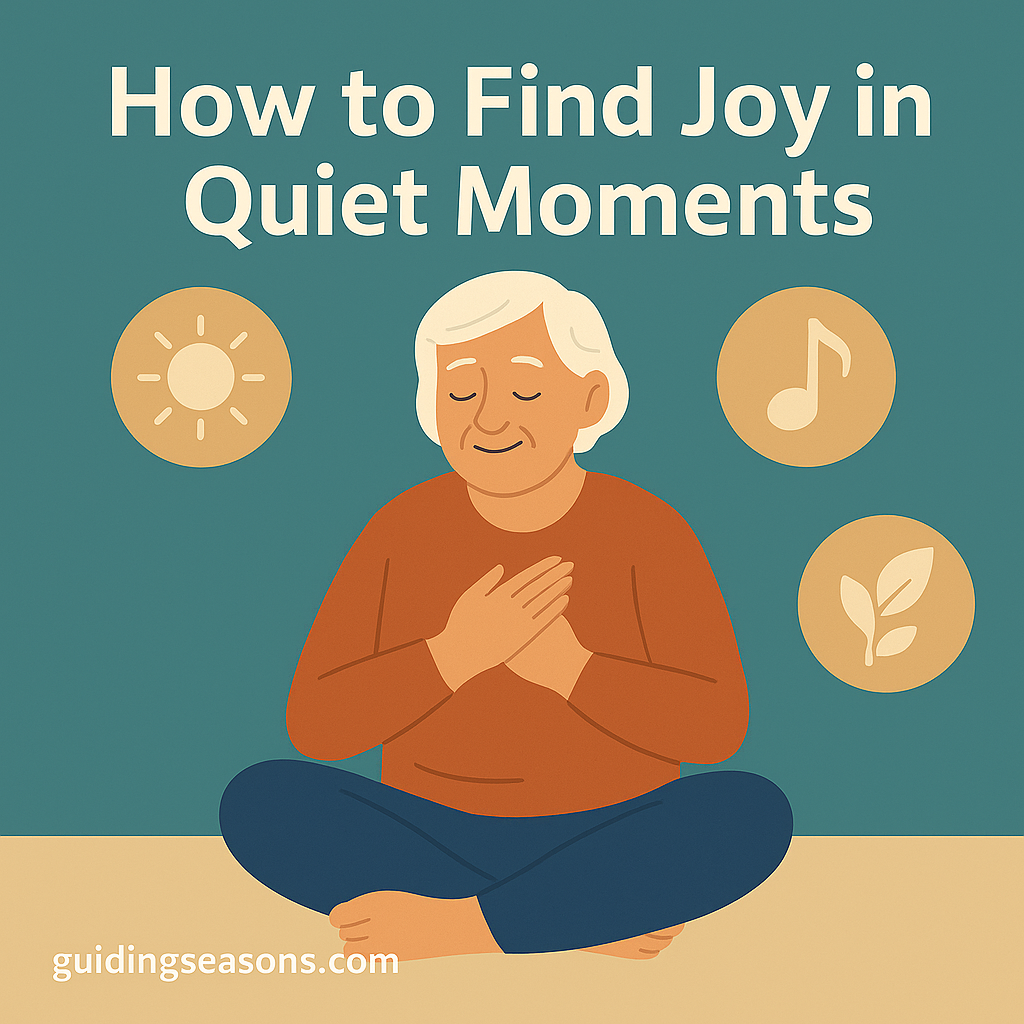
Older woman sitting cross-legged with her hands over her heart, surrounded by calming icons such as a sun, music note, and leaf, representing finding joy in quiet moments.
Illustration of a senior woman practicing peaceful reflection with soothing icons around her.

Life can be surprisingly noisy.

Television plays in the background. Phones buzz with notifications. News updates arrive throughout the day. There are appointments to remember, errands to complete, household responsibilities to handle, and worries that sometimes seem determined to occupy our thoughts.

In the middle of all that activity, quiet moments can feel almost unusual.

Yet some of life’s most satisfying experiences happen when very little is happening at all.

A warm cup of coffee in the morning. Sunlight coming through the window. Sitting outside and hearing birds nearby. Reading a few pages of a good book. Watching the sky change colors at the end of the day.

These experiences may seem ordinary, but that is part of what makes them valuable. You don’t need a vacation, an expensive purchase, or a major celebration to enjoy them.

Finding joy in quiet moments is largely about learning to notice what is already around you.

For older adults, this can be particularly meaningful. Retirement and other life changes may create a different daily rhythm than the one you had during your working years. Instead of viewing slower periods as empty time that needs to be filled, you can learn to appreciate them as opportunities for reflection, relaxation, connection, and enjoyment.

Here are practical ways to make quiet moments a meaningful part of everyday life.

Continue reading “How to Find Joy in Quiet Moments”

How to Maintain Curiosity as You Age

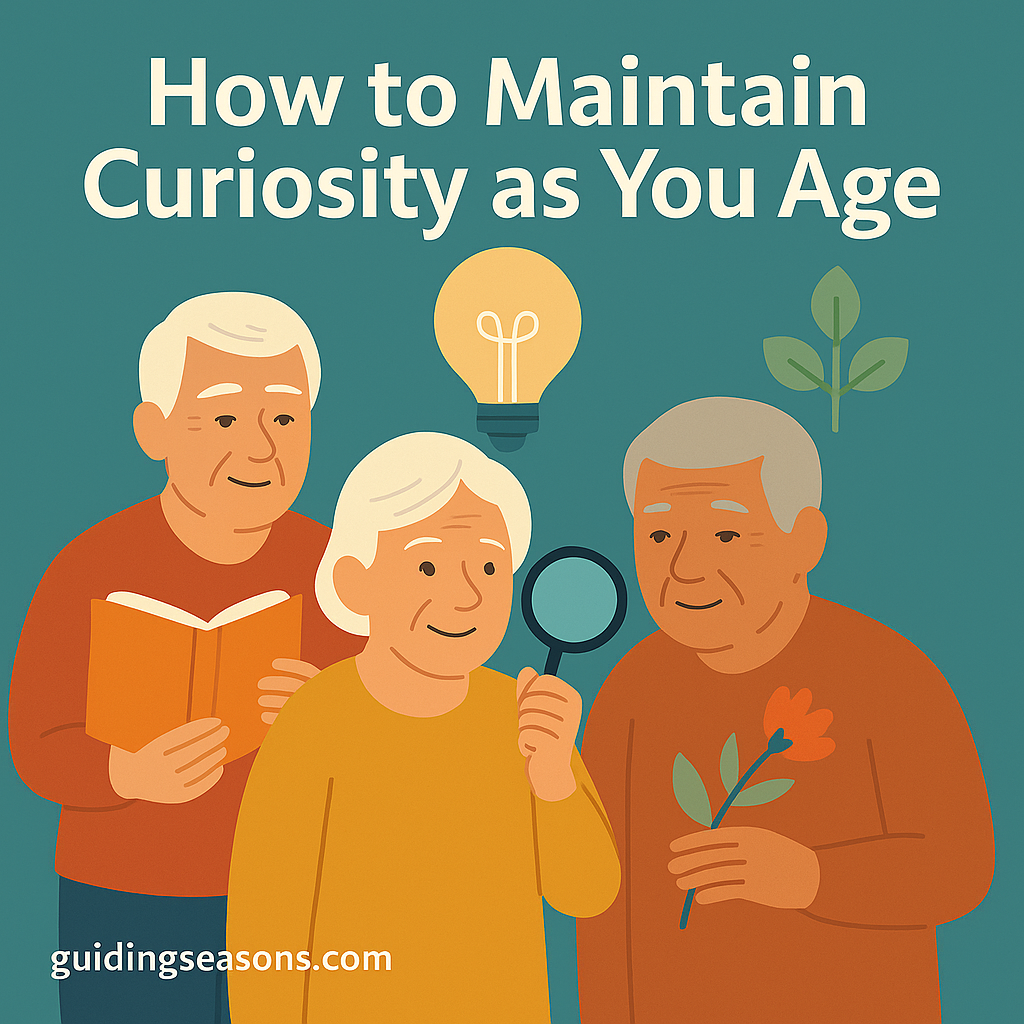
Three older adults exploring curious activities such as reading, examining a magnifying glass, and observing a flower, with idea and nature icons above them.
Seniors engaging in curious, exploratory activities to symbolize maintaining curiosity as you age.

Curiosity isn’t something we outgrow.

Children may be famous for asking endless questions, but the desire to understand, explore, and discover can remain with us throughout life. In fact, later adulthood can provide opportunities to explore subjects that were difficult to make time for during the busiest years of work and family responsibilities.

You may finally have time to learn about history, understand how a new piece of technology works, try photography, research your family tree, study another language, identify the birds visiting your backyard, or read about a place you’ve always wanted to visit.

Curiosity doesn’t require traveling around the world or constantly searching for exciting experiences.

It can begin with something as simple as asking:

“I wonder why that happens?”

That question can lead to a book, conversation, class, hobby, outing, or entirely new interest.

Staying mentally engaged can also be a positive part of healthy aging. The National Institute on Aging (NIA) explains that older adults retain the ability to learn new things, form new memories, and improve at different skills. Research reviewed by the NIA has also found promising connections between meaningful, mentally engaging activities and cognitive health, although researchers are still studying the long-term effects.

The goal, however, doesn’t have to be improving your brain or accomplishing something impressive.

Curiosity is worthwhile simply because it can make everyday life more interesting.

Here’s how to keep nurturing it.

Continue reading “How to Maintain Curiosity as You Age”