
Retirement Planning: How to Prepare for a Secure, Stable, and Stress-Free Future

Flat illustration of an older couple planning retirement finances with charts, savings plans, and goals representing financial security and future planning.
Flat illustration showing retirement planning, financial goals, and long-term security for a stable and comfortable future. guidingseasons.com

Retirement planning is one of the most important financial steps you can take — but it’s also one of the most overlooked.

Many people delay planning because it feels complex, uncertain, or far away. But the reality is simple: the earlier and more clearly you plan, the more options and security you create later.

Retirement isn’t just about stopping work — it’s about maintaining your lifestyle, protecting your independence, and reducing financial stress in the years ahead.

This guide walks you through how to plan effectively, avoid common mistakes, and build a retirement strategy that fits your life.

Continue reading “Retirement Planning: How to Prepare for a Secure, Stable, and Stress-Free Future”
How to Ensure Financial Stability for Decades

Flat illustration of a senior couple holding financial documents and a money bag symbol, with warm gold and teal colors and a small guidingseasons.com watermark in the bottom left.
Senior couple reviewing financial plans for long-term stability.

Financial stability in retirement isn’t just about having enough money saved — it’s about feeling secure, confident, and prepared for the long road ahead. Because retirement can potentially last 20, 30, or even 40 years, today’s retirees can benefit greatly from long-term planning strategies designed to protect their resources through changing markets, rising costs, and unexpected expenses.

The good news? You don’t need to be a financial expert to build lasting stability. With practical habits, thoughtful planning, and the right systems in place, you can better protect your finances and enjoy retirement without constantly worrying about money.

Here’s how to create and maintain financial stability that can last for decades.

Continue reading “How to Ensure Financial Stability for Decades”

How to Manage Taxes During Retirement

Flat illustration of a senior couple reviewing tax papers together with a calculator and coin icons, and a small guidingseasons.com watermark in the bottom left.
Senior couple reviewing tax documents with a calculator and tax icon.

Retirement often brings more freedom, a slower pace, and more time to enjoy life — but it doesn’t mean taxes disappear. In fact, taxes can become more complicated once your income comes from multiple sources, such as Social Security, pensions, investments, retirement accounts, or part-time work.

The good news? With a little knowledge and planning, you can manage your taxes confidently and avoid unpleasant surprises. Understanding how retirement income is taxed can help you keep more of your money and make smarter financial decisions throughout your later years.

Here’s a simple guide to help you navigate taxes during retirement.

Continue reading “How to Manage Taxes During Retirement”

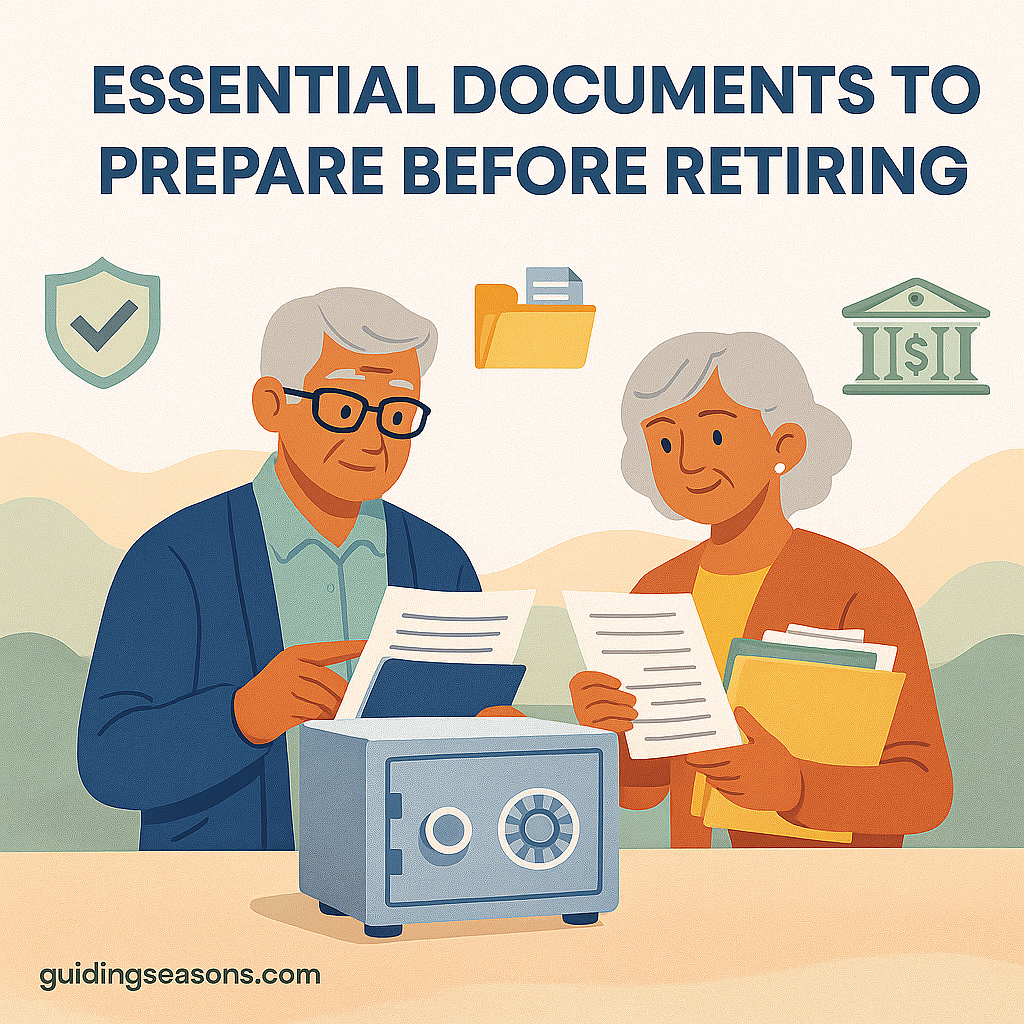
Essential Documents to Prepare Before Retiring

Flat illustration of an older couple reviewing retirement documents beside a safe, with icons of a shield, file folder, and bank symbol above them, and a small guidingseasons.com watermark in the bottom left.
Senior couple organizing important retirement documents with helpful planning icons.

Preparing for retirement isn’t just about saving money or planning how you’ll spend your free time—it’s also about making sure the right documents are in place. Having these records organized can help protect your finances, clarify your wishes, and give you and your family greater peace of mind.

The good news is that you don’t need a huge stack of complicated paperwork. You need a clear, organized set of documents that supports your health, income, finances, and future plans. This guide walks you through the essential documents to gather before retiring so you can enter your next chapter with greater confidence.

Continue reading “Essential Documents to Prepare Before Retiring”

How to Reduce Financial Stress Later in Life

Illustration of a senior man holding his forehead with a worried expression beside a large dollar sign icon, created for the article “How to Reduce Financial Stress Later in Life,” with a small guidingseasons.com watermark at the bottom.
Senior man looking stressed beside a dollar sign icon representing financial concerns.

Financial stress can affect anyone, but money worries may take on a different meaning later in life. During your working years, you may have had the opportunity to earn more money, work additional hours, or recover from a financial setback over time. In retirement, income is often more fixed, while expenses such as housing, healthcare, insurance, and everyday necessities can continue to change.

That can make an unexpected car repair, medical bill, increase in property taxes, or even a higher grocery bill feel more significant.

Fortunately, reducing financial stress doesn’t always require having substantially more money. Often, it begins with understanding exactly where you stand, simplifying your finances, preparing for unexpected expenses, and focusing on the financial decisions you can control.

Small changes can make your financial life easier to manage and give you greater confidence about the years ahead.

Continue reading “How to Reduce Financial Stress Later in Life”

How to Simplify Your Finances Before Retirement

Illustration of a senior man sitting at a table reviewing financial documents with a calculator and notebook, created for the article “How to Simplify Your Finances Before Retirement,” with guidingseasons.com shown at the bottom.
Senior man reviewing financial documents with a calculator and notebook.

As retirement approaches, your financial life should ideally become easier to manage—not more complicated. Yet many people reach their 50s and 60s with multiple bank accounts, old workplace retirement plans, several credit cards, insurance policies, subscriptions, investment accounts, and years of financial paperwork.

Keeping track of everything can become a job of its own.

Simplifying your finances before retirement can help reduce that burden. It can make monthly expenses easier to understand, reduce the chance of missed payments, improve financial organization, and make it easier for a trusted family member or representative to step in if you ever need assistance.

The goal isn’t necessarily to have as few accounts as possible. Instead, it is to create a financial system that you understand and can manage without unnecessary complexity.

Here are practical ways to simplify your finances as you prepare for retirement.

Continue reading “How to Simplify Your Finances Before Retirement”

How to Plan for Long-Term Care Expenses

Illustration of a senior woman reviewing Medicare and long-term care documents while holding paperwork, created for the article “How to Plan for Long-Term Care Expenses,” with guidingseasons.com shown at the bottom.
Senior woman reviewing Medicare and long-term care documents.

Long-term care is one of the most important—and often overlooked—parts of retirement planning. While no one likes to imagine needing daily assistance or medical support in the future, planning early can help protect your finances, reduce stress on your family, and give you more choices as you age.

Whether you hope to stay at home, consider assisted living, or simply want peace of mind knowing you’re prepared “just in case,” this guide walks you through how to prepare for long-term care expenses with clarity and confidence.

Why Long-Term Care Planning Matters

Long-term care refers to a range of services that can help people with everyday activities such as bathing, dressing, mobility, meal preparation, and medication management. Many forms of ongoing custodial care are not covered by Medicare, which can surprise retirees and their families.

Continue reading “How to Plan for Long-Term Care Expenses”

How to Prepare for Early Retirement

Illustration of a senior man stretching happily at a table with a laptop, piggy bank, and retirement plan document, created for the article “How to Prepare for Early Retirement.”
Senior man stretching happily while reviewing his early retirement plan.

Retiring early is a dream for many people—more time for travel, hobbies, relaxation, and enjoying life on your own terms. But early retirement also brings unique challenges: you’ll need your savings to last longer, you may face higher healthcare costs before Medicare, and your investment strategy may need adjustments.

The good news is that with thoughtful planning and the right financial habits, early retirement can be both realistic and rewarding. This guide walks you through the essential steps to prepare for early retirement with confidence.

Continue reading “How to Prepare for Early Retirement”

How to Adjust Your Budget During Retirement

Flat illustration of a senior woman reviewing financial papers and using a calculator, with the title “How to Adjust Your Budget During Retirement” and guidingseasons.com watermark on the bottom left.
Senior woman managing her retirement budget with a calculator and paperwork.

Planning for retirement doesn’t end when you stop working—your budget needs to continue evolving as your lifestyle, health, and financial needs change. Adjusting your budget during retirement can help you protect your savings, reduce financial stress, and maintain the freedom to enjoy this stage of life on your terms.

Below is a practical, senior-friendly guide with clear steps you can use right away.

Continue reading “How to Adjust Your Budget During Retirement”

How to Combine Pensions and Social Security

Illustration of a senior woman reviewing pension and Social Security documents with financial icons in the background.
Older woman holding pension and Social Security documents with financial icons like a calendar and dollar symbol around her.

Combining a pension with Social Security benefits can create a strong foundation for your retirement income. But understanding how the two work together—including timing, taxes, and payment rules—can feel confusing. The good news is that with a bit of planning, you can maximize what you receive and make confident decisions about your financial future.

Here’s a simple, senior-friendly guide to coordinating pensions and Social Security.

1. Understand How Your Pension Works

Start by reviewing the basics of your pension:

  • How much you’ll receive monthly
  • Whether benefits are reduced if claimed early
  • If survivor benefits are available
  • Whether it’s based on private employment, government work, or military service

Knowing these details helps you plan the timing of Social Security.

2. Review Your Social Security Benefit Estimate

Your benefit depends on your earnings history and when you start claiming.

Key ages:

  • 62: Earliest age, reduced benefits
  • Full Retirement Age (FRA): Usually 66–67
  • 70: Maximum monthly benefit

Check your online estimate at SSA.gov.

3. Consider When to Claim Each Income Source

You don’t have to take your pension and Social Security at the same time.

Common approaches:

  • Claim pension early + delay Social Security to increase Social Security payout
  • Claim Social Security earlier if your pension is higher
  • Delay both if you’re still working and don’t need the income yet

Choose based on health, income needs, and long-term goals.

4. Watch Out for the Windfall Elimination Provision (WEP)

If you have a government pension from work that didn’t pay into Social Security, your Social Security benefit may be reduced.

WEP does not eliminate your benefit—it adjusts the formula.

This mostly affects:

  • Some teachers
  • Firefighters
  • Police
  • Certain state or city workers
  • Federal employees hired before 1984

If you paid Social Security taxes your whole career, WEP doesn’t apply.

5. Understand the Government Pension Offset (GPO)

GPO affects spousal and survivor benefits, not your personal benefit.

If you have a non-Social Security-covered pension, your spousal/survivor benefit may be reduced.

This rule often applies to:

  • Local government jobs
  • Certain public service positions

Knowing this ahead of time prevents surprises.

6. Be Aware of Possible Taxes

Both pension and Social Security income may be taxable depending on total yearly income.

You may owe taxes if:

  • You earn over certain thresholds
  • You have significant retirement income
  • You live in a state that taxes Social Security or pensions

A tax professional can help you plan ahead.

7. Coordinate With Your Spouse

If you’re married, planning together can increase your household income.

Consider:

  • Which benefit to claim first
  • Whether to delay a higher earner’s Social Security
  • Survivor benefit needs
  • Health and longevity differences

Smart coordination strengthens long-term security.

8. Evaluate Longevity and Health

If you expect a longer retirement, delaying Social Security often pays off.

But:

  • If you need steady income now
  • If your health is uncertain
  • Or you prefer financial stability today

Taking benefits earlier can also be the right choice.

9. Consider Working With a Financial Advisor

A retirement planner or advisor can:

  • Run customized income projections
  • Explain WEP/GPO
  • Help with timing strategies
  • Estimate taxes
  • Coordinate spousal benefits

Professional guidance can simplify complex decisions.

10. Revisit Your Plan Regularly

Retirement income planning isn’t “set and forget.”

Review your choices when:

  • Costs change
  • One spouse retires
  • Health changes
  • Laws or benefit rules update

Staying flexible keeps your plan strong.

Final Thoughts

Combining pensions and Social Security doesn’t have to be complicated. Once you understand how each benefit works, how timing affects payouts, and whether special rules apply, you can build a retirement income plan that supports your lifestyle with stability and confidence. With thoughtful planning, your pension and Social Security can work together to create long-lasting financial peace.