Senior Resources and Services: How to Find Support, Assistance, and Essential Services at Every Stage

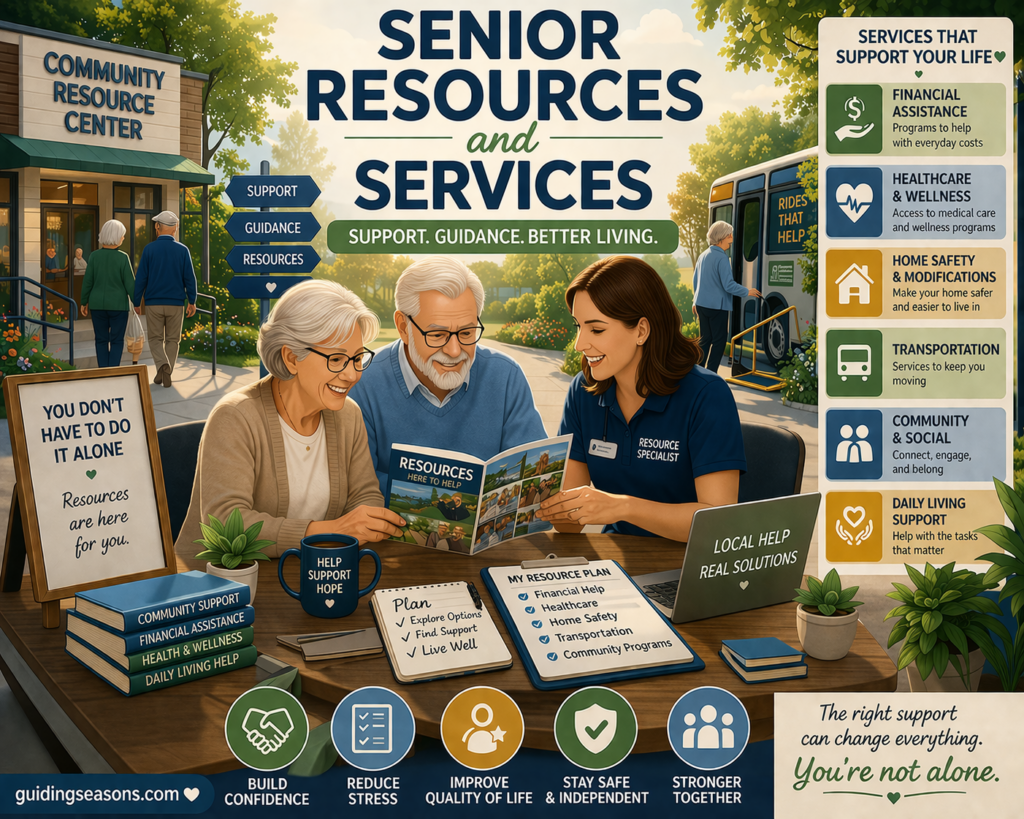
Flat illustration of seniors receiving support at a community resource center with icons for healthcare, financial assistance, transportation, and daily living services.
Flat illustration showing senior resources and support services for healthcare, financial help, and daily living assistance. guidingseasons.com

As life changes, having access to the right resources and services can become increasingly important.

Healthcare needs may change. Getting around may become more difficult. A home that once worked perfectly may need accessibility improvements. Managing meals, household tasks, finances, or appointments may require more planning than before.

At the same time, staying socially connected and involved in the community can be just as important as finding practical assistance.

Fortunately, there are many programs and services designed to help older adults maintain their independence, safety, health, and quality of life. The challenge is often knowing what exists, where to look, and which services are actually appropriate for your situation.

This guide provides a starting point for understanding senior resources and building a dependable support system for yourself or someone you care about.

Continue reading “Senior Resources and Services: How to Find Support, Assistance, and Essential Services at Every Stage”
How to Identify Red Flags in Care Homes

Flat illustration of an older woman reviewing a clipboard with a worried expression, alongside a red caution symbol and warm background tones, with a small guidingseasons.com watermark on the bottom left.
Senior woman evaluating signs of poor care while reviewing information about care homes.

Choosing a care home for yourself, a parent, spouse, or another loved one can be a difficult decision. You aren’t simply choosing a building or comparing monthly prices. You’re choosing the place responsible for someone’s safety, daily care, comfort, dignity, and quality of life.

Many care homes provide attentive and compassionate care. However, quality can vary considerably from one facility to another, which is why it’s important to know what to look for before making a decision.

Some problems are obvious, such as dirty rooms or broken equipment. Others are more subtle. Staff members who constantly appear rushed, residents who rarely interact with anyone, unanswered call buttons, vague explanations about fees, or repeated changes in personnel can all deserve closer attention.

One warning sign alone doesn’t necessarily mean a facility provides poor care. Instead, look for patterns and consider how management responds when you ask questions.

Here are some of the most important red flags to watch for when evaluating a care home.

Continue reading “How to Identify Red Flags in Care Homes”

How to Evaluate Long-Term Care Services

Flat illustration of a senior couple looking at a computer screen displaying a checklist and a care facility icon, with a small guidingseasons.com watermark in the bottom left.
Senior couple reviewing long-term care options displayed on a computer screen.

Choosing long-term care services is a major decision—one that can affect your comfort, safety, independence, and overall quality of life. Whether you’re exploring care for yourself or a loved one, it’s important to understand what options exist and how to determine which service best fits your needs.

Long-term care is not one-size-fits-all. It includes a wide range of support, from occasional assistance at home to full-time residential and nursing care. Evaluating your options carefully can help you select a service that supports your well-being, respects your preferences, and provides reliable, compassionate care.

Here’s a simple, step-by-step guide to evaluating long-term care services with confidence.

Continue reading “How to Evaluate Long-Term Care Services”

How to Connect With Social Support Networks

Flat illustration of a senior woman waving at her smartphone during a video call, with another senior displayed in a circular icon above her, and a small guidingseasons.com watermark in the bottom left.
Senior woman connecting with others through a smartphone video call.

Staying socially connected can become especially important as we get older. Support networks can provide friendship, emotional balance, practical help, safety, and a sense of belonging. Whether you’re newly retired, living alone, or simply looking to strengthen your community circle, building a supportive network can make daily life feel brighter and more fulfilling.

Connecting with others doesn’t have to feel overwhelming. With a few simple steps, you can build relationships that encourage, uplift, and support you through different chapters of life.

Here’s how to get started.

Continue reading “How to Connect With Social Support Networks”

How to Find Safe Senior Exercise Programs

Flat illustration of an older woman lifting teal dumbbells with a safety checkmark icon above her and a small guidingseasons.com watermark in the bottom left, created for the article “How to Find Safe Senior Exercise Programs.”
Senior woman lifting dumbbells with a safety checkmark icon.

Staying physically active is one of the most important things you can do to support your health, mobility, independence, and confidence as you get older. Regular movement can help maintain muscle strength, improve balance, support heart health, and make everyday activities such as climbing stairs, carrying groceries, or getting out of a chair easier.

The key, however, is finding an exercise program that matches your current abilities and needs.

A good senior exercise program should challenge you without making you feel unsafe or pressured to keep up with others. Whether you are interested in walking, water aerobics, strength training, chair exercises, tai chi, or a group fitness class, there are plenty of ways to stay active at virtually any fitness level.

Here is how to find a safe senior exercise program that works for you.

Continue reading “How to Find Safe Senior Exercise Programs”

How to Locate Local Volunteer Opportunities

Illustration of a senior woman gesturing toward a volunteer icon, created for the article “How to Locate Local Volunteer Opportunities,” with a small guidingseasons.com watermark at the bottom.
Senior woman gesturing toward a volunteer icon representing community opportunities.

Volunteering is one of the most meaningful ways to stay active, connected, and purposeful during your senior years. Whether you want to share your skills, meet new people, support your community, or simply try something new, there are many local opportunities available—often closer than you think.

The key is knowing where to look and choosing opportunities that fit your interests, abilities, energy level, and schedule. This guide offers simple, senior-friendly ways to discover volunteer roles right in your community.

Continue reading “How to Locate Local Volunteer Opportunities”

How to Find Trusted Mental Health Resources

Illustration of a senior woman sitting at a table with a candle, framed photo, and journal, reflecting peacefully beneath the title “How to Navigate Grief and Healing,” with guidingseasons.com shown at the bottom.
Senior woman reflecting with a candle, journal, and photo nearby.

Caring for your mental health is just as important as caring for your physical health—especially in your senior years, when life changes, losses, or feelings of loneliness can affect emotional well-being. The challenge is knowing which mental health resources are safe, reliable, and truly helpful.

The good news? Seniors today have more access to mental health support than ever before—from local programs to national hotlines to online counseling services. This guide walks you through simple, trustworthy ways to find mental health support you can rely on.

Continue reading “How to Find Trusted Mental Health Resources”

How to Request Assistance for Mobility Needs

Illustration of a senior woman using a walker with support from a younger man beside a mobility van, created for the article “How to Request Assistance for Mobility Needs.”
Senior woman receiving mobility assistance with the help of a caregiver beside a transport van.

As mobility needs change, everyday tasks—like getting to appointments, navigating airports, or moving around your community—can become more challenging. The good news is that many services and resources exist to support mobility, independence, and safety. Whether you need transportation, equipment, or home modifications, knowing where and how to request assistance can make the process much easier.

This guide walks you through senior-friendly steps to find, request, and receive the mobility support you need with confidence.

Continue reading “How to Request Assistance for Mobility Needs”

How to Get Involved in Local Community Events

Older woman with longer hair holding an event flyer at a community gathering with icons for a calendar, location pin, and handshake.
Older woman attending a local community event and holding an event flyer.

Staying involved in your community can be one of the most enjoyable ways to remain socially connected and active as you get older. Community activities provide opportunities to meet people, discover new interests, contribute your experience, and maintain a sense of connection to the place where you live.

Getting involved doesn’t mean filling your calendar with activities. Even one regular event—a weekly walking group, monthly library club, volunteer shift, or community lunch—can create opportunities for meaningful interaction.

Community involvement may also support overall well-being. The National Institute on Aging (NIA) notes that staying socially connected and participating in meaningful activities may support cognitive health and recommends activities such as volunteering, joining social groups, learning new skills, and participating in community programs.

The key is finding activities that match your interests, mobility, schedule, budget, and comfort level.

Whether you enjoy volunteering, gardening, music, learning, exercise, or simply having coffee with other people, there are likely opportunities worth exploring.

Continue reading “How to Get Involved in Local Community Events”

How to Find Reliable Medical Services

Older man reviewing medical information on his smartphone with healthcare icons and a checklist behind him.
Older man researching reliable medical services using his phone.

Finding medical care you can trust becomes increasingly important as you get older. You may be managing several medications, seeing multiple specialists, monitoring chronic conditions, or simply trying to stay healthy and independent for as long as possible.

The challenge isn’t necessarily finding a doctor. In many communities, there may be dozens of physicians, clinics, urgent care centers, specialists, and hospitals to choose from. The harder part is determining which providers are qualified, dependable, accessible, covered by your insurance, and a good fit for your individual needs.

Reliable health care also involves more than medical expertise. Communication, coordination, accessibility, appointment availability, billing practices, and follow-up care all matter.

Fortunately, you don’t have to make these decisions blindly.

By checking credentials, confirming insurance coverage, comparing providers, asking the right questions, and paying attention to your experience during your first few visits, you can build a medical team you feel confident relying on.

Continue reading “How to Find Reliable Medical Services”