As life changes, having access to the right resources and services can become increasingly important.
Healthcare needs may change. Getting around may become more difficult. A home that once worked perfectly may need accessibility improvements. Managing meals, household tasks, finances, or appointments may require more planning than before.
At the same time, staying socially connected and involved in the community can be just as important as finding practical assistance.
Fortunately, there are many programs and services designed to help older adults maintain their independence, safety, health, and quality of life. The challenge is often knowing what exists, where to look, and which services are actually appropriate for your situation.
This guide provides a starting point for understanding senior resources and building a dependable support system for yourself or someone you care about.
What Senior Resources and Services Really Include
Senior resources cover much more than healthcare or assisted living.
Depending on your circumstances and where you live, resources may include:
- Healthcare and medical services
- Transportation assistance
- Meal delivery and nutrition programs
- Senior and community centers
- Home modification programs
- Help with everyday activities
- Financial assistance programs
- Legal assistance
- Mental health resources
- Exercise and wellness programs
- Volunteer opportunities
- Social groups and support networks
- Long-term care services
- Caregiver resources
Some programs are provided by government agencies, while others may be offered through nonprofit organizations, healthcare systems, religious organizations, community centers, private companies, or volunteer groups.
A good place to begin is by learning about the different types of helpful community resources available for seniors.
You may discover useful programs you did not realize existed.
Why Senior Resources Are Often Underused
Having resources available does not necessarily mean people use them.
Older adults and their families may overlook helpful programs because they:
- Don’t know the programs exist
- Aren’t sure where to begin
- Assume they won’t qualify
- Find applications confusing
- Don’t know which organizations to trust
- Feel uncomfortable asking for assistance
- Prefer to remain completely independent
- Wait until a problem becomes urgent
It is usually easier to explore resources before they become absolutely necessary.
For example, learning about transportation options while you are still driving can make a future transition easier. Researching home-care services before you need daily assistance gives you more time to compare providers.
Think of senior resources as tools for maintaining independence rather than simply services for emergencies.
Start by Identifying What Kind of Help You Need
Searching for “senior assistance” can quickly become overwhelming because the term covers so many different services.
Instead, identify the specific problem you are trying to solve.
Ask questions such as:
- Is transportation becoming difficult?
- Do I need occasional help around the house?
- Am I struggling with meal preparation?
- Do I need help understanding benefits or finances?
- Is my home becoming difficult to navigate?
- Would more social interaction improve my daily life?
- Do I need help managing a health condition?
- Am I considering home care or long-term care?
- Do I need legal guidance?
- Would an exercise or wellness program help me remain active?
Once you know the problem, finding the appropriate resource becomes much easier.
Financial Resources and Benefits
Financial stability affects nearly every aspect of retirement.
Housing, healthcare, transportation, food, insurance, and long-term care can all place pressure on a household budget.
For many retirees, income may come from several sources, including:
- Social Security
- Pensions
- Retirement accounts
- Investments
- Annuities
- Part-time employment
- Rental income
- Government assistance programs
Understanding how those sources work together can help you make better decisions about your overall financial situation.
For example, retirees receiving both a pension and Social Security should understand how to combine pensions and Social Security as part of their retirement income planning.
Depending on income, location, age, disability status, veteran status, and other factors, additional assistance may also be available for healthcare, food, utilities, housing, or transportation.
Eligibility varies considerably, so avoid assuming that you will or will not qualify without checking the actual program requirements.
Healthcare and Medical Services
Reliable healthcare becomes increasingly important as we age, but finding appropriate care involves more than simply choosing the nearest doctor’s office.
Consider factors such as:
- Insurance acceptance
- Physician credentials
- Accessibility
- Office location
- Appointment availability
- Hospital affiliations
- Communication
- Specialist referrals
- Telehealth availability
- Coordination between providers
Keep a current list of your healthcare providers, medications, insurance information, allergies, and emergency contacts.
When searching for a new provider or healthcare facility, use established directories and verify important information directly with the provider.
Our guide to finding reliable medical services explains what to consider when evaluating healthcare options.
Finding Mental Health Support
Emotional and mental well-being remain important throughout life.
Retirement, grief, caregiving responsibilities, health changes, loneliness, reduced mobility, and major life transitions can all affect emotional health.
Support might come from:
- Licensed counselors
- Psychologists
- Psychiatrists
- Primary care providers
- Support groups
- Community mental health programs
- Telehealth services
- Crisis services when urgent help is needed
When looking for professional help, credentials, licensing, privacy, experience, and the appropriateness of the provider for your needs all matter.
Learn more about how to find trusted mental health resources.
Mental health concerns deserve the same thoughtful attention as physical health concerns. If there is an immediate danger or mental health crisis, seek emergency or crisis assistance rather than waiting for a routine appointment.
Transportation Services for Seniors
Transportation can have a major effect on independence.
Someone who no longer drives—or simply prefers to drive less—still needs reliable ways to reach:
- Medical appointments
- Grocery stores
- Pharmacies
- Community activities
- Religious services
- Friends and family
- Senior centers
- Social events
Depending on the community, options may include public transit, reduced-fare programs, paratransit, nonprofit transportation programs, volunteer drivers, medical transportation, taxis, and rideshare services.
Our overview of transportation services available for seniors can help you understand the possibilities.
Before relying on a transportation program, check its service area, operating hours, reservation requirements, accessibility, cost, and cancellation policies.
Assistance With Mobility Needs
Transportation and mobility are closely related, but they are not the same thing.
Mobility assistance may involve:
- Wheelchair accessibility
- Walkers or other mobility devices
- Accessible transportation
- Assistance entering buildings
- Help navigating airports or public facilities
- Accessible parking
- Home accessibility improvements
If mobility limitations are beginning to affect daily activities, asking for appropriate accommodations can make ordinary tasks safer and less stressful.
See how to request assistance for mobility needs for additional guidance.
Making Your Home Safer and More Accessible
For many older adults, remaining at home for as long as practical is an important goal.
The home itself, however, may need to change.
Common improvements include:
- Better lighting
- Grab bars
- Handrails
- Non-slip flooring
- Reduced clutter
- Easier-to-reach storage
- Improved bathroom accessibility
- Safer stairs
- Lever-style handles
- Accessible kitchen storage
- Clear walking paths
The kitchen deserves particular attention because it combines heat, sharp objects, appliances, storage, and frequent movement.
Our guide on how to build a senior-friendly kitchen explains practical ways to improve usability and safety.
Organization matters too. Reducing clutter and keeping frequently used items accessible can make everyday tasks easier. See how to improve home organization for practical ideas.
You do not necessarily need a complete renovation. Small changes can sometimes make a substantial difference.
Getting Help With Daily Living Activities
There may come a time when ordinary tasks become harder to complete safely.
These are often called activities of daily living and may include tasks such as:
- Bathing
- Dressing
- Grooming
- Toileting
- Eating
- Moving safely around the home
Other everyday tasks, such as shopping, cooking, housekeeping, transportation, and managing appointments, may also become challenging.
Needing help with some activities does not automatically mean someone needs to move into a care facility.
Depending on the situation, assistance may come from family members, caregivers, home-care agencies, community organizations, or other local programs.
Our guide on how to get help with daily living activities explains some of the options to consider.
Meal and Nutrition Services
Cooking can become more difficult because of mobility limitations, health issues, fatigue, transportation problems, or changes in household circumstances.
Community meal services can help. The Administration for Community Living reports that the national Senior Nutrition Program serves nearly 1 million meals each day through about 5,000 local providers.
Programs may provide:
- Home-delivered meals
- Congregate meals at community locations
- Nutrition education
- Grocery assistance
- Food assistance programs
- Meals through senior centers
Some programs have eligibility requirements, while others are broadly available.
If food preparation or grocery shopping has become difficult, learn how to access meal services in your area.
When evaluating a service, ask about cost, delivery frequency, dietary accommodations, eligibility, waiting lists, and how meals are prepared.
Senior Centers and Community Programs
A senior center can be much more than a place to spend free time.
Depending on the facility, programs may include:
- Exercise classes
- Educational workshops
- Social activities
- Games and hobbies
- Technology classes
- Health screenings
- Meal programs
- Transportation assistance
- Benefits counseling
- Day trips
- Volunteer programs
The best senior center is not necessarily the closest one.
Look at accessibility, programming, atmosphere, membership requirements, transportation options, hours, and whether the activities actually match your interests.
Our guide on how to choose the right senior center can help you compare options.
Staying Connected Through Social Support
Social connection can be an important part of healthy aging.
A strong support network may include:
- Family
- Friends
- Neighbors
- Community organizations
- Faith communities
- Clubs
- Volunteer organizations
- Support groups
- Senior centers
Maintaining those relationships sometimes requires more intentional effort after retirement, relocation, loss of a spouse, or changes in mobility.
If your social circle has become smaller, start gradually.
Our guide on how to connect with social support networks offers practical ideas for building and maintaining connections.
Support Groups Can Provide a Different Kind of Help
Friends and family are valuable, but sometimes it helps to speak with people who understand a particular experience firsthand.
Support groups may exist for people dealing with:
- Grief
- Caregiving
- Chronic health conditions
- Retirement transitions
- Loss of a spouse
- Mental health challenges
- Specific illnesses
Some groups meet in person, while others operate online or by phone.
The right group should feel respectful, supportive, and appropriately moderated.
Explore support groups that keep seniors connected to learn what to look for.
Exercise and Wellness Programs
Staying active can support mobility, balance, strength, and overall well-being, but an exercise program should be appropriate for your health, fitness level, and physical abilities.
Federal physical activity guidelines recommend that older adults generally work toward at least 150 minutes of moderate-intensity aerobic activity each week, along with muscle-strengthening and balance activities, as their abilities and health allow.
Senior-focused programs may offer:
- Walking groups
- Water exercise
- Strength training
- Balance classes
- Chair exercise
- Yoga
- Tai chi
- Low-impact aerobics
Before joining, consider the instructor’s qualifications, class intensity, accessibility, supervision, and whether modifications are available.
If you have medical conditions or physical limitations, discuss appropriate activity with a qualified healthcare professional.
Our guide on how to find safe senior exercise programs provides additional factors to consider.
Volunteering and Finding a Sense of Purpose
Senior resources are not limited to receiving assistance.
Community involvement can provide opportunities to contribute your knowledge, skills, experience, and time.
Volunteer opportunities may be available through:
- Schools
- Libraries
- Hospitals
- Animal shelters
- Food banks
- Museums
- Community organizations
- Religious organizations
- Environmental groups
- Mentoring programs
Volunteering can also provide routine, social interaction, and a stronger connection to the community.
Learn how to locate local volunteer opportunities that fit your interests, schedule, and abilities.
Getting Involved in Community Events
Local activities are another simple way to remain connected.
Community events might include:
- Workshops
- Festivals
- Classes
- Concerts
- Library events
- Walking groups
- Hobby clubs
- Educational programs
- Senior activities
- Neighborhood gatherings
You do not need a packed social calendar.
One or two enjoyable activities can create opportunities to meet people and develop new routines.
See how to get involved in local community events for ideas on finding activities nearby.
Legal Resources Seniors Should Know About
Legal planning can become increasingly important with age.
Common areas include:
- Wills
- Powers of attorney
- Advance healthcare directives
- Estate planning
- Housing issues
- Consumer protection
- Benefits
- Elder abuse
- Financial exploitation
- Long-term care agreements
Some communities have legal-aid organizations or programs specifically serving older adults.
Because laws and individual circumstances vary, educational information should not replace advice from a qualified attorney when legal guidance is needed.
Our overview of legal resources seniors should know can help you understand where to begin.
Planning for Long-Term Care
Long-term care can include several different levels of support.
Depending on someone’s needs, options may include:
- Assistance at home
- Home health services
- Adult day programs
- Assisted living
- Memory care
- Skilled nursing facilities
Choosing care should rarely be based on cost or convenience alone.
Consider:
- Licensing and accreditation
- Staff qualifications
- Staffing levels
- Services provided
- Safety procedures
- Medical support
- Location
- Costs and contracts
- Communication with families
- Resident rights
- Inspection or complaint history where available
Our guide on how to evaluate long-term care services provides a framework for comparing your options.
Whenever possible, research care before an urgent need forces a quick decision.
Recognizing Red Flags in Care Homes
Families evaluating assisted living, memory care, or nursing facilities should know what warning signs to watch for.
Potential concerns may include:
- Poor cleanliness
- Unexplained injuries
- Frequent staff turnover
- Inadequate supervision
- Residents appearing consistently neglected
- Unanswered questions
- Poor communication
- Strong odors or unsanitary conditions
- Medication-management concerns
- Restrictions that are difficult to explain
A single observation does not necessarily tell you everything about a facility, but patterns of problems deserve attention.
Read how to identify red flags in care homes before evaluating a facility for yourself or someone you care about.
How to Evaluate Any Senior Service
Whether you are choosing transportation, home care, a meal program, a senior center, or another service, use a consistent evaluation process.
Verify Who Operates the Service
Determine whether it is run by a government agency, nonprofit organization, healthcare provider, community organization, or private company.
Understand the Eligibility Requirements
Some programs may have requirements based on:
- Age
- Income
- Disability
- Geographic location
- Medical need
- Veteran status
Ask About Costs
Find out whether the service is free, subsidized, insurance-covered, donation-based, or privately paid.
Ask about recurring charges and additional fees.
Check Qualifications
For services involving healthcare, caregiving, financial advice, or legal matters, verify appropriate professional credentials when applicable.
Understand Exactly What Is Provided
Do not rely only on the name of the program.
Ask what services are included, how frequently they are available, what is excluded, and what happens if your needs change.
Get Important Information in Writing
For significant financial commitments or care arrangements, review written agreements carefully before signing.
How to Find Senior Resources in Your Community
There is no single source that lists every available program.
You may need to check several places, including:
- Local aging agencies
- City and county programs
- State agencies
- Senior centers
- Healthcare providers
- Hospitals
- Libraries
- Community centers
- Nonprofit organizations
- Veterans organizations
- Religious organizations
- Transportation agencies
- Legal-aid organizations
Start with understanding helpful community resources for seniors and then narrow your search based on the type of assistance you need.
Create a Personal Resource List Before You Need It
One useful approach is to create your own senior resource directory.
Keep contact information for services such as:
- Primary care provider
- Pharmacy
- Insurance provider
- Emergency contacts
- Transportation service
- Local senior center
- Meal assistance program
- Home-care provider
- Trusted repair or home service providers
- Legal professional
- Financial professional
- Local aging-services agency
You may not need every service today.
Having the information available means you will not have to begin researching from scratch during a stressful situation.
Keep Important Information Organized
Managing multiple services can become complicated.
Consider keeping a physical folder or secure digital record containing:
- Identification information
- Insurance information
- Healthcare contacts
- Medication lists
- Benefit information
- Service-provider contacts
- Appointment information
- Legal documents
- Emergency contacts
- Important account information
Be careful about where sensitive financial, medical, and identification information is stored.
Organization should make information easier for you to access without making it easier for unauthorized people to obtain.
Be Careful With Scams and Unsolicited Offers
Older adults can be targeted by scams involving healthcare, government benefits, home repairs, investments, charities, technology support, and other services.
Be cautious when someone:
- Pressures you to act immediately
- Requests unusual forms of payment
- Asks unexpectedly for passwords or sensitive financial information
- Claims you have won something but must pay first
- Pretends to represent a government agency without verification
- Refuses to provide information in writing
- Discourages you from discussing the offer with family or trusted professionals
When uncertain, stop and independently verify the organization before providing information or money.
Don’t Be Afraid to Ask Questions
When contacting a senior service, asking specific questions can save time.
You might ask:
- Who qualifies?
- What does the service cost?
- Is there a waiting list?
- What documents are required?
- How often is the service available?
- What areas do you serve?
- Is transportation provided?
- Are staff members licensed or screened?
- Can services change if my needs change?
- Who should I contact if there is a problem?
Write down the answers.
If something is unclear, ask for an explanation before making a decision.
Involve Trusted People When Appropriate
Managing healthcare, finances, housing, transportation, and care arrangements simultaneously can become complicated.
A trusted family member, friend, caregiver, attorney, financial professional, healthcare professional, or other appropriate person may help you:
- Compare options
- Attend appointments
- Review paperwork
- Keep records
- Ask questions
- Notice potential problems
Maintaining independence does not mean you must handle every decision without input from anyone else.
Support can strengthen independence when it helps you remain informed and in control of your decisions.
Small Steps Can Make Finding Help Easier
You do not need to build an entire support system in one weekend.
Start with one concern.
For example:
- Identify the problem.
- Find two or three potential resources.
- Verify eligibility and cost.
- Contact the organizations.
- Compare your options.
- Keep the information for future reference.
Once one issue is addressed, move to the next.
A gradual approach makes the process much more manageable.
Common Mistakes to Avoid
Finding good resources is partly about knowing what not to do.
Try to avoid:
- Waiting for a crisis before researching help
- Assuming you do not qualify for assistance
- Choosing the first provider without comparison
- Signing agreements you do not understand
- Giving personal information to unverified organizations
- Ignoring transportation planning
- Overlooking social and emotional needs
- Trying to manage everything alone
- Failing to revisit your needs as circumstances change
The services that work for you today may not be the services you need several years from now.
Build a Support System, Not Just a List of Services
A strong support system combines people, services, information, and preparation.
It might include:
Healthcare support
Doctors, specialists, pharmacies, insurance resources, and mental health services.
Daily living support
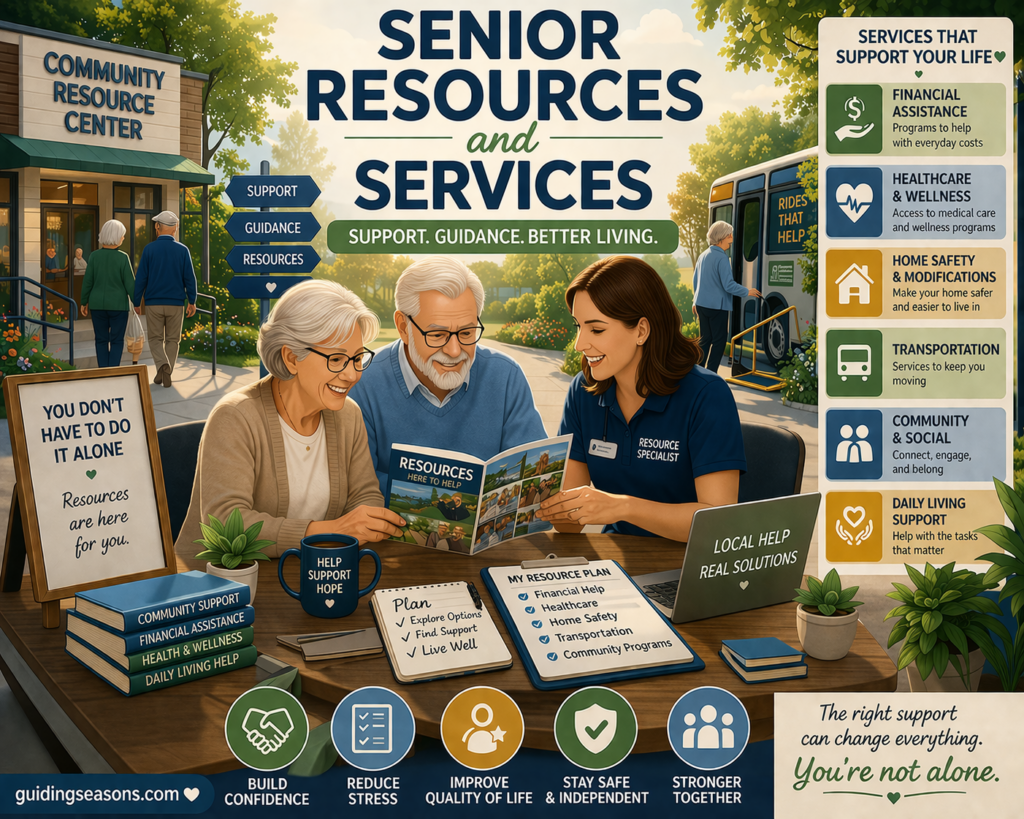
Transportation, meal programs, home assistance, and accessibility resources.
Financial support
Retirement income, benefits, assistance programs, and trusted financial guidance.
Legal support
Estate planning, advance directives, consumer protection, and appropriate legal assistance.
Social support
Friends, family, senior centers, community groups, support groups, and volunteer organizations.
Future care planning
Home care, assisted living, long-term care, and caregiver resources.
No two support systems will look exactly the same.
The goal is to create one that matches your circumstances and can adapt as your needs change.
When Should You Start Looking for Senior Resources?
You do not have to wait until you consider yourself “old enough” to need senior services.
Planning earlier can give you more choices.
Consider researching resources when:
- Approaching retirement
- Moving to a new community
- Recovering from an illness or injury
- Experiencing changes in mobility
- Becoming a caregiver
- Losing a spouse or partner
- Considering whether to stop driving
- Finding household tasks increasingly difficult
- Thinking about long-term care
- Helping an aging parent
The best time to learn about many services is before they become urgent.
A Practical Senior Resource Checklist
Use this checklist as a starting point:
- Review your healthcare providers and insurance.
- Understand your retirement income and benefits.
- Identify transportation alternatives.
- Check your home for safety and accessibility concerns.
- Locate your nearest senior or community center.
- Research local meal programs.
- Identify available home-assistance services.
- Keep emergency contacts current.
- Organize important documents.
- Review essential legal planning.
- Maintain regular social connections.
- Find physical activities appropriate for your abilities.
- Learn what long-term care options exist locally.
- Keep a list of trusted community resources.
- Review your needs periodically.
You may not need every item immediately. The purpose is to know where gaps exist before those gaps become urgent problems.
Continue Exploring Senior Resources
Different situations require different kinds of assistance. Use these guides to explore the areas most relevant to you:
- Understanding Helpful Community Resources for Seniors
- How to Choose the Right Senior Center
- How to Request Assistance for Mobility Needs
- How to Find Trusted Mental Health Resources
- How to Locate Local Volunteer Opportunities
- How to Evaluate Long-Term Care Services
- How to Connect With Social Support Networks
- How to Find Safe Senior Exercise Programs
- Legal Resources Seniors Should Know
- How to Identify Red Flags in Care Homes
- How to Get Help With Daily Living Activities
- Support Groups That Keep Seniors Connected
- Transportation Services Available for Seniors
- How to Access Meal Services in Your Area
- How to Find Reliable Medical Services
- How to Get Involved in Local Community Events
Final Thoughts
Finding senior resources is not simply about getting help when something goes wrong.
It is about creating a network that supports independence, safety, stability, health, and connection throughout later life.
Start by understanding your current needs. Learn what resources are available in your community. Verify important information before choosing a service, and keep useful contacts organized even if you do not need them immediately.
Most importantly, remember that your support system can evolve.
The resources you need at 65 may be different from those you need at 75 or 85. Regularly reviewing your health, home, finances, transportation, social connections, and daily routines can help you recognize changes early.
With preparation and reliable information, senior resources become more than emergency assistance. They become practical tools for maintaining greater independence, confidence, and quality of life.