Staying socially connected is an important part of healthy aging. As routines change, friends or family members move away, mobility becomes more difficult, or a spouse or longtime companion passes away, it can become harder to maintain the social connections that once came naturally.
Support groups and community groups can help fill that gap. They provide places where older adults can meet people, share experiences, participate in meaningful activities, learn new skills, and simply have someone to talk with on a regular basis.
These connections can have benefits beyond companionship. According to the National Institute on Aging (NIA), loneliness and social isolation are associated with increased risks for several physical and mental health problems. The NIA also reports that about 1 in 4 adults age 65 and older are socially isolated, highlighting how common this challenge can be.
Fortunately, there are many ways for seniors to build and maintain supportive relationships. The right choice depends on your interests, health, transportation, personality, and the type of connection you’re looking for.
Why Staying Connected Matters as You Age
Social connection isn’t simply about having a busy calendar. Meaningful relationships can provide emotional support, a sense of belonging, practical help, and opportunities to stay mentally and physically active.
The Centers for Disease Control and Prevention (CDC) notes that supportive social connections are associated with better mental and physical health and that people with stronger social bonds are more likely to live longer, healthier lives. Social connection can also help people manage stress and encourage healthy behaviors such as physical activity.
You don’t necessarily need a large circle of friends to benefit. A small number of dependable relationships can be meaningful.
For example, imagine a 72-year-old retiree who recently moved to a new community. Instead of trying to build an entirely new social life at once, she joins a Tuesday morning walking group and a monthly book club at her library. Those two activities give her several predictable opportunities each month to see familiar faces, have conversations, and gradually develop friendships.
That kind of regular contact can be much easier to maintain than waiting for social opportunities to happen on their own.
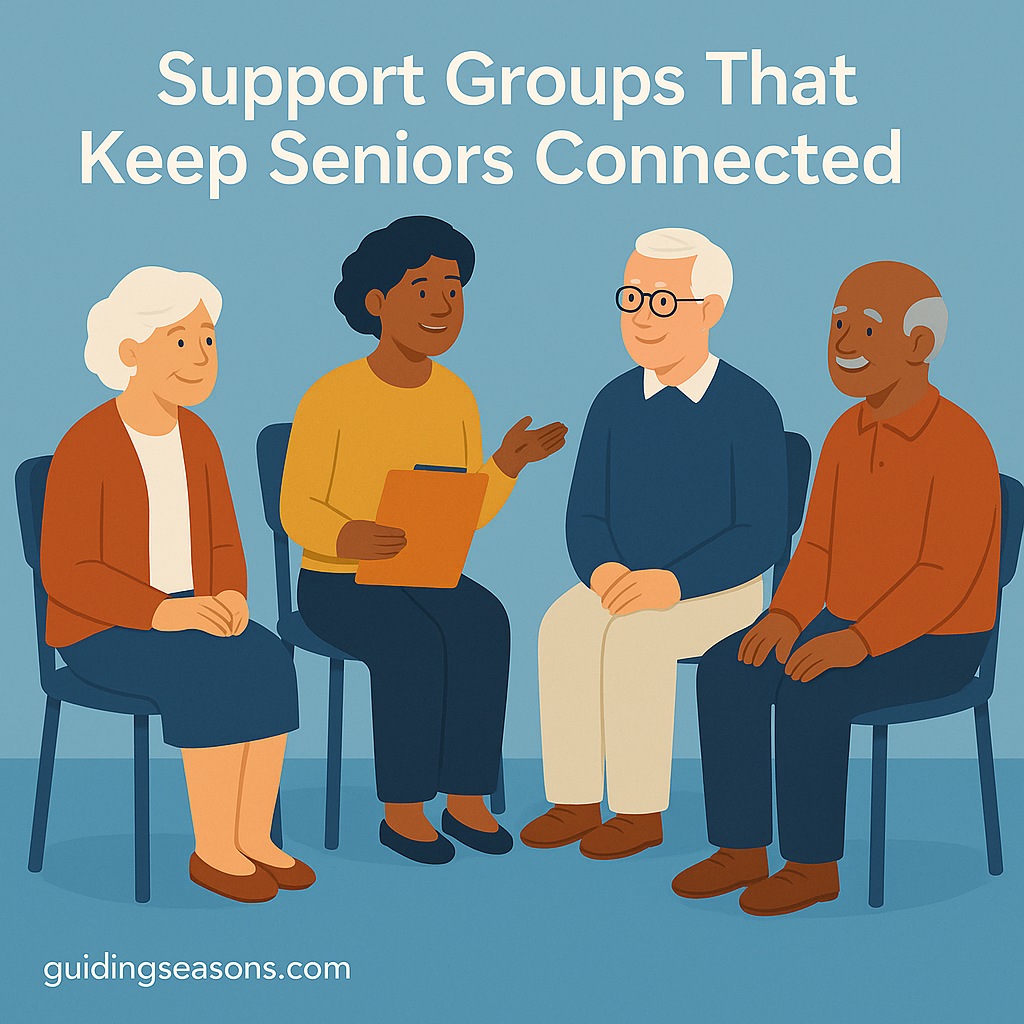
General Senior Social and Support Groups
General senior groups are a good starting point for older adults primarily looking for conversation, companionship, and new friendships.
These groups may include weekly social gatherings, coffee-and-chat mornings, discussion circles, community lunches, friendship groups, or informal gatherings at senior centers.
The atmosphere is often relaxed. You may not need to discuss anything deeply personal. Some people attend simply because they enjoy seeing familiar faces every week.
Senior centers are particularly useful because they may offer several activities in one location. Someone might attend an exercise class in the morning, stay for lunch, and participate in cards or another social activity afterward.
If you haven’t participated in a group for a long time, starting with a casual activity can make the transition easier.
Health and Wellness Support Groups
Living with a chronic health condition can sometimes feel isolating, particularly when friends and family members don’t fully understand the daily challenges involved.
Health-focused support groups bring together people dealing with similar experiences.
Groups may focus on:
- Diabetes
- Heart conditions
- Arthritis
- Parkinson’s disease
- Cancer
- Vision or hearing loss
- Chronic pain
- Caregiving
- General healthy aging
Some groups primarily provide emotional support, while others combine conversation with educational presentations, exercise, nutrition information, or practical strategies for managing daily life.
Hospitals, clinics, nonprofit organizations, and community health centers are good places to ask about these programs.
A support group should complement—not replace—professional medical care. Medical decisions and treatment questions should still be discussed with a qualified health care professional.
Grief and Loss Support Groups
Losing someone close can dramatically change everyday life. In addition to grief itself, a person may lose a major source of companionship and suddenly find that established routines feel very different.
Grief support groups provide an environment where people can talk with others who have experienced similar losses.
Groups may focus on losing a spouse or partner, losing another family member, adjusting to life after loss, or coping with grief that continues over time.
One benefit is simply not having to explain everything. Other members may already understand why certain anniversaries, holidays, places, or everyday routines can suddenly become difficult.
Some groups are facilitated by counselors, social workers, clergy members, or trained volunteers. Hospices, hospitals, community organizations, and places of worship may offer grief programs.
If grief is severely interfering with daily life or is accompanied by persistent depression or thoughts of self-harm, professional help should be sought rather than relying solely on a peer support group.
Activity-Based Social Communities
Not every supportive community needs to be organized around a problem. For many older adults, one of the easiest ways to make friends is to participate in something they already enjoy.
Activity-based groups might include:
- Walking groups
- Gardening clubs
- Book clubs
- Art and painting classes
- Knitting or crafting circles
- Photography groups
- Choirs and music groups
- Cooking classes
- Card and board game gatherings
- Pickleball or other recreational sports
Shared activities naturally give people something to talk about, which can make meeting new people feel less awkward.
The CDC specifically recommends participating in enjoyable activities with others as one way older adults can strengthen social connectedness. Examples include gardening, walking, crafts, group exercise, arts, games, and faith-based activities.
Look for something you genuinely enjoy rather than choosing an activity solely because it’s labeled for seniors. Shared interests often create stronger connections.
Technology Support Groups for Seniors
Technology can be a powerful tool for maintaining relationships, especially when children, grandchildren, relatives, and longtime friends live far away.
But smartphones, video calls, apps, passwords, and constantly changing technology can be frustrating for anyone.
Technology groups designed for older adults may provide help with:
- Smartphones and tablets
- Text messaging
- Video calling
- Social media
- Online appointment systems
- Useful mobile apps
- Passwords and account security
- Recognizing scams
- General internet safety
Libraries, senior centers, community colleges, and nonprofit organizations frequently offer technology classes or one-on-one assistance.
The goal isn’t to become a technology expert. Even learning how to comfortably make a video call can make it easier to stay involved with distant family and friends.
Mental and Emotional Wellness Groups
Emotional health deserves attention throughout life. Older adults may experience stress related to retirement, health changes, caregiving responsibilities, financial concerns, loss, or changing family relationships.
Support groups and workshops may address topics such as anxiety, depression, stress management, mindfulness, relaxation, emotional resilience, or adjusting to major life changes.
Peer groups can help people realize that they aren’t the only ones experiencing these challenges.
However, a support group isn’t a substitute for professional mental health treatment when it is needed. Persistent sadness, anxiety, major changes in sleep or appetite, or other concerning symptoms are good reasons to speak with a health care provider.
Faith and Spiritual Communities
For people who value religion or spirituality, faith communities can provide both emotional support and regular opportunities for social interaction.
Possibilities include Bible study groups, prayer circles, meditation groups, spiritual discussion groups, volunteer programs, community meals, and interfaith gatherings.
Places of worship often have established networks for checking on older members, arranging transportation, providing meals, or visiting people who are unable to leave home.
You don’t necessarily need to attend formal religious services to participate in every program. Some organizations offer community activities that are open to the public.
Online Support Groups
Transportation, health concerns, caregiving responsibilities, or limited mobility can make attending an in-person meeting difficult.
Online groups provide another option.
Depending on the organization, meetings may take place through video conferencing, online discussion boards, social networks, or even traditional telephone calls.
Advantages can include flexible schedules, no travel time, access to specialized groups that aren’t available locally, and the ability to connect with people across the country.
Online interaction doesn’t have to replace face-to-face relationships. It can supplement them.
For example, someone might attend an in-person senior center activity once a week while participating in a virtual hobby group on another day.
When joining online communities, be cautious about sharing financial information, medical records, passwords, your home address, or other sensitive personal details.
Intergenerational Programs
Social connection doesn’t have to happen exclusively among people of the same age.
Intergenerational programs bring older adults together with children, teenagers, college students, or younger adults.
Programs may involve tutoring, mentoring students, reading with children, teaching practical skills, participating in oral-history projects, volunteering, or exchanging cultural experiences.
These programs can be especially rewarding because older adults have decades of knowledge and experience to share.
Rather than simply receiving support, participants have an opportunity to contribute something meaningful to someone else’s life. That sense of purpose can make the experience particularly valuable.
Volunteering Can Create Connection Too
If a traditional support group doesn’t appeal to you, volunteering can accomplish many of the same social goals.
Volunteers work alongside people who share a common purpose, creating repeated opportunities for conversation and friendship.
Consider volunteering at an animal shelter, library, food pantry, school, community garden, museum, hospital, park, or nonprofit organization.
Even a few hours each month can establish a routine and introduce you to people you otherwise might never meet.
The National Institute on Aging suggests volunteering and joining activities you enjoy as practical ways to strengthen social connections and help reduce isolation.
How to Find Support Groups Near You
Start close to home. You may be surprised by how many programs already exist in your community.
Check local senior centers, recreation departments, libraries, hospitals, community colleges, parks and recreation programs, places of worship, nonprofit organizations, and community centers.
Your health care provider may also know about groups related to specific medical conditions.
Online services can expand the search. Community websites, local social media groups, Meetup, and similar platforms may list walking clubs, hobby groups, classes, volunteer opportunities, and social gatherings.
Another useful resource is the Eldercare Locator, a public service of the U.S. Administration for Community Living that helps connect older adults and families with local aging services.
When evaluating a group, consider the meeting location, transportation requirements, accessibility, cost, schedule, group size, and whether the atmosphere feels comfortable.
What to Look for in a Good Support Group
A healthy group should make members feel respected and welcome.
For groups involving sensitive topics, ask whether there is a facilitator and what privacy expectations members are asked to follow. You can also ask whether the first meeting is free, whether registration is required, and whether family members or caregivers may attend.
Be cautious about organizations that pressure members to purchase expensive products or services, disclose financial information, or make medical decisions without consulting appropriate professionals.
A legitimate support group should support your independence rather than pressure you.
Tips for Joining Your First Group
Walking into a room where everyone seems to know one another can feel intimidating. Give yourself permission to ease into the experience.
You don’t have to speak extensively at your first meeting. Introduce yourself, listen, and learn how the group works.
If you’re uncomfortable attending alone, ask a friend, relative, or caregiver to accompany you when appropriate.
Try attending more than once before deciding whether a group is right for you. The first meeting may feel unfamiliar simply because everything is new.
At the same time, don’t force yourself to stay in a group that doesn’t feel comfortable. Personalities and group cultures differ. Trying another group may lead to a much better fit.
Start Small and Build a Routine
Building social connection doesn’t require filling every day with activities.
A more realistic goal may be to establish one or two dependable points of contact each week.
For instance, you could attend a walking group every Wednesday morning and call a longtime friend every Sunday afternoon. Once those habits become comfortable, you might add another activity.
Consistency often matters more than having a packed schedule.
Small interactions count too. Talking with a neighbor, chatting with someone after an exercise class, calling a relative, or sharing coffee with a friend can all contribute to a stronger sense of connection.
Final Thoughts
Support groups can help seniors maintain something everyone needs regardless of age: meaningful human connection.
The best group doesn’t necessarily have to call itself a “support group.” It might be a walking club, church gathering, grief group, volunteer team, book club, technology class, community garden, or weekly coffee gathering.
What matters is finding opportunities to regularly interact with people who make you feel welcomed, respected, and involved.
If you haven’t participated in a group before, begin with something simple. Attend one meeting. Visit your local senior center. Ask your library about upcoming activities. Join a class centered on a hobby you already enjoy.
One conversation can lead to another. Familiar faces can gradually become acquaintances, and acquaintances can become friends.
Staying connected doesn’t mean having dozens of relationships or constantly being busy. It means having meaningful opportunities to participate, contribute, talk, listen, and belong—and those opportunities can remain an important part of a healthy and fulfilling life at any age.