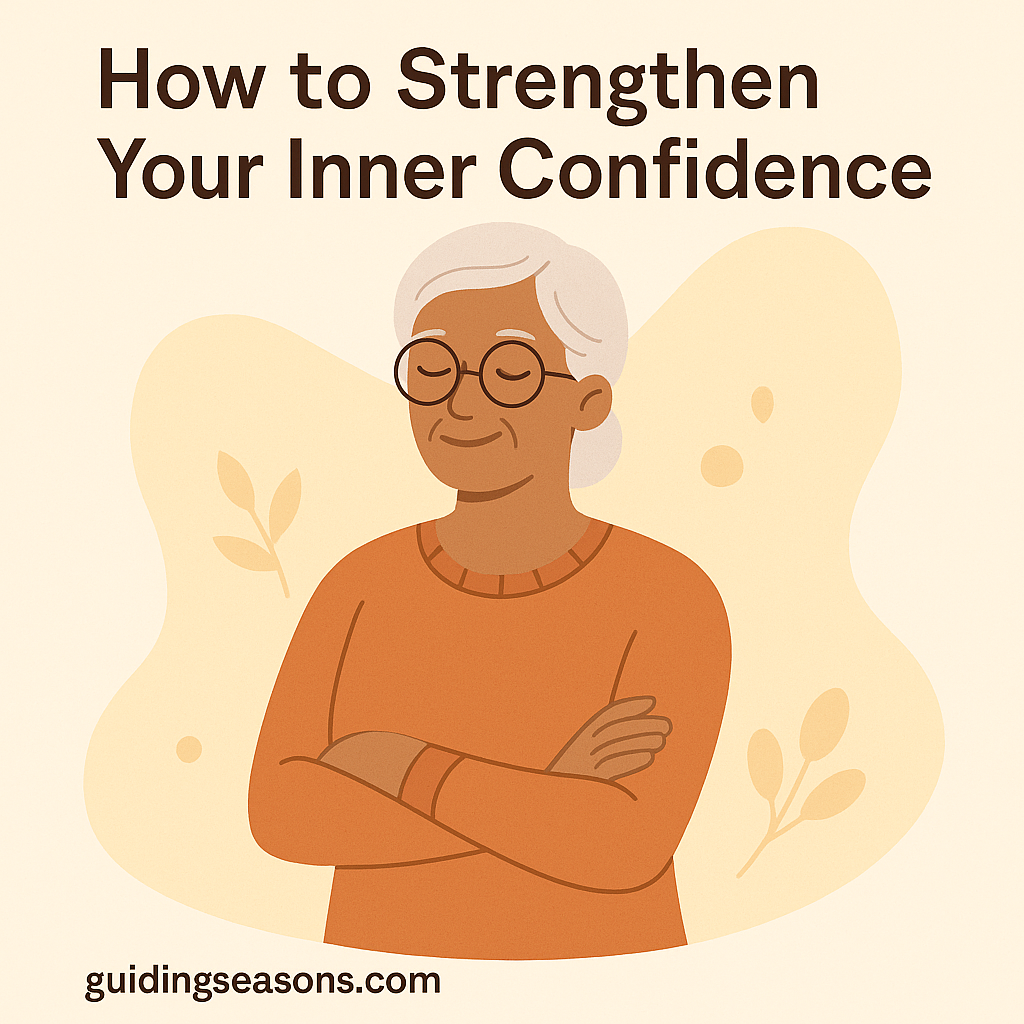
Confidence is often associated with being bold, outspoken, decisive, or certain of yourself. We may picture a confident person as someone who walks into a room without hesitation, takes charge of situations, and rarely worries about what other people think.
But confidence doesn’t always look like that—especially later in life.
As you grow older, confidence can become quieter and more personal. Instead of needing to prove what you can accomplish, confidence may become more about trusting yourself to make decisions, adapt to change, learn when necessary, and handle challenges as they arise.
That kind of confidence doesn’t depend on having all the answers.
It comes from knowing that even when life changes, you still have experience, judgment, strengths, and the ability to respond.
Retirement, changes in health or mobility, the loss of familiar responsibilities, changes in relationships, or learning new technology can sometimes shake that sense of certainty. But they don’t erase the abilities and wisdom you’ve developed over a lifetime.
In fact, the National Institute on Aging (NIA) emphasizes that older adults remain capable of learning new things, forming new memories, and improving their performance in different skills. The NIA also points out that some aspects of thinking can benefit from the knowledge and insight accumulated through years of experience.
Strengthening inner confidence isn’t about returning to the person you were 20 or 30 years ago.
It’s about learning to trust the person you are today.
Why Confidence Can Feel Different Later in Life
Much of our earlier confidence comes from roles and accomplishments.
You may have felt confident because you knew your profession well, managed a household, raised children, ran a business, maintained a busy schedule, or had people regularly asking for your advice.
Those roles provide feedback.
You solve a problem and someone thanks you.
You complete a project and receive recognition.
You earn a promotion.
Your children depend on you.
Other people see what you’re capable of, which reinforces your own sense of competence.
Later in life, some of those external signals may become less frequent.
Retirement can remove a professional identity that existed for decades. Adult children may become increasingly independent. Changes in health or mobility can require you to approach familiar activities differently. Technology can transform ordinary tasks that once felt simple.
You might suddenly find yourself thinking:
“Am I still capable of doing this?”
“Should I ask someone else to handle it?”
“What if I make the wrong decision?”
“Maybe I’m too old to learn this.”
These thoughts can gradually weaken confidence if they’re never challenged.
But changing circumstances don’t automatically mean declining capability.
Sometimes you simply need new ways to measure confidence.
Understand the Difference Between Outer and Inner Confidence
Outer confidence often depends on circumstances.
You feel confident because you’re experienced at something.
Inner confidence goes deeper.
It says:
“I may not know exactly what to do yet, but I trust myself to figure out the next step.”
That distinction becomes increasingly valuable when life is unpredictable.
Imagine two people trying to use a new online banking system.
The first person thinks:
“I don’t understand this. I’m terrible with technology.”
The second person thinks:
“I don’t understand this yet. I’ll go through it slowly, and if I get stuck, I’ll ask for help.”
Neither person knows how to use the system.
The difference isn’t knowledge.
It’s self-trust.
Inner confidence allows you to be inexperienced without immediately deciding that you’re incapable.
Stop Comparing Yourself With an Earlier Version of Yourself
One of the easiest ways to undermine confidence is to constantly compare yourself with who you used to be.
You might think:
“I used to have more energy.”
“I used to remember everything.”
“I used to be able to work all day.”
“I used to travel without worrying about anything.”
Some changes associated with getting older are real, and pretending otherwise isn’t helpful.
But constantly measuring today’s abilities against those of decades ago creates an unfair standard.
Instead, ask:
“What works for me now?”
Perhaps you don’t want to drive long distances anymore, but you’re comfortable driving locally.
Maybe gardening for four hours leaves you exhausted, but gardening for 45 minutes is enjoyable.
Perhaps learning new technology requires more patience than you’d like, but you’re still able to learn it.
Adapting isn’t the same as giving up.
In many cases, adapting is evidence of good judgment.
Keep Small Promises to Yourself
Confidence grows through evidence.
One of the simplest ways to create that evidence is by making small commitments and following through.
Suppose you tell yourself:
“I’ll walk for 10 minutes after breakfast tomorrow.”
Then you do it.
That seems minor, but you’ve given yourself evidence that your intentions can become actions.
Try this with manageable commitments:
- Call the friend you’ve been meaning to contact
- Spend 15 minutes organizing a drawer
- Walk around the block
- Read five pages of a book
- Make the appointment you’ve been postponing
- Practice a new skill for 10 minutes
- Attend one community activity
Don’t make the promise so ambitious that it becomes another opportunity to criticize yourself.
Start small enough that success is realistic.
Each completed commitment sends a quiet message:
“I can rely on myself.”
That is one of the foundations of inner confidence.
Try a 30-Day Confidence Experiment
If you’d like something more structured, try this simple exercise for one month.
Each day, choose one small action that requires a little initiative.
It could be as simple as asking a question during an appointment, learning one feature on your phone, walking into a new store, calling someone first, trying a different recipe, or expressing your opinion when you normally remain quiet.
At the end of the day, write down what you did.
After 30 days, you’ll have a list of 30 pieces of evidence showing that you can act even when something feels unfamiliar or uncomfortable.
For example:
Day 3: Learned how to send a photograph from my phone.
Day 8: Called an old friend instead of waiting for them to call.
Day 12: Asked the pharmacist a question I had been hesitant to ask.
Day 17: Drove to a restaurant I hadn’t visited before.
Day 24: Went to a community class by myself.
Day 30: Introduced myself to someone new.
None of these actions is dramatic.
That’s the point.
Confidence usually grows from repeated experiences, not one enormous achievement.
Reframe Mistakes as Information
Fear of making mistakes can quietly shrink your world.
You stop trying unfamiliar things because you don’t want to look foolish, waste money, become frustrated, or need help.
But mistakes aren’t proof of incompetence.
They’re often information.
Suppose you’re learning to order groceries online and accidentally add three cartons of milk instead of one.
You could think:
“I can’t do anything online.”
Or:
“Now I know I need to check the quantity before placing the order.”
The mistake hasn’t changed.
Your interpretation has.
The second response allows you to learn and continue.
Confidence isn’t the belief that you won’t make mistakes.
It’s knowing that a mistake doesn’t automatically mean you should stop trying.
Let Yourself Be a Beginner Again
Adults often dislike being beginners because we’re accustomed to competence.
After decades of knowing how to handle everyday life, suddenly struggling with something can feel uncomfortable.
But everyone who becomes skilled at something begins by not knowing how to do it.
The NIA notes that older adults can continue learning new skills and highlights research in which older adults learning activities such as quilting or digital photography showed improvements in memory.
You might try:
- Photography
- Gardening
- A new language
- Cooking
- Painting
- Using a tablet or smartphone
- Playing an instrument
- Genealogy
- Pickleball
- Dancing
- Creative writing
- Woodworking
Don’t judge the first attempt by the standards of someone who’s been practicing for years.
Give yourself permission to be new at something.
Learning itself can become evidence that you’re still capable of growth.
Pay Attention to How You Speak to Yourself
Confidence is difficult to build when your internal conversation is constantly critical.
Notice what you say to yourself after making a mistake.
Do you think:
“That was stupid.”
“I should know better.”
“I’m useless at this.”
“I can’t do anything anymore.”
Now imagine saying those same words to a friend who was struggling.
You probably wouldn’t.
Try replacing harsh judgment with something accurate and constructive.
Instead of:
“I’m terrible at this.”
Try:
“I’m still learning this.”
Instead of:
“I should have known better.”
Try:
“Now I know what to do differently.”
Instead of:
“I can’t do things like I used to.”
Try:
“I may need to do this differently now.”
This isn’t empty positive thinking.
You’re simply refusing to turn one frustrating experience into a judgment about your entire ability or worth.
Recognize Strengths That Become More Valuable With Experience
Confidence isn’t only physical ability, speed, memory, or productivity.
Some strengths become deeper through experience.
You may have developed:
- Patience
- Perspective
- Empathy
- Judgment
- Emotional awareness
- Problem-solving ability
- Communication skills
- Resilience
- Practical knowledge
- The ability to recognize what really matters
These qualities can be easy to overlook because they’re less visible than professional titles or physical accomplishments.
Think about difficult periods you’ve already survived.
Perhaps you’ve dealt with job losses, financial difficulties, relationship problems, raising children, caring for relatives, moving, illness, grief, or major changes you never anticipated.
You may not have handled every situation perfectly.
Nobody does.
But you’re still here.
Your history contains evidence of your ability to adapt.
Don’t Wait Until You Feel Completely Confident
A common misconception is that confidence comes first and action follows.
Often, it’s the other way around.
You act while feeling uncertain.
You discover that you can manage the situation.
Then confidence grows.
Suppose you’d like to join a community class but feel uncomfortable going alone.
Waiting until you feel completely confident could mean never going.
Instead, create a smaller goal:
“I’ll attend one class and stay for 30 minutes.”
Now you’re not committing to becoming a permanent member.
You’re running an experiment.
You may discover that the first five minutes feel awkward but the next 25 don’t.
That experience gives your brain new evidence.
The next visit becomes easier.
Learn to Tolerate a Little Discomfort
Confidence grows near the edge of your comfort zone.
Not far beyond it.
You don’t need to frighten or overwhelm yourself.
Instead, practice tolerating manageable amounts of uncertainty.
If you’re uncomfortable speaking in groups, ask one question.
If you dislike going somewhere alone, visit for 20 minutes.
If technology makes you nervous, learn one feature rather than the entire device.
If you’ve become socially withdrawn, call one person rather than attending a large event.
Small stretches gradually expand what feels familiar.
Stay Connected With Other People
Inner confidence comes from within, but supportive relationships can help strengthen it.
Spending too much time isolated from others can make self-doubt louder because you lose opportunities for encouragement, perspective, conversation, and shared experiences.
The CDC reports that supportive social connections are associated with less stress, better emotional and physical health, reduced loneliness, and greater quality of life. It encourages older adults to participate in activities they enjoy with others and explore new hobbies, community spaces, and groups when appropriate.
Connection might involve:
- Meeting a friend for coffee
- Walking with a neighbor
- Joining a book club
- Attending a senior center activity
- Volunteering
- Taking a class
- Calling family regularly
- Participating in a faith community
- Joining a hobby group
You don’t need dozens of relationships.
A few supportive people who make you feel respected and valued can make an enormous difference.
Ask for Help Without Viewing It as Failure
Independence and confidence aren’t identical.
A confident person can still ask for assistance.
In fact, knowing when you need help can demonstrate good judgment.
Maybe you need someone to show you how an app works.
Perhaps you need assistance lifting something heavy.
Maybe you want a second opinion before making an important financial decision.
You haven’t surrendered your independence simply because someone helped.
Think about how often you’ve helped other people throughout your life.
Did their request automatically make you think less of them?
Probably not.
Extend yourself the same courtesy.
Stop Giving Everyone Else’s Opinion Equal Weight
Advice can be valuable.
But if you constantly need someone else to approve every decision, your confidence can gradually weaken.
Before asking for reassurance, try asking yourself first:
“What do I think?”
Perhaps your adult children think you should travel more.
Your friends think you should move.
Someone else thinks you should spend your retirement differently.
Listen respectfully, especially when advice involves legitimate safety, health, legal, or financial concerns.
But remember that other people don’t live inside your life.
Your preferences matter.
You can consider advice without automatically surrendering your judgment.
Understand the Difference Between Confidence and Control
Trying to control every outcome can sometimes look like confidence.
But true confidence doesn’t require certainty.
You cannot control whether every plan works.
You cannot control how other people respond.
You cannot predict every financial, health, family, or lifestyle change.
Inner confidence says:
“I don’t know exactly what will happen, but I trust myself to respond.”
That is a much more durable form of confidence because it doesn’t disappear every time life becomes unpredictable.
Keep a Record of Things You’ve Handled Well
People tend to remember mistakes while overlooking ordinary successes.
Create a simple “evidence list.”
Write down things you’ve handled successfully.
They don’t need to be impressive.
For example:
- Made an important phone call
- Learned a new phone feature
- Asked for clarification at an appointment
- Fixed something around the house
- Cooked dinner for family
- Attended an event alone
- Solved a financial problem
- Helped a neighbor
- Finished a difficult task
- Said no when something wasn’t right for me
When you’re doubting yourself, read the list.
You’re not trying to convince yourself that you’re extraordinary.
You’re reminding yourself of facts you’ve forgotten.
When Low Confidence Begins Affecting Daily Life
Everyone experiences periods of uncertainty.
But pay attention when self-doubt begins significantly restricting your life.
For example:
- You avoid ordinary decisions because you’re afraid of choosing incorrectly.
- You repeatedly seek reassurance for decisions you once made independently.
- You stop seeing people because you feel uncomfortable or inadequate.
- You abandon enjoyable activities because you’re afraid of making mistakes.
- You frequently feel worthless, hopeless, or incapable.
- Changes in mood or anxiety begin interfering with everyday activities.
Low confidence itself isn’t necessarily a mental health condition. However, persistent withdrawal, hopelessness, loss of interest, or difficulty functioning can sometimes occur alongside conditions such as depression or anxiety.
If these feelings are persistent or interfering with your daily life, consider talking with your doctor or a qualified mental health professional.
Support is another tool—not evidence that you’ve failed.
Build Confidence Around Who You Are Now
Perhaps the most important shift is learning to stop asking:
“Can I still be the person I used to be?”
Try asking:
“Who am I becoming now?”
You don’t have to maintain every ability, role, responsibility, or ambition from an earlier stage of life.
You can build confidence around your current strengths.
Maybe you’re more patient.
Maybe you understand people better.
Maybe you’ve become comfortable saying no.
Maybe you appreciate your time more.
Maybe you’re finally willing to pursue interests you postponed for decades.
Growing older doesn’t require becoming a smaller version of your younger self.
It can mean becoming a different version of yourself—one shaped by experience.
Related Guidance You May Find Helpful
Strengthening inner confidence is closely connected to purpose, outlook, and self-understanding. You may also find these topics helpful:
- How to Build Meaning and Purpose in Retirement
- How to Connect With Your Inner Purpose
- How to Improve Your Daily Outlook
Together, these areas can help strengthen self-trust while encouraging a more engaged and meaningful approach to later life.
Final Thoughts
Inner confidence isn’t about being fearless.
It isn’t about knowing everything.
And it certainly isn’t about pretending that aging doesn’t bring changes.
Real confidence is quieter.
It’s being willing to say:
“I don’t know yet, but I can learn.”
“This didn’t work, so I’ll try something different.”
“I need help with this, and that’s okay.”
“My circumstances have changed, but I still have something to contribute.”
“I’ve handled uncertainty before.”
Start by giving yourself one small piece of evidence.
Choose something you’ve been hesitating to do.
Make the phone call.
Learn the new feature.
Ask the question.
Attend the class for 30 minutes.
Take the short walk.
Express your opinion.
Then notice what happened.
Tomorrow, create another small piece of evidence.
Confidence rarely arrives all at once. It develops through dozens of ordinary moments when you discover that you can make a decision, learn, adapt, recover from mistakes, ask for help, and continue moving forward.
Over time, you may find yourself relying less on outside reassurance and more on something far more dependable:
your own experience, judgment, resilience, and trust in yourself.