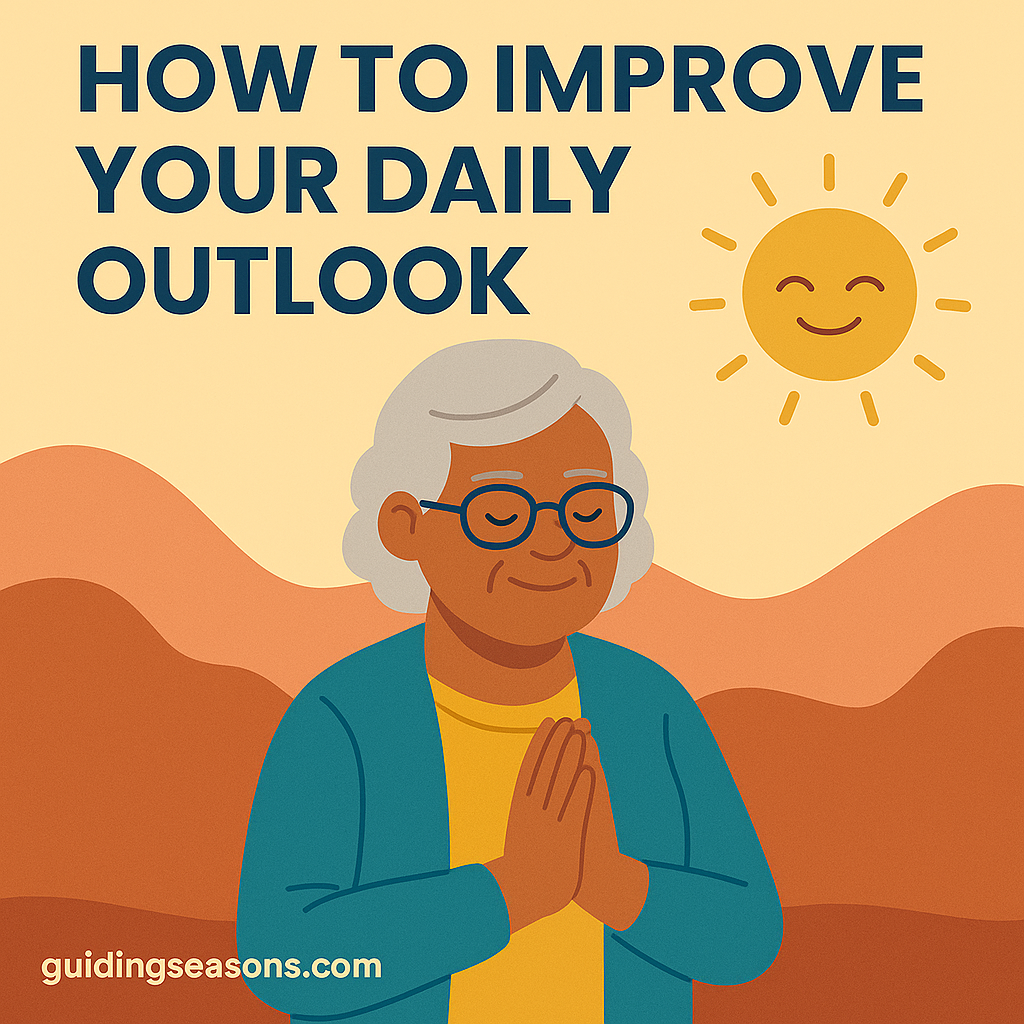
Your daily outlook influences how life feels—not only during major events, but during the ordinary hours that make up most of your days.
As you move into retirement or another later stage of life, your daily rhythm may change significantly. The alarm clock may no longer ring at 6:00 a.m. There may be fewer deadlines, meetings, school schedules, or responsibilities determining what happens next. At first, that freedom can feel wonderful.
But having more control over your time can also create an unexpected question:
What do I want my days to look like now?
Without the external structure that once organized your life, some days may begin to blend together. Motivation can fluctuate. You might wake up without a clear reason to get moving or find yourself spending more time watching television, scrolling online, or thinking about problems.
Improving your daily outlook doesn’t mean forcing yourself to be cheerful.
It doesn’t mean ignoring grief, health concerns, financial worries, family problems, or other legitimate challenges. A healthy outlook allows difficult emotions to exist while also recognizing that one frustrating moment doesn’t necessarily have to determine the rest of the day.
The goal is balance.
With a few intentional habits, you can create more structure, connection, curiosity, and meaning in ordinary life.
Why Your Daily Outlook May Change as Life Changes
For decades, much of your schedule may have been determined by outside responsibilities.
Work began at a certain time.
Children needed to get to school.
Bills had to be paid.
Appointments filled the calendar.
Weekends were used for errands, household projects, and family activities.
Those responsibilities could certainly create stress, but they also provided structure.
Retirement can remove a large portion of that structure almost overnight.
Suddenly, Monday morning may not feel dramatically different from Saturday morning.
That’s freedom—but freedom often works better when it has some direction.
A lack of structure can sometimes contribute to:
- Difficulty getting started in the morning
- Spending too much time sitting or watching television
- Reduced social interaction
- Boredom
- Restlessness
- Irregular sleep habits
- Feeling as though the days are blending together
Rather than trying to recreate your old working schedule, consider building a new rhythm appropriate for your current life.
Start the Day With One Simple Anchor
How you begin the morning can influence what happens next.
That doesn’t mean you need an elaborate routine involving exercise, meditation, journaling, and a perfectly prepared breakfast before sunrise.
Your morning anchor can be simple.
Perhaps you:
- Make coffee and read for 20 minutes
- Take a short morning walk
- Sit outside with tea
- Stretch
- Write in a journal
- Water your plants
- Listen to music
- Prepare breakfast without checking your phone
- Review what you’d like to accomplish that day
The activity itself matters less than the consistency.
Imagine waking up without any plans. You make coffee, turn on the television, check your phone, and suddenly it’s 11:30 a.m.
Compare that with deciding:
“Every morning after breakfast, I’m going to walk for 20 minutes.”
Now the day has a starting point.
One small anchor often leads naturally into the next activity.
Give Yourself Three Reasons to Get Moving
You don’t need a packed schedule to create a meaningful day.
In fact, overscheduling retirement can simply replace one form of stress with another.
Try creating three anchors for the day instead.
For example:
One thing for your body:
Take a 30-minute walk.
One thing that needs attention:
Pick up groceries.
One thing you enjoy:
Call a friend and talk for 20 minutes.
That’s enough structure to give the day direction without making it feel like a work schedule.
On another day, your three anchors might be gardening, paying two bills, and watching a favorite movie.
The specific activities can change.
The idea is to avoid reaching the end of the day wondering where all the time went.
Spend Some Time Moving
Physical activity can influence more than physical health.
The Centers for Disease Control and Prevention (CDC) notes that regular physical activity can support brain health, improve sleep, reduce anxiety, and help people maintain independence as they age. The CDC recommends that adults age 65 and older generally aim for at least 150 minutes of moderate-intensity aerobic activity each week, along with muscle-strengthening and balance activities, while taking individual health and physical abilities into account. (cdc.gov)
You don’t necessarily have to exercise for 150 minutes all at once—or even think of movement as “exercise.”
Movement could include:
- Walking
- Gardening
- Dancing
- Swimming
- Cycling
- Chair exercises
- Light strength training
- Stretching
- Household activities
If you’re currently inactive or have medical limitations, your appropriate activity level may be different, so discuss significant changes with your healthcare provider when necessary.
The larger point is simple:
Your body and your daily outlook are connected.
A little movement can help break up long stretches of inactivity and give your day another positive anchor.
Get Outside When You Can
A change of environment can sometimes change the feel of an entire day.
You don’t need a major outdoor adventure.
Sit on your porch.
Walk around the block.
Have coffee in the backyard.
Visit a park.
Water the garden.
Walk to the mailbox.
Spend 15 minutes watching birds.
Ordinary outdoor experiences give you something immediate to notice—the temperature, sunlight, wind, trees, sounds, and people around you.
This can be particularly useful when you’ve spent too much time inside thinking about something that’s bothering you.
Sometimes changing your surroundings is enough to interrupt that cycle.
Pay Attention to What You’re Feeding Your Mind
Information affects outlook too.
News, social media, television, online arguments, and constant notifications can fill hours of the day.
Staying informed is valuable.
Constantly consuming information isn’t always necessary.
Consider what happens if you begin every morning by reading stories about crime, political conflict, economic uncertainty, disasters, and health concerns.
Even when those issues are legitimate, starting and ending every day with negative information can make the world feel more threatening than your immediate surroundings actually are.
Try creating reasonable boundaries.
You might:
- Check the news once or twice rather than repeatedly
- Disable unnecessary phone notifications
- Avoid reading upsetting stories immediately before bed
- Unfollow social media accounts that consistently irritate you
- Put your phone away during meals
- Take occasional breaks from social media
You’re not ignoring the world.
You’re deciding how much of your attention it receives.
Notice When Comparison Changes Your Mood
Comparison can quietly affect outlook.
You see someone your age traveling internationally.
Another person seems healthier.
Someone else has a larger retirement account.
A former coworker appears to have a more exciting retirement.
It’s easy to compare your ordinary Tuesday afternoon with somebody else’s vacation photograph.
But you rarely see the complete picture.
People have different financial circumstances, health conditions, family responsibilities, personalities, relationships, and priorities.
A more useful comparison is with your own life.
Ask:
“Is there something I would genuinely like to improve?”
If the answer is yes, identify one realistic step.
Comparison becomes useful when it leads to constructive action.
It becomes harmful when it simply convinces you that everyone else is doing better.
Add Something to Look Forward To
Anticipation can add energy to an otherwise ordinary week.
You don’t need a cruise, expensive vacation, or major event on the calendar.
Something small works too.
For example:
- Lunch with a friend on Friday
- A movie Wednesday night
- A Saturday farmers market
- A grandchild’s soccer game
- A library visit
- A weekly exercise class
- Trying a new restaurant
- A gardening project
- A Sunday drive
- Starting a new book
Try keeping at least one enjoyable activity on your calendar each week.
Over a year, that simple habit creates more than 50 experiences to anticipate.
Some may become traditions.
Others may lead to new interests, friendships, or routines.
The point isn’t staying constantly entertained.
It’s reminding yourself that there is something ahead worth anticipating.
Create Meaning in Ordinary Moments
Purpose doesn’t always have to come from major accomplishments.
Meaning can be surprisingly ordinary.
Making breakfast for your spouse matters.
Helping your grandchild with homework matters.
Taking care of a pet matters.
Calling someone who lives alone matters.
Maintaining your garden matters.
Preparing a family recipe matters.
Volunteering for two hours matters.
Listening when a friend needs to talk matters.
A meaningful life is often constructed from hundreds of seemingly small interactions rather than a handful of impressive achievements.
When you’re wondering whether your day was productive enough, try asking a different question:
“Did anything I did today matter to me or someone else?”
The answer may surprise you.
Maintain Social Connections
Outlook can become more difficult to manage when too much time is spent alone.
The National Institute on Aging (NIA) emphasizes the importance of social connection for older adults and notes that social isolation and loneliness are associated with higher risks for certain physical and mental health problems. The NIA encourages maintaining relationships and participating in activities such as volunteering, hobbies, classes, and community groups. (nia.nih.gov)
Connection doesn’t require having a huge social circle.
A few meaningful relationships can make an enormous difference.
Consider:
- Calling an old friend
- Meeting someone for coffee
- Joining a walking group
- Attending a community class
- Volunteering
- Visiting family
- Joining a hobby club
- Talking with neighbors
If you realize you’ve gone several days without a meaningful conversation, that may be a useful signal to reach out.
Allow Yourself to Have an Unproductive Day
Not every day needs accomplishments.
This can be surprisingly difficult for people who spent decades measuring their days through work.
You might feel guilty after an afternoon spent reading, watching a movie, sitting outside, or doing very little.
Ask yourself why.
Rest isn’t wasted time.
Some days genuinely need to be slower.
Your daily outlook may actually improve when you stop demanding that every day prove its value through productivity.
A balanced week can contain both activity and rest.
Don’t Let One Bad Moment Become a Bad Day
Suppose something frustrating happens at 9:00 a.m.
You receive an unexpected bill.
Someone makes an irritating comment.
An appointment gets canceled.
You make a mistake.
It’s easy to mentally label the entire day:
“Today is terrible.”
But the day isn’t over.
Try becoming more precise.
Instead of:
“This is a bad day.”
Try:
“That was a frustrating 20 minutes.”
There may still be many hours remaining.
You can go for a walk.
Have lunch.
Call someone.
Work in the garden.
Watch something funny.
Cook dinner.
One unpleasant experience doesn’t automatically deserve ownership of the remaining day.
Acknowledge Difficult Feelings Instead of Fighting Them
Improving your outlook doesn’t mean replacing every negative emotion with a positive one.
Some days you’re going to feel frustrated.
Other days you may feel sad, lonely, tired, worried, or simply uninterested.
You don’t have to immediately fix every emotion.
Try acknowledging it:
“I’m feeling discouraged today.”
Then ask:
“What would make the next hour slightly better?”
Maybe you need rest.
Maybe you need movement.
Maybe you need company.
Maybe you need to accomplish one small task.
Maybe you simply need time.
The goal isn’t to eliminate uncomfortable feelings.
It’s to prevent them from automatically controlling everything you do next.
Give Yourself Small Wins
When motivation is low, large goals can make it worse.
“Clean the entire house.”
“Get back in shape.”
“Organize all my finances.”
Those goals feel enormous.
Shrink them.
Clean one counter.
Walk for 10 minutes.
Review one bank statement.
Put away five items.
Send one email.
Small accomplishments create momentum.
You can always continue if you feel motivated.
But even if you stop, you’ve still moved something forward.
End Your Day by Noticing What Went Right
People naturally remember problems.
The appointment that ran late.
The argument.
The traffic.
The thing you forgot.
Try balancing that tendency by deliberately noticing something that went well.
Before bed, ask yourself:
“What was one good part of today?”
Maybe:
- The weather was pleasant.
- You had a good conversation.
- Dinner turned out well.
- You finished something you’d been avoiding.
- Your dog made you laugh.
- You enjoyed your morning coffee.
- Someone called unexpectedly.
- You saw a beautiful sunset.
You don’t need to pretend the difficult parts didn’t happen.
You’re simply refusing to let them become the entire story of the day.
Build a Weekly Rhythm
Daily routines are useful, but weekly rhythms can be even more helpful during retirement.
You might create something like:
Monday: errands and household tasks
Tuesday: walking group
Wednesday: open day
Thursday: lunch with a friend
Friday: hobby or project
Saturday: family or local activities
Sunday: slower day and planning for the week
Your schedule doesn’t need to look anything like this.
The value comes from having a loose rhythm.
Some days have responsibilities.
Some have connection.
Some have activity.
And some intentionally have very little.
Structure and freedom don’t have to be opposites.
A little structure can actually make free time more enjoyable.
When a Low Outlook Becomes Persistent
Everyone has difficult days.
A few quiet or unmotivated days aren’t automatically cause for concern.
But pay attention when a low outlook becomes persistent.
Possible signs that additional support may be helpful include:
- Losing interest in activities you normally enjoy
- Persistent sadness or irritability
- Significant changes in sleep or appetite
- Withdrawing from other people
- Difficulty concentrating
- Feeling hopeless
- Struggling to complete normal daily activities
These experiences can have many causes, including health conditions, medication effects, grief, loneliness, depression, anxiety, or major life changes.
If they’re persistent or interfering with everyday life, consider talking with your healthcare provider or a qualified mental-health professional rather than assuming they’re simply a normal part of getting older.
Related Guidance You May Find Helpful
Improving your daily outlook often connects with broader questions about purpose, confidence, and meaning.
You may also find these topics useful:
- How to Build Meaning and Purpose in Retirement
- How to Connect With Your Inner Purpose
- How to Strengthen Your Inner Confidence
- How to Develop a Positive Aging Mindset
- How to Let Go of Past Stressors
- Finding Joy in a Simplified Lifestyle
Together, these ideas can help you create a daily life that feels more intentional without putting pressure on yourself to feel positive all the time.
Final Thoughts
Improving your daily outlook isn’t about convincing yourself that everything is wonderful.
Some days will be difficult.
Plans will change.
People will disappoint you.
Health concerns may arise.
You may occasionally feel bored, lonely, frustrated, tired, or uncertain about what comes next.
A healthier outlook allows those realities to exist without letting them define every hour.
Give your morning a simple anchor.
Move your body when you’re able.
Spend some time outside.
Stay connected with people.
Limit information that consistently drains you.
Keep something enjoyable on the calendar.
Give yourself permission to rest.
And at the end of the day, notice at least one thing that was worthwhile.
None of these actions is dramatic.
That’s precisely why they can be useful.
A satisfying life isn’t created only through major milestones. It’s also created through thousands of ordinary mornings, conversations, walks, meals, projects, quiet afternoons, and evenings.
You don’t need every day to be extraordinary.
You simply want enough days to contain something meaningful, enjoyable, peaceful, or worth remembering.
One good conversation.
One completed task.
One walk outside.
One moment that makes you laugh.
Sometimes that’s enough to change how the entire day feels.