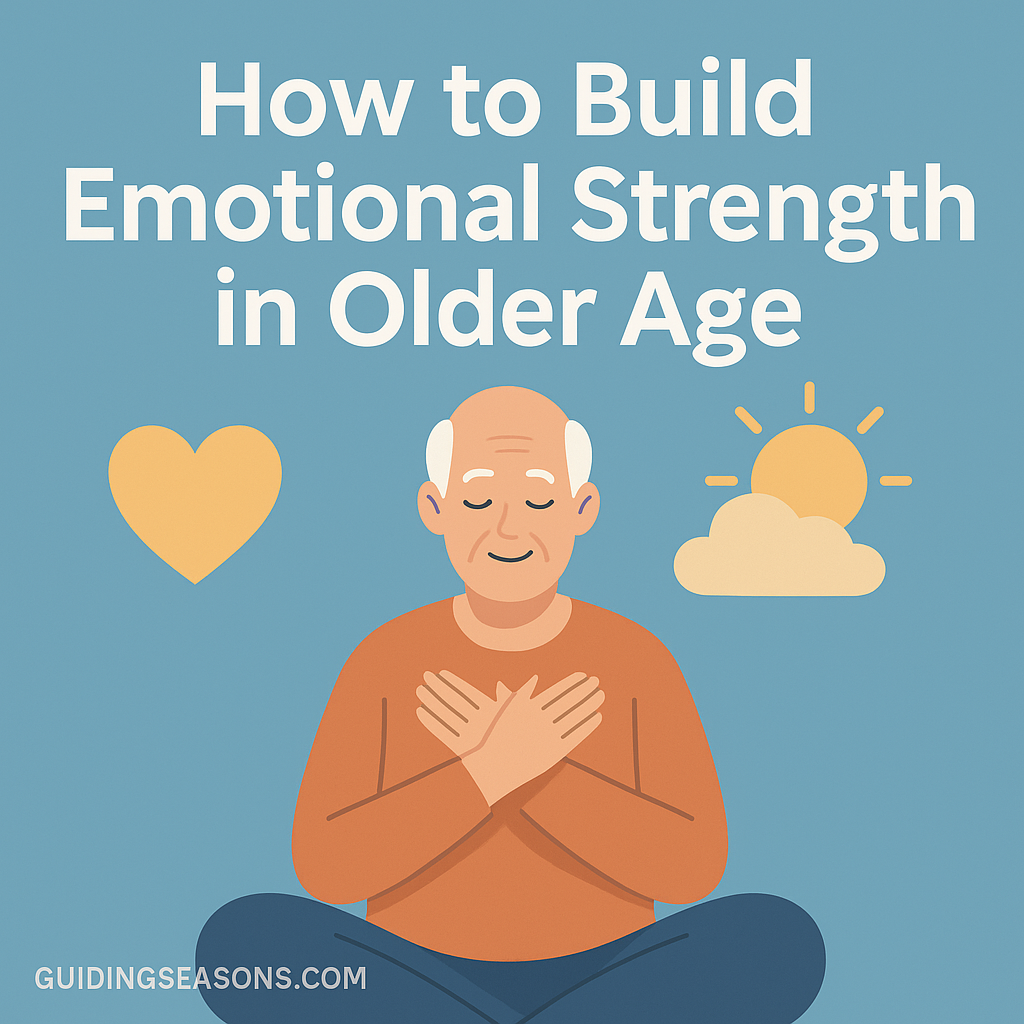
Emotional strength isn’t about becoming unaffected by difficult experiences. It doesn’t mean suppressing sadness, refusing help, or forcing yourself to remain positive when life is genuinely hard.
Real emotional strength is much more flexible.
It’s the ability to experience disappointment, uncertainty, loss, frustration, or change while gradually finding your footing again. It’s knowing when to solve a problem, when to accept something you cannot change, when to rest, and when to reach out to someone else.
These skills can become especially important as you grow older.
Retirement may change your sense of identity and daily structure. Health concerns can introduce uncertainty. Relationships evolve. Adult children build lives of their own. Financial priorities may shift. Friends or loved ones may move away or pass on.
At the same time, older age can bring decades of experience to draw from.
You’ve already navigated change.
You’ve solved problems you once thought were overwhelming.
You’ve adapted to circumstances you never expected.
That history can become an important source of emotional resilience.
The National Institute on Aging (NIA) describes resilience as the ability to resist, recover from, or successfully adapt to stressors and continues to support research into resilience and healthy aging.
Emotional strength, then, isn’t necessarily something you either have or don’t have. It can be supported through everyday habits, relationships, perspective, and healthy coping strategies.
Here are practical ways to strengthen it.
1. Learn to Name What You’re Feeling
When something is wrong, our first reaction is sometimes simply:
“I feel terrible.”
Try becoming more specific.
Are you:
- Worried?
- Lonely?
- Angry?
- Disappointed?
- Embarrassed?
- Overwhelmed?
- Frustrated?
- Bored?
- Grieving?
- Physically exhausted?
Identifying the emotion doesn’t automatically solve the problem, but it gives you useful information.
For example, imagine you’ve been unusually irritable for several days.
You might initially think you’re simply in a bad mood.
But after thinking about it, you realize you haven’t spoken with anyone socially in nearly a week.
The underlying feeling may be loneliness rather than anger.
That changes the possible solution.
Instead of telling yourself to “cheer up,” you might call a friend or arrange lunch with someone.
Emotional awareness helps you respond to what you actually need.
2. Stop Treating Every Difficult Emotion as a Problem
Emotional strength doesn’t mean eliminating uncomfortable feelings.
Some emotions are appropriate responses to difficult circumstances.
If someone you love is ill, worry is understandable.
If a friend dies, sadness is natural.
If you’ve experienced a major disappointment, frustration makes sense.
Trying to immediately eliminate these emotions can create another layer of pressure.
Instead, practice acknowledging them.
You might tell yourself:
“This is difficult.”
“I’m disappointed about what happened.”
“I’m worried right now.”
Then ask:
“What would help me handle this moment?”
Perhaps you need a conversation.
Maybe you need information.
Perhaps you need rest.
Or you may simply need time.
You don’t have to feel good every moment in order to be emotionally strong.
3. Pay Attention to Your Inner Voice
The way you interpret a challenge can influence how manageable it feels.
Consider the difference between:
“I can’t handle this.”
and:
“This is difficult, but I’ll figure out the next step.”
The second statement doesn’t pretend the problem is easy.
It simply leaves room for action.
When you notice harsh or discouraging self-talk, try replacing it with something more balanced.
Instead of:
“I’m too old to learn this.”
Try:
“This may take me some time, but I can learn.”
Instead of:
“Everything is going wrong.”
Try:
“Several things are difficult right now. What can I address first?”
Instead of:
“I should have handled that better.”
Try:
“I didn’t handle that the way I wanted. What can I do differently next time?”
Emotional resilience often grows through realistic thinking rather than exaggerated positivity.
4. Remember Challenges You’ve Already Survived
When facing a new problem, it’s easy to forget your own history.
Take a few minutes to think about difficult situations you’ve already navigated.
Perhaps you’ve experienced:
- Career setbacks
- Financial difficulties
- Relationship problems
- Major moves
- Parenting challenges
- Health concerns
- Losses
- Unexpected responsibilities
- Periods of uncertainty
You don’t need to romanticize those experiences.
Simply acknowledge:
“I found a way through that.”
You might even create a personal resilience list.
Write down five difficult periods you’ve experienced and next to each one identify what helped you move forward.
Maybe you asked for help.
Perhaps you learned something new.
Maybe you changed your expectations.
Perhaps you simply continued one day at a time.
Your past can provide evidence that you’re capable of adapting.
5. Focus on the Next Step, Not the Entire Problem
Problems often become overwhelming when we mentally experience every possible consequence at once.
Suppose you receive an unexpected $1,200 home repair estimate.
Within minutes, you might start thinking:
“What if something else breaks?”
“What if repairs keep getting more expensive?”
“What if my savings aren’t enough?”
Now a $1,200 repair has become an imaginary financial crisis stretching years into the future.
Instead, ask:
“What’s the next useful step?”
Perhaps it’s getting a second estimate.
That’s all.
Once you have more information, you decide what comes next.
Breaking problems into smaller decisions can make difficult circumstances feel more manageable.
6. Create Daily Routines That Give You Stability
Routines can provide emotional grounding during periods of uncertainty.
Your routine doesn’t need to be rigid.
It might include:
- Waking at roughly the same time
- Having breakfast
- Taking a morning walk
- Reading
- Completing one household task
- Working on a hobby
- Calling someone
- Stretching in the afternoon
- Preparing dinner
- Relaxing before bed
The activities themselves aren’t magical.
Their value comes from creating predictable points in your day.
When other areas of life feel uncertain, familiar routines can provide a sense of continuity.
7. Build a Personal Coping Toolkit
Different situations require different coping strategies.
Instead of waiting until you’re overwhelmed to decide what might help, create a short list ahead of time.
Your emotional coping toolkit might include:
- Taking a 15-minute walk
- Calling a particular friend
- Sitting outside
- Journaling
- Listening to favorite music
- Taking several slow breaths
- Gardening
- Praying or meditating
- Working on a hobby
- Taking a break from the news
- Getting an early night’s sleep
Keep five strategies somewhere easy to remember.
Then, when you’re having a difficult afternoon, ask:
“Which tool would help right now?”
You aren’t trying to erase the emotion.
You’re giving yourself constructive options for responding to it.
8. Protect Your Social Connections
Emotional strength isn’t built entirely alone.
Relationships can provide perspective, encouragement, companionship, and practical support when circumstances become difficult.
The National Institute on Aging warns that social isolation and loneliness can affect the physical, mental, cognitive, and emotional health of older adults. NIA-supported research involving more than 7,000 adults age 65 and older has also found an association between higher social engagement—including visiting neighbors and volunteering—and better cognitive health later in life.
You don’t need an enormous social network.
Focus on maintaining relationships that matter.
Consider:
- Calling a friend regularly
- Having lunch with family
- Talking with neighbors
- Joining a hobby group
- Volunteering
- Participating in a faith community
- Taking a class
- Joining a walking group
If you’re going through something difficult, tell someone.
Emotional resilience doesn’t mean carrying every burden privately.
9. Know the Difference Between Solving and Accepting
Some problems can be changed.
Others can’t.
Emotional strength involves recognizing the difference.
If you’re worried because you’ve been ignoring bills, you can organize the paperwork and address them.
If you’re frustrated because you’re physically less capable of doing something than you were 20 years ago, the solution may involve adapting rather than reversing time.
Ask:
“Is there something I can actually do about this?”
If yes, identify the next step.
If no, the work becomes acceptance and adaptation.
That doesn’t mean you have to like the situation.
It means you stop spending all of your energy demanding that reality be different.
10. Reduce Unnecessary Sources of Stress
Not every source of stress deserves equal access to your attention.
Think about what repeatedly leaves you tense or discouraged.
Perhaps it’s:
- Checking the news constantly
- Social media arguments
- Certain conversations
- Saying yes to too many commitments
- Comparing yourself with other people
- Trying to solve family members’ problems
- Spending time with consistently negative people
Some of these things can’t be completely avoided.
But boundaries can help.
Perhaps you check the news once in the morning rather than throughout the day.
Maybe you stop participating in the same family argument.
Perhaps you decline an obligation that you don’t realistically have the energy for.
Protecting your emotional energy isn’t the same as avoiding every uncomfortable situation.
It’s deciding which ones actually deserve your involvement.
11. Use Physical Activity to Support Emotional Well-Being
Physical and emotional health are connected.
The CDC reports that regular physical activity can reduce feelings of anxiety, improve sleep, reduce the risk of depression, and help older adults maintain independence. Current guidelines for adults 65 and older generally recommend at least 150 minutes of moderate-intensity aerobic activity per week, plus muscle-strengthening activities on at least two days and activities that improve balance. People who cannot meet those amounts because of health conditions should be as active as their abilities and circumstances allow.
You don’t necessarily need a gym.
Movement can include:
- Walking
- Gardening
- Swimming
- Dancing
- Tai chi
- Cycling
- Water aerobics
- Appropriate strength exercises
- Some forms of yoga
If you’re currently inactive or have medical conditions that affect exercise, talk with a healthcare professional about what type and amount of activity is appropriate for you.
The goal isn’t athletic performance.
It’s supporting your overall well-being.
12. Give Yourself Something to Work Toward
Emotional strength can grow when life contains direction.
You don’t need a huge goal.
Perhaps you’d like to:
- Walk a local trail
- Grow tomatoes successfully
- Read 12 books this year
- Learn basic photography
- Improve your cooking
- Volunteer twice a month
- Organize family photographs
- Learn to use a new piece of technology
- Visit somewhere you’ve never been
Goals provide forward movement.
Imagine deciding to spend 30 minutes three times per week learning photography.
That’s only 90 minutes each week.
Over one year, however, it becomes approximately 78 hours of practice.
That’s enough time to develop a meaningful new skill without turning your retirement into another full-time job.
Small commitments accumulate.
13. Practice Gratitude Without Pretending Everything Is Fine
Gratitude can be useful, but it shouldn’t become pressure to ignore genuine problems.
You can be worried about your health and grateful for your spouse.
You can miss your career and appreciate having slower mornings.
You can grieve someone and still enjoy dinner with your family.
These experiences aren’t contradictions.
At the end of the day, try identifying one thing you appreciated.
Perhaps:
- Someone called you.
- Your morning walk felt good.
- You enjoyed your lunch.
- You accomplished something you’d been avoiding.
- The weather was beautiful.
- You laughed at something.
You’re not declaring that the entire day was wonderful.
You’re simply recognizing that difficult and good moments can exist together.
14. Allow Your Identity to Change
Life roles change over time.
You may once have primarily identified yourself as a manager, business owner, teacher, parent, caregiver, provider, or professional.
When that role changes, you may wonder:
“Who am I now?”
You don’t need to replace your old identity immediately.
Give yourself room to explore.
Perhaps you’re now a mentor.
A volunteer.
A gardener.
A traveler.
A grandparent.
A student again.
A friend with more time to give.
Or simply someone discovering what the next stage of life looks like.
Identity doesn’t stop developing because you’ve reached a certain age.
15. Become Comfortable Asking for Help
Independence is valuable, but complete self-sufficiency isn’t realistic for anyone.
We rely on other people throughout life.
Sometimes emotional strength means recognizing:
“I can’t solve this by myself.”
You might need help from:
- A friend
- Family member
- Healthcare provider
- Financial professional
- Counselor
- Therapist
- Support group
- Faith or spiritual community
Asking for appropriate help isn’t surrendering independence.
Often, it’s the decision that allows you to preserve it.
16. Recognize When Emotional Difficulties Need More Support
Everyday sadness, worry, frustration, and stress are part of life.
But emotional difficulties deserve additional attention when they become persistent or begin interfering with normal activities.
Consider talking with a healthcare provider or qualified mental-health professional if you’re experiencing ongoing:
- Sadness
- Anxiety
- Irritability
- Loss of interest in activities you normally enjoy
- Social withdrawal
- Significant changes in sleep or appetite
- Difficulty functioning in everyday life
- Feelings of hopelessness
These experiences shouldn’t automatically be dismissed as “just getting older.”
There may be emotional, social, medical, or medication-related factors worth discussing with a professional.
Seeking support can itself be an act of resilience.
Try a Seven-Day Emotional Strength Practice
You don’t have to implement everything in this article at once.
Try a simple seven-day experiment.
Each morning, identify one thing you can control.
During the day, spend at least a few minutes doing something supportive—walking, talking with someone, sitting outside, working on a hobby, or another activity that works for you.
Each evening, answer two questions:
What challenged me today?
How did I respond?
Your answers don’t need to be impressive.
Maybe:
“I became frustrated when my appointment was canceled. I went for a walk instead of spending the afternoon thinking about it.”
That’s resilience in everyday form.
Not dramatic.
Not perfect.
Just adaptive.
Final Thoughts
Emotional strength in older age doesn’t mean becoming tougher, quieter, or unaffected by life’s challenges.
It means becoming more flexible in how you respond to them.
You acknowledge what you’re feeling.
You determine what you can control.
You ask for help when you need it.
You maintain relationships.
You move your body when you’re able.
You protect your energy.
You adapt when circumstances change.
And you remember that difficult periods aren’t evidence that you’ve somehow failed at aging.
You’ve already spent decades adapting.
Think about how much has changed during your lifetime—technology, relationships, jobs, homes, family responsibilities, finances, health, and the world around you.
You’ve adjusted repeatedly.
That experience matters.
Emotional resilience isn’t about knowing that nothing difficult will happen.
It’s knowing that when something difficult does happen, you can take it one decision, one conversation, one adjustment, and one day at a time.
You don’t need to become emotionally unshakeable.
You simply need ways to find your footing again.