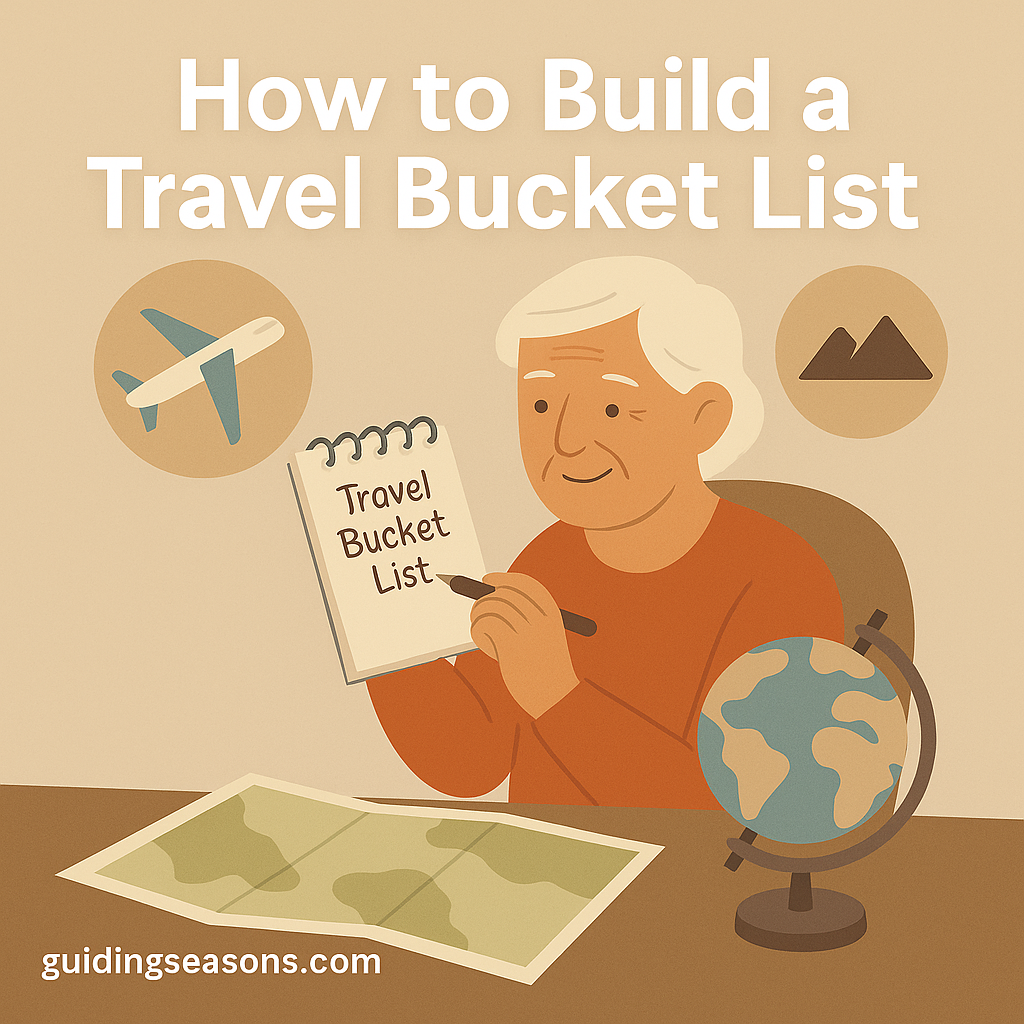
A travel bucket list is more than a collection of famous places you hope to visit someday.
At its best, it is a personal roadmap for experiences that matter to you.
Your list might include seeing the Grand Canyon at sunrise, taking a scenic train ride through the mountains, spending a quiet week near the ocean, visiting the town where your grandparents grew up, exploring a famous museum, or taking your grandchildren somewhere special.
There is no correct travel bucket list.
Some people dream about international adventures. Others would rather explore national parks, small towns, coastal roads, gardens, historical sites, or destinations within a few hours of home.
The important thing is that the list reflects your interests, abilities, budget, and priorities rather than someone else’s idea of what travel should look like.
And a good bucket list should eventually lead to action.
Here is how to create one that inspires you while still helping you turn those ideas into real trips.
Start With the Experiences You Want to Feel
Before writing down destinations, think about why you want to travel.
Ask yourself what kind of experience leaves you feeling happiest.
Do you want:
- Relaxation?
- Adventure?
- Nature?
- History?
- Culture?
- Food?
- Family connection?
- Personal reflection?
- Photography?
- Learning?
- Celebration?
Your answers can guide the destinations you choose.
For example, someone who enjoys peaceful landscapes might be happier visiting national parks, coastal towns, or mountain communities than spending a week rushing through crowded cities.
Someone fascinated by history might prioritize places such as historic districts, archaeological sites, museums, battlefields, or old European cities.
Someone who values family connection might build a bucket list around trips with children or grandchildren.
Start with the emotion and experience you want. The destination can come afterward.
Write Down Every Travel Idea That Interests You
Once you know what excites you, start brainstorming.
Do not worry about price, distance, mobility, or logistics yet.
Write down anything that sounds interesting.
Your list might include:
- National parks
- Beaches
- Historic cities
- Scenic drives
- Train journeys
- Cruises
- Small towns
- Gardens
- Museums
- Festivals
- Food destinations
- Wildlife experiences
- Road trips
- Family visits
- International destinations
The first version of your list is meant to capture possibilities.
You can make it realistic later.
You may end up with 10 ideas or 100.
That is fine.
Include Experiences, Not Just Places
A common mistake is creating a bucket list that consists only of destination names.
Instead of writing:
“Italy”
write:
“Spend a week in Tuscany, visit small towns, and enjoy local food.”
Instead of:
“New England”
write:
“Take a fall road trip through New England to see the leaves.”
Instead of:
“Alaska”
write:
“Take an Alaska cruise and see glaciers.”
The experience gives the destination meaning.
Other examples might include:
- Watch the sunrise over the Grand Canyon
- Ride a scenic train through the Rocky Mountains
- Attend a jazz festival in New Orleans
- See spring flowers in Washington, D.C.
- Visit a Christmas market in Europe
- Take a whale-watching trip
- See fall colors in Vermont
- Walk through a famous botanical garden
- Visit the hometown of an ancestor
- Take a grandchild on their first major vacation
These goals are easier to imagine and eventually easier to plan.
Think About What You Have Always Put Off
Some of the most meaningful bucket-list ideas are places you have talked about visiting for years.
Ask yourself:
- Where have I always said I wanted to go?
- What trip have I postponed repeatedly?
- What places fascinated me when I was younger?
- Is there somewhere my spouse, partner, or friend has always wanted to visit?
- Are there trips I assumed I would take “someday”?
Write those down.
“Someday” becomes much more useful when it turns into an actual list.
Add Personally Meaningful Trips
Not every important trip needs to involve a famous landmark.
Your bucket list can also include places connected to your own story.
Consider:
- Revisiting your childhood hometown
- Returning to where you went on your honeymoon
- Visiting relatives you rarely see
- Exploring your family’s ancestral region
- Taking a milestone birthday trip
- Celebrating an anniversary somewhere meaningful
- Traveling with your adult children
- Taking a grandchild on a special trip
These experiences can become more memorable than checking off a famous attraction.
Travel is often as much about people and memories as geography.
Create Different Categories
A long bucket list becomes much easier to manage when divided into categories.
For example:
Close to Home
Trips you could take within a few hours.
U.S. Destinations
Places requiring a longer domestic trip.
International Trips
Destinations outside the country.
Nature
National parks, scenic drives, wildlife, beaches, mountains, and gardens.
Culture and History
Museums, historic cities, architecture, festivals, and heritage sites.
Family Experiences
Trips with children, grandchildren, siblings, or friends.
Once-in-a-Lifetime Experiences
Trips requiring more money, time, or planning.
Organizing the list helps you realize that you do not need to wait for one enormous vacation.
You may have several achievable trips already sitting on your list.
Start With Local Adventures
Some people imagine a bucket list must include distant or exotic destinations.
It does not.
A nearby trip can still be meaningful.
Look within roughly 50 to 200 miles of home and ask what you have never explored.
Possibilities include:
- Historic neighborhoods
- State parks
- National monuments
- Beaches
- Scenic highways
- Museums
- Gardens
- Old towns
- Cultural districts
- Lakes
A local overnight trip can be an excellent first bucket-list experience.
It also gives you an opportunity to practice packing, transportation planning, and hotel selection before taking a larger trip.
Explore National Parks and Public Lands
National parks can provide hundreds of possible bucket-list ideas.
The National Park Service currently manages more than 400 park sites, ranging from famous national parks to historic sites, monuments, battlefields, recreation areas, and cultural locations. NPS recommends researching each site’s activities, reservations, fees, maps, operating information, and accessibility before visiting.
Instead of adding only the best-known parks, explore places that match your interests.
You might choose a park based on:
- Scenic drives
- Wildlife
- History
- Accessible trails
- Photography
- Birdwatching
- Waterfalls
- Desert landscapes
- Coastal scenery
The National Park Service also provides accessibility information and recommends contacting individual parks in advance if you need information about accommodations, mobility devices, accessible transportation, or other specific needs.
That makes it easier to choose experiences that fit your comfort level.
Consider Your Comfort and Mobility
Your bucket list should challenge you in enjoyable ways—not make travel unnecessarily difficult.
Think realistically about:
- Walking distance
- Stairs
- Uneven surfaces
- Elevators
- Transportation
- Heat
- Altitude
- Long travel days
- Luggage
- Rest requirements
This does not necessarily mean removing a destination.
It may simply mean experiencing it differently.
For example, someone who does not want to walk five miles through a historic city might choose:
- A guided vehicle tour
- Hop-on, hop-off transportation
- A centrally located hotel
- Shorter excursions
- Rest breaks
- Accessible attractions
A destination does not have to be experienced the way younger travelers or travel influencers experience it.
Design the trip around yourself.
Research Accessibility Before Ranking a Destination
If accessibility is important, investigate it during the bucket-list stage rather than after everything is booked.
Look for:
- Step-free hotel entrances
- Elevators
- Walk-in showers
- Accessible public transportation
- Wheelchair or scooter availability
- Accessible attractions
- Rest areas
- Tour operators that can accommodate mobility needs
Accessibility can vary even within the same destination.
A beautiful historic city may have cobblestone streets but also excellent transportation and accessible museums.
Research gives you a more accurate picture.
Match Destinations to the Best Season
Some bucket-list trips are strongly tied to timing.
Examples include:
- Cherry blossoms in spring
- National parks in mild weather
- Beaches during warm months
- Fall foliage
- Wildlife migrations
- Holiday markets
- Seasonal festivals
Create a “best time to go” note beside each major destination.
For example:
New England foliage trip — late September to October
European Christmas markets — November to December
Desert national parks — cooler months
This transforms a vague destination into something much easier to schedule.
Avoid Assuming Summer Is Always Best
Summer may have excellent weather in some places, but it can also mean:
- Higher prices
- Larger crowds
- Hotter temperatures
- Limited hotel availability
- Busy attractions
Spring and fall often provide pleasant weather with fewer visitors.
Retired travelers may have a major advantage here because they are less likely to be restricted by school calendars or limited vacation days.
Use that flexibility.
Create a “Sooner Rather Than Later” Category
Not all bucket-list trips have equal urgency.
Some experiences may become more difficult later because they involve:
- Significant walking
- Long flights
- High altitude
- Remote locations
- Extensive transportation
- Physical activity
This does not mean assuming your abilities will decline.
It simply means recognizing that certain trips require more energy than others.
If you have always wanted to take a physically demanding trip, you might move it higher on the list.
Meanwhile, a relaxing resort stay might remain enjoyable at almost any stage of life.
Separate Big Trips From Easy Trips
Your list should contain both.
For example:
Big Trips
- Two weeks in Italy
- Alaska cruise
- African safari
- Australia
- Cross-country train journey
Easy Trips
- Nearby coastal weekend
- National park road trip
- Historic town
- Museum weekend
- Visit to relatives
If every trip on your list costs $8,000, the list may feel impossible.
Including smaller adventures means you can keep traveling while saving for major experiences.
Assign a Rough Budget to Each Trip
You do not need precise prices yet.
Simply classify each idea.
For example:
$ — Under $500
Day trips, local weekends, visits with friends.
$$ — $500 to $2,000
Domestic trips, road trips, several hotel nights.
$$$ — $2,000 to $5,000
Longer domestic trips, cruises, some international vacations.
$$$$ — $5,000+
Extended international travel or premium experiences.
These are only examples, but assigning rough categories immediately makes the list more actionable.
Try the Five-Factor Bucket List Score
If you have dozens of ideas and cannot decide where to start, score each trip.
Give each category a score from 1 to 5:
- Excitement
- Personal meaning
- Affordability
- Ease of travel
- Urgency
The maximum score is 25 points.
For example:
Alaska Cruise
Excitement: 5
Personal meaning: 4
Affordability: 3
Ease: 4
Urgency: 4
Total: 20/25
Nearby Historic Town
Excitement: 3
Personal meaning: 3
Affordability: 5
Ease: 5
Urgency: 2
Total: 18/25
Both may be excellent options, but the scores help reveal why one deserves priority.
The scoring system is not meant to make the decision for you.
It simply forces you to think through what matters.
Pick Your Top Five Trips
Once you have a larger list, select five priorities.
Try including a mixture such as:
- One major dream trip
- One easy domestic trip
- One nature-focused trip
- One meaningful family trip
- One affordable local getaway
Now your bucket list becomes manageable.
Instead of thinking about 40 possibilities, you have five trips worth researching first.
Turn Your Number-One Trip Into a Real Plan
Choose the highest-priority trip and answer five questions.
Where?
Be specific.
Not “Europe.”
Perhaps “Rome and Florence.”
When?
Choose a season or approximate month.
For How Long?
Five days? Two weeks?
With Whom?
Solo, spouse, friend, family, or group tour?
Rough Budget?
Estimate transportation, lodging, food, activities, and insurance.
The moment those questions have answers, a dream begins turning into a trip.
Create a Simple Savings Target
Suppose your number-one trip is likely to cost $3,600 and you would like to travel in 18 months.
Divide:
$3,600 ÷ 18 months = $200 per month
Now the trip has a concrete financial plan.
If $200 monthly feels unrealistic, you can:
- Extend the timeline
- Choose a less expensive hotel
- Travel during shoulder season
- Reduce the trip length
- Use travel rewards
- Choose a less expensive destination first
Bucket lists become much more useful when financial planning is included.
Build a Travel Calendar
Once several trips have priorities, spread them across the next few years.
For example:
Year 1
- Spring: Local garden weekend
- Fall: New England road trip
Year 2
- Spring: National park trip
- Fall: European vacation
Year 3
- Summer: Alaska cruise
You are not committing yourself permanently.
The calendar simply helps you visualize how your plans might fit together.
Leave Rest Days in Bigger Trips
A bucket-list trip does not need to become an endurance test.
Instead of planning:
Day 1 — Fly
Day 2 — Museum
Day 3 — Tour
Day 4 — Train
Day 5 — Tour
Day 6 — Excursion
Day 7 — Fly home
build breathing room into the itinerary.
For a 10-day vacation, consider scheduling one or two lighter days with no major reservation.
Use those days to:
- Sleep later
- Visit a café
- Walk through a park
- Browse shops
- Sit by the water
- Rest at the hotel
Often those slower moments become some of the best memories.
Consider Slow Travel
Rather than visiting five destinations in seven days, consider staying longer in fewer places.
Slow travel can mean:
- Less packing
- Fewer train stations
- Less airport time
- Lower transportation expenses
- More rest
- More time to understand the destination
Three nights in each city may feel much more enjoyable than arriving and leaving every morning.
Your bucket list does not need to be a race.
Add People to the List
Some experiences matter because of who shares them with you.
Write names beside certain trips.
For example:
- Yellowstone — with grandchildren
- Italy — with spouse
- Baseball road trip — with brother
- Childhood hometown — with children
This turns vague wishes into meaningful goals.
It also encourages conversations.
The person you hope to travel with may have been dreaming about the same trip.
Create a “Maybe” List
You do not have to decide about everything.
Keep a secondary list for destinations that interest you but do not yet feel essential.
This might include places discovered through:
- Travel documentaries
- Books
- Friends
- Social media
- Travel blogs
- News stories
Over time, some will move onto your priority list.
Others will disappear.
That is perfectly normal.
Research International Trips More Carefully
International bucket-list destinations require an additional layer of planning.
Before committing, investigate:
- Passport requirements
- Visa requirements
- Local transportation
- Travel advisories
- Local laws
- Medical care
- Insurance
- Medication restrictions
- Language considerations
The U.S. Department of State recommends that international travelers review destination-specific Travel Advisories, entry and exit requirements, passport requirements, local laws, health information, and U.S. embassy information before traveling. It also encourages travelers to prepare copies of important documents and consider travel insurance.
You do not need to research all of this while brainstorming.
But once an international trip moves into your top five, these details should become part of the planning process.
Keep the List Somewhere You Will See It
Your travel bucket list should not disappear into a drawer.
Keep it:
- In a notebook
- On your computer
- In a phone note
- In a spreadsheet
- On a printed map
- On a bulletin board
You can even create columns for:
- Destination
- Experience
- Best season
- Approximate budget
- Priority
- Travel companion
- Status
For example:
Grand Canyon | Sunrise and scenic drives | Spring/Fall | $$ | High | Spouse | Researching
This makes the list feel like an active plan instead of a fantasy.
Celebrate Completed Trips
Do not simply cross off a destination and forget about it.
Add:
- Date visited
- Favorite memory
- Favorite photograph
- Favorite restaurant
- Something unexpected
Your bucket list gradually becomes a record of your travels.
Some destinations might even return to the list.
There is no rule saying you can visit a bucket-list destination only once.
Allow the List to Change
Your interests may change.
You might discover that you prefer train travel to flying.
You might decide crowded cities no longer appeal to you.
Perhaps your favorite trips become national parks, cruises, small towns, or longer stays in one place.
Update the list.
A travel bucket list should reflect the person you are now—not the traveler you imagined becoming 20 years ago.
Don’t Wait Until Everything Is Perfect
It is easy to postpone travel while waiting for:
- The perfect budget
- The perfect season
- Someone else to be available
- The perfect itinerary
- The perfect deal
Planning matters, but perfection is rarely necessary.
Start with something manageable.
If an international vacation is not realistic this year, take a weekend trip.
If you cannot spend $5,000, plan something wonderful for $500.
Every meaningful trip does not have to be “the trip of a lifetime.”
A lifetime of travel is made from many different experiences.
A Sample 10-Trip Bucket List
A balanced bucket list might look like this:
- Visit the Grand Canyon
- Take an Alaska cruise
- See New England fall foliage
- Spend a weekend in a nearby historic town
- Take a scenic train journey
- Visit Italy
- Take a grandchild to a national park
- See a famous botanical garden
- Return to a favorite childhood destination
- Spend a relaxing week near the ocean
Notice that the list includes expensive and inexpensive trips, domestic and international destinations, nature, family, relaxation, and personal meaning.
That makes the list much more achievable than filling it exclusively with expensive international destinations.
Final Thoughts
Building a travel bucket list is not about creating a competition to see how many countries you can visit.
It is about identifying experiences that would make your life richer.
Begin by dreaming freely.
Write down the places, people, landscapes, foods, cultures, and experiences that genuinely excite you.
Then organize the list.
Consider your comfort, mobility, budget, preferred seasons, travel companions, and how much time each trip requires.
Choose your top five.
Finally, take the most important trip on the list and give it a date, a rough budget, and a first planning step.
That is the difference between a wish and a goal.
Perhaps your list contains 30 destinations and you eventually visit only 15.
That does not make the list a failure.
Those 15 journeys could create hundreds of memories.
And your first bucket-list adventure does not have to be on another continent.
It might begin with a scenic road two hours from home, a national park you have never visited, or a town you have driven past for years.
What matters is not how far you travel.
It is choosing experiences that matter to you—and giving yourself the opportunity to actually experience them.