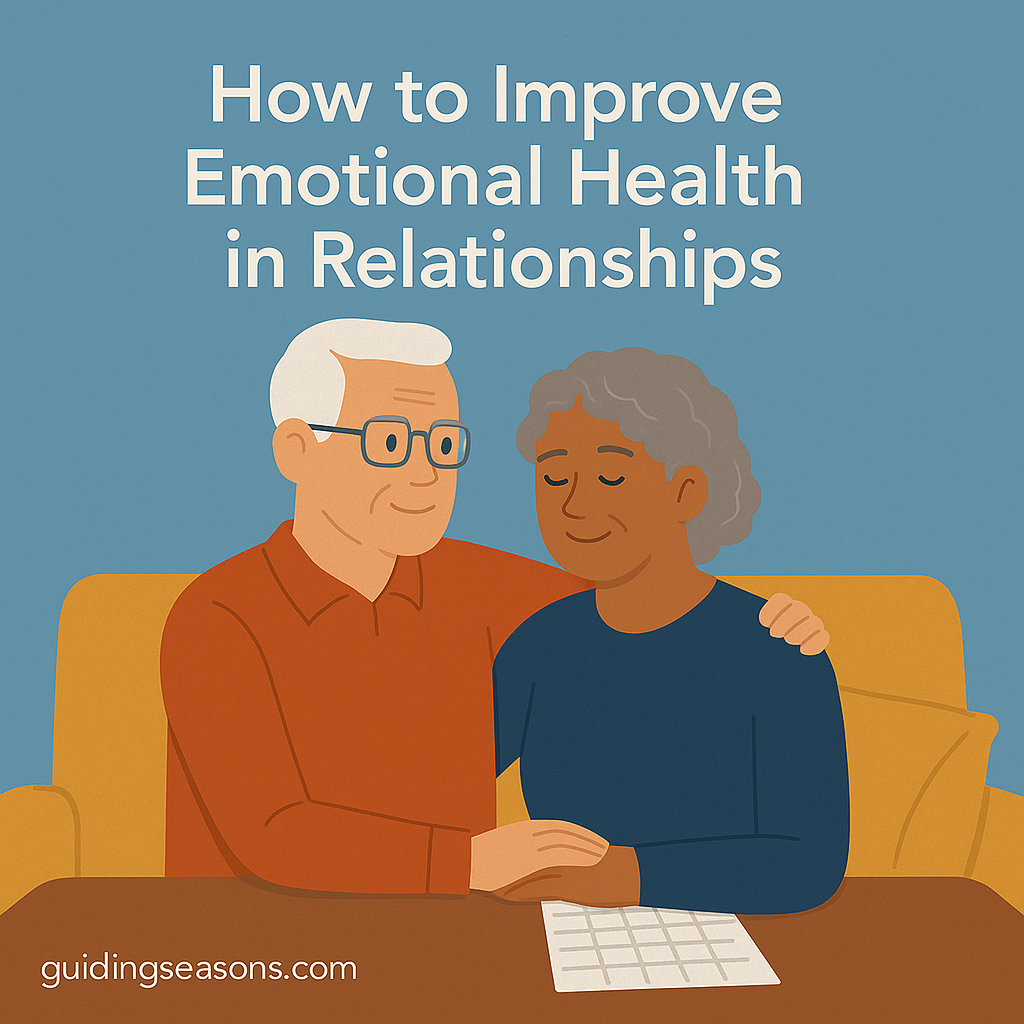
Healthy relationships can have a powerful influence on emotional well-being at every stage of life. Whether the relationship is with a spouse, partner, adult child, sibling, longtime friend, or another person you care about, feeling respected, understood, and supported can make everyday life more fulfilling.
Relationships, however, do not stay healthy automatically.
People change. Retirement can alter routines. Health challenges can create stress. Adult children may become busier with careers and families of their own. Friendships can shift after relocation or the loss of mutual friends. Couples who have spent decades together may suddenly find themselves spending much more time together after retirement.
These transitions can strengthen relationships, but they can also expose communication problems, unresolved resentments, or differences that were easier to overlook earlier in life.
Improving emotional health in relationships does not require perfection. It usually comes from smaller habits practiced consistently: listening carefully, expressing feelings honestly, respecting boundaries, showing appreciation, resolving conflicts constructively, and remaining willing to grow.
The goal is not to eliminate every disagreement or difficult emotion. Healthy relationships still experience frustration, sadness, disappointment, and conflict. Emotional health means learning how to handle those experiences while preserving respect and connection.
Understand What Emotional Health in a Relationship Means
Emotional health is more than simply feeling happy.
It includes the ability to recognize and manage emotions, communicate feelings appropriately, recover from difficult experiences, maintain supportive relationships, and adapt when circumstances change.
The Centers for Disease Control and Prevention (CDC) describes positive emotional well-being as the ability to manage emotions while maintaining a sense of meaning, purpose, and supportive relationships. The CDC also notes that emotional well-being can strengthen relationships, improve resilience, and help people manage stress and difficult life experiences.
Within a relationship, emotional health may look like this:
You can disagree without trying to hurt each other.
You can say when something is bothering you.
You can ask for support.
You can spend time apart without assuming something is wrong.
You can apologize when necessary.
You can enjoy each other’s company without pretending that everything is always perfect.
These habits create emotional safety — the sense that you can be yourself while still being treated with dignity and care.
Practice Honest but Compassionate Communication
Healthy relationships require honesty, but honesty should not become an excuse for harshness.
There is a difference between saying:
“You never care about what I want.”
and:
“I felt disappointed when the decision was made without including me.”
Both communicate frustration, but the second approach describes the experience rather than attacking the person.
Try expressing what happened, how you felt, and what you need.
For example:
“When our plans changed without anyone telling me, I felt left out. Next time, I’d appreciate a call.”
This provides the other person with information they can actually use.
The CDC recommends expressing emotions honestly and respectfully, maintaining a calm approach, and listening actively when communicating about difficult emotions.
Clear communication reduces the expectation that other people should somehow know what you are thinking.
Your spouse may not realize you need more quiet time.
Your adult child may not understand why canceled visits bother you.
A friend may not know that a joke hurt your feelings.
People cannot respond to needs they do not know exist.
Listen to Understand, Not Just to Respond
Listening is one of the strongest forms of emotional support.
Yet many conversations involve two people preparing their next response instead of actually listening to each other.
Try slowing down.
Let the other person finish.
Pay attention to both the words and the emotion behind them.
You might respond with:
“So you’re worried that we’re not spending enough time together?”
or:
“It sounds like you felt overlooked when that happened.”
This does not mean you agree with everything they say.
It means you have made an effort to understand their experience.
The American Psychological Association notes that constructive communication — including listening to a partner’s point of view and attempting to understand their feelings — is healthier than destructive conflict patterns such as yelling, personal criticism, or withdrawing from discussion.
Feeling heard can lower defensiveness and make difficult conversations much easier.
Give Relationships Your Full Attention
Modern life offers endless distractions.
Television, smartphones, notifications, household chores, and other responsibilities can make it possible to spend hours in the same room without having a meaningful interaction.
Create small periods of undivided attention.
Maybe you and your spouse have coffee together each morning without phones.
Perhaps you call an adult child every Sunday afternoon.
You might meet a close friend for a walk every Thursday.
The amount of time does not need to be enormous.
Imagine a couple spending just 15 uninterrupted minutes together each evening talking about something beyond errands, appointments, or household responsibilities.
Fifteen minutes a day adds up to more than 91 hours of focused conversation in one year.
Small routines can have a large cumulative effect.
The APA recommends that couples regularly make time to check in with each other and talk about deeper or more personal subjects rather than communicating only about practical responsibilities.
Learn to Identify Your Own Emotions
Communication becomes much easier when you understand what you are actually feeling.
Sometimes anger is the most obvious emotion, but something else may be underneath it.
You might be:
- Lonely
- Worried
- Embarrassed
- Disappointed
- Overwhelmed
- Hurt
- Afraid
- Unappreciated
Suppose your adult son cancels dinner at the last minute.
Your first reaction might be anger:
“He never respects my time.”
But after thinking about it, perhaps the deeper feeling is disappointment because you had been looking forward to seeing him all week.
Saying:
“I was disappointed because I was really looking forward to tonight”
is more likely to produce connection than:
“You never make time for me.”
The CDC recommends checking in with yourself and identifying difficult emotions as an important step in managing them effectively.
Understanding your emotional state gives you more choice in how you respond.
Set Healthy Boundaries
Healthy relationships require both closeness and individuality.
A boundary defines what you are comfortable with and what you are willing to do.
Boundaries may involve:
- How much time you can give
- Topics you prefer not to discuss
- Whether you are available to provide transportation
- How often you can help with grandchildren
- Financial assistance
- Privacy
- Personal space
- How you expect to be spoken to
For example:
“I love spending time with the grandchildren, but I can’t babysit every weekend.”
Or:
“I want to talk about this, but I don’t want us yelling at each other.”
Healthy boundaries are not threats.
They help prevent exhaustion and resentment.
Someone who repeatedly says yes to things they do not want to do may eventually become angry with the very people they were trying to please.
Clear boundaries make expectations easier to understand.
Respect Other People’s Boundaries Too
Boundaries work in both directions.
Your adult children may have boundaries around parenting decisions.
Your spouse may need time alone.
A friend may not want to discuss a private health issue.
Someone you love may occasionally decline an invitation.
Respecting these choices communicates trust.
Closeness does not require constant access to another person’s time or personal information.
Healthy relationships allow room for individuality.
Show Appreciation Regularly
Many relationships begin with frequent appreciation but gradually become more focused on routines and responsibilities.
People still need to know they are valued.
You might say:
“Thank you for making dinner.”
“I appreciate you driving me to that appointment.”
“I’m glad we’re friends.”
“You’ve always been someone I can count on.”
These statements may sound simple, but they can be powerful.
The CDC recommends expressing gratitude and spending meaningful time with family and friends as practical ways to strengthen social connection.
Try not to reserve appreciation only for birthdays or special occasions.
Notice ordinary kindness.
A spouse who makes coffee every morning, a friend who regularly checks in, or an adult child who helps with technology may have done these things so often that they become easy to overlook.
Familiarity should not make appreciation disappear.
Handle Conflict Without Attacking the Person
Conflict is normal.
Even strong relationships contain disagreement.
The goal is not to prevent every argument but to make sure disagreements do not become destructive.
Focus on the specific issue rather than someone’s character.
Instead of:
“You’re selfish.”
try:
“I wish you had asked me before making that decision.”
Avoid insults, name-calling, threats, and bringing up unrelated past mistakes.
The APA warns that destructive conflict behaviors — such as yelling, personal criticism, and withdrawing completely from discussion — can harm relationships. Constructive strategies are more likely to preserve connection.
Try asking:
“What could we do differently next time?”
That moves the conversation from blame toward problem-solving.
Take Breaks When Emotions Become Too Strong
Sometimes continuing a conversation immediately is not productive.
If voices are rising and neither person is listening, suggest a break.
You might say:
“I care about resolving this, but I think we’re both too upset right now. Can we come back to it later?”
A break should not become silent punishment.
Whenever possible, identify when you will return to the conversation.
For example:
“Let’s take 30 minutes and talk again after lunch.”
This reassures the other person that you are pausing the conflict rather than abandoning the relationship.
Offer Emotional Support Without Trying to Fix Everything
When someone you love is struggling, your instinct may be to solve the problem.
But emotional support does not always require solutions.
Sometimes the most helpful response is:
“I’m sorry you’re going through that.”
“I’m here.”
“Do you want advice, or would you rather I just listen?”
That last question can be particularly valuable.
A friend grieving the loss of a spouse may not need suggestions.
An adult child worried about work may simply need somewhere safe to express frustration.
Being present can be enough.
Supportive relationships can help people cope with difficult experiences and stress, which is one reason the CDC considers social connection important for health and well-being.
Make Quality Time Intentional
Relationships can gradually weaken when people rely only on accidental interaction.
Make connection part of your routine.
You might:
- Have breakfast together weekly
- Walk after dinner
- Call a friend every Friday
- Plan a monthly family meal
- Attend community events together
- Work on a shared hobby
- Take occasional day trips
Quality time does not have to involve expensive entertainment.
A 30-minute neighborhood walk can provide more conversation than sitting beside each other for two hours watching television.
Choose activities that allow interaction.
Maintain Interests Outside the Relationship
Emotional health also requires independence.
Your spouse or best friend cannot realistically meet every social and emotional need you have.
Maintain other sources of connection and purpose.
Continue hobbies.
See friends.
Volunteer.
Exercise.
Spend time with family.
Learn something new.
Strong relationships often involve two people who have both shared experiences and individual interests.
Independence can actually make time together more interesting because each person brings new experiences into the relationship.
Let Go of the Need to Win Every Disagreement
Not every difference requires a winner.
Perhaps you and your sibling disagree about politics.
You and your spouse prefer different travel styles.
Your adult child makes a decision you would not make yourself.
Ask whether agreement is truly necessary.
Sometimes the healthiest response is:
“I see it differently, but I understand that it’s your decision.”
Emotional maturity includes recognizing which issues deserve continued discussion and which differences can simply exist.
A relationship can survive disagreement when respect remains intact.
Address Resentment Before It Becomes Permanent
Unspoken frustration can accumulate.
Maybe you have felt unappreciated for months but never mentioned it.
Perhaps a friend’s repeated behavior bothers you, but you keep telling yourself it is not worth discussing.
Over time, small frustrations can become larger resentments.
When something matters, address it respectfully before anger has months or years to build.
Choose a calm moment and focus on the specific issue.
Avoid turning the discussion into a review of every mistake the person has ever made.
The purpose is repair, not punishment.
Apologize When Necessary
Everyone makes mistakes in relationships.
A sincere apology can help rebuild trust.
Instead of saying:
“I’m sorry if you were offended,”
try:
“I’m sorry I interrupted you and raised my voice. I should have handled that differently.”
A good apology takes responsibility without immediately adding an excuse.
If possible, explain what you will do differently next time.
Repairing mistakes is part of emotional health.
The strongest relationships are not necessarily those in which no one ever gets hurt. They are often relationships in which people know how to repair the connection afterward.
Practice Forgiveness Without Ignoring Harm
Forgiveness can help release resentment, but it should not be confused with tolerating harmful behavior.
You can forgive someone and still maintain boundaries.
You can accept an apology while expecting different behavior.
You can choose not to hold onto an old disagreement while still remembering what you learned from it.
Forgiveness is most useful when it allows you to move forward rather than repeatedly reliving the same hurt.
Some conflicts take longer to process than others.
Give yourself time.
Adapt as Relationships Change
Relationships evolve throughout life.
The relationship between a parent and an adult child should not look exactly like it did when the child was 15.
Friendships may change after retirement.
Marriage can change when one spouse develops health limitations.
People may become caregivers.
Grandchildren grow older.
Someone may move away.
Emotional health requires flexibility.
Ask:
“What does this relationship need now?”
Perhaps you cannot travel together anymore, but you can have weekly lunches.
Maybe an old friend lives across the country, so video calls become part of the friendship.
The format can change while the connection remains strong.
Recognize When Outside Help May Be Useful
Some problems are difficult to resolve without support.
Consider professional help when:
- The same conflict repeats constantly
- Communication has become hostile
- Trust has been seriously damaged
- Resentment is growing
- Grief is affecting the relationship
- Family caregiving creates intense tension
- You feel consistently anxious or emotionally exhausted
A counselor or therapist can help people understand patterns, improve communication, and develop healthier ways to respond to conflict.
Seeking help does not mean the relationship has failed.
Sometimes it simply provides tools that neither person was ever taught.
Create a Simple Emotional Health Routine
Improving a relationship does not always require dramatic change.
Try a simple weekly routine.
Once each week, ask someone close to you three questions:
“How have you been feeling?”
“Is there anything you need from me?”
“Is there something you’re looking forward to?”
Then listen.
You might also make one point of expressing appreciation.
A few intentional minutes each week can prevent important feelings from being overlooked.
Focus on Progress Rather Than Perfection
No relationship is emotionally healthy every minute of every day.
You will occasionally become impatient.
Someone will misunderstand you.
You may say something poorly.
Plans will change.
Disagreements will happen.
Do not judge the entire relationship by one difficult conversation.
Look instead at the overall pattern.
Do you generally respect each other?
Can you communicate honestly?
Can you apologize?
Can you enjoy time together?
Do both people feel that their needs matter?
Healthy relationships are not flawless relationships.
They are relationships that contain enough trust, respect, flexibility, and repair to continue growing.
Final Thoughts
Emotional health is one of the foundations of strong, lasting relationships.
It develops through everyday habits rather than one dramatic conversation.
Speak honestly but kindly. Listen carefully. Identify your emotions before reacting. Express appreciation. Create healthy boundaries. Make time for genuine connection and learn how to disagree without attacking the person you care about.
Remember that emotional support does not always require fixing a problem. Sometimes the greatest gift you can offer is your attention.
Relationships also need room to evolve.
The way you relate to a spouse, sibling, friend, or adult child may change as retirement, health, caregiving, relocation, and other life transitions reshape your circumstances.
Stay willing to adjust.
A fifteen-minute conversation, a sincere apology, a thoughtful phone call, or a simple “I appreciate you” may seem insignificant on its own. Repeated over months and years, however, these small moments create trust.
And trust creates stronger relationships.
You do not need perfect communication or a conflict-free life to have emotionally healthy relationships. You need people who are willing to listen, communicate, repair mistakes, respect one another, and continue making the relationship a priority.
Those small efforts can create something deeply valuable: relationships in which people feel heard, supported, respected, and genuinely connected.