Creative activities aren’t simply enjoyable ways to fill your free time. Painting a landscape, learning a song, taking photographs, dancing, writing a story, or making something with your hands can challenge you to observe, remember, coordinate movements, solve problems, and learn new skills.
These qualities can make creative hobbies particularly appealing as we get older.
The National Institute on Aging (NIA) recommends staying mentally and socially engaged as part of a broader approach to cognitive health. It notes that research involving activities such as music, theater, dance, creative writing, quilting, and digital photography has shown promising results, although the evidence that these activities produce lasting cognitive benefits is not yet definitive.
That’s an important distinction. Painting or playing the piano shouldn’t be viewed as a treatment or guaranteed way to prevent dementia. Instead, creative activities can be enjoyable, mentally stimulating parts of an active lifestyle.
The best activity is usually one that interests you enough to keep doing it.
Here are several creative arts worth exploring and simple ways to make them part of your routine.
Why Creative Arts Can Be Good for an Active Mind
Many creative activities combine several skills at the same time.
Consider painting a simple bowl of fruit.
You’re looking carefully at shapes and colors, deciding where objects belong on the page, controlling a brush, remembering techniques you’ve learned, mixing colors, and making decisions when something doesn’t look right.
Playing an instrument presents a different challenge. You may need to read music, remember notes, listen to pitch and rhythm, and coordinate your hands.
Photography encourages you to observe light, patterns, colors, and composition.
Writing requires you to retrieve words, organize thoughts, remember experiences, and create connections between ideas.
The NIA specifically points to research in which older adults learning cognitively demanding new skills, including quilting and digital photography, showed greater memory improvement than comparison groups engaged primarily in social or less demanding activities. At the same time, the agency cautions that researchers still need to learn more about the long-term cognitive effects of meaningful activities.
The lesson isn’t that one particular art form is a secret to brain health. It’s that continuing to learn, create, move, think, and interact with other people can be a valuable part of healthy aging.
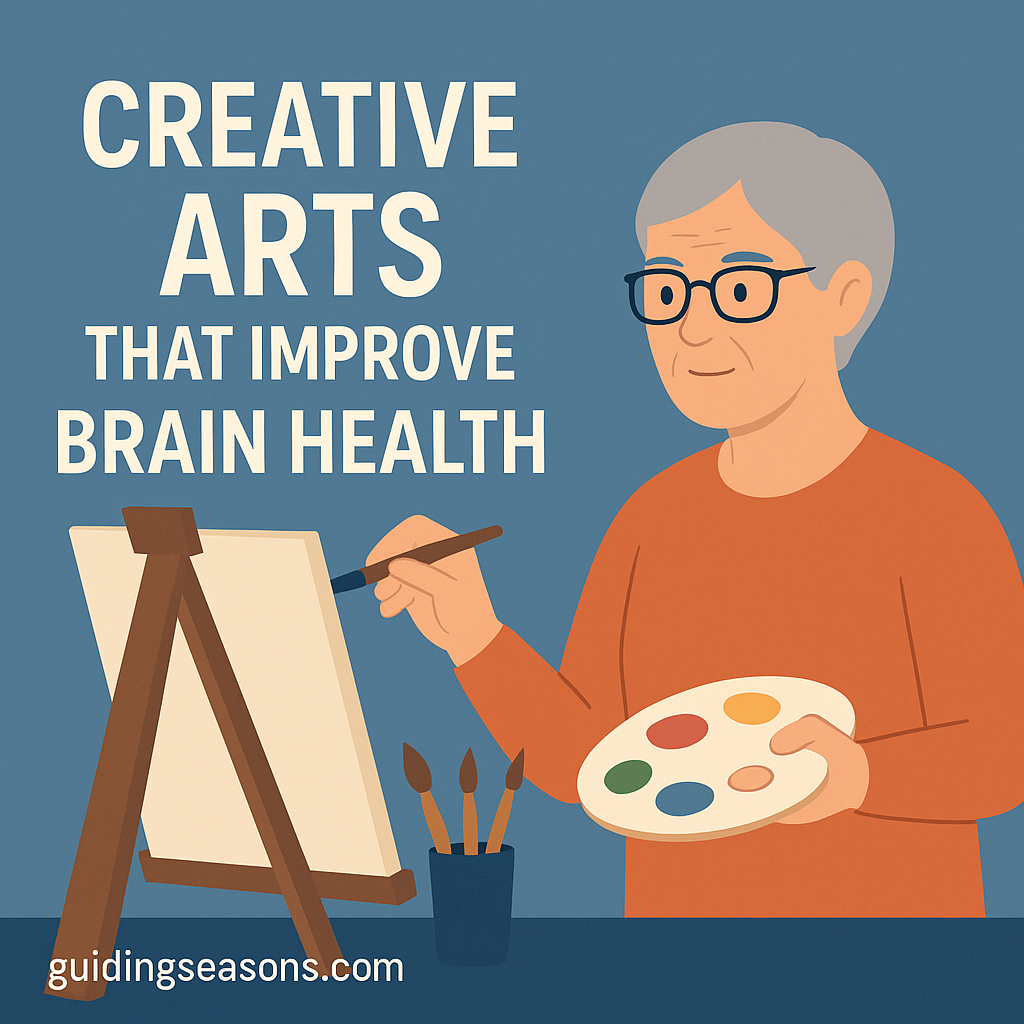
Painting and Drawing
Painting and drawing are excellent options because they can be adapted to nearly any experience level.
You don’t need to produce realistic portraits or complicated landscapes.
Simply sketching objects around your home requires you to slow down and observe details.
You might suddenly notice that an apple isn’t simply red. One side may be bright red or yellow where sunlight reaches it, while the opposite side contains dark red, brown, or purple tones.
That process encourages careful observation.
Potential Benefits
Painting and drawing can encourage:
- Concentration
- Visual observation
- Hand-eye coordination
- Creative problem-solving
- Self-expression
- Relaxation
Simple Ways to Begin
Start with:
- A sketchbook and pencil
- Colored pencils
- Watercolors
- Acrylic paints
- Adult beginner art classes
Try a 15-minute sketch challenge.
Choose one ordinary household object—a coffee mug, plant, shoe, or piece of fruit—and spend 15 minutes drawing it.
Don’t erase constantly or worry about whether it looks perfect.
The exercise is about learning to observe.
Music and Instrument Playing
Music provides many different ways to participate creatively.
You can sing, play an instrument, learn rhythm, join a choir, or simply begin studying music for the first time.
If you’ve always wanted to play piano, guitar, ukulele, or another instrument, getting older doesn’t mean you’ve missed your opportunity.
The NIA emphasizes that older adults can continue learning new things, forming memories, and improving their performance in new skills.
Music Can Challenge You to Use
- Memory
- Attention
- Listening
- Timing
- Hand coordination
- Pattern recognition
You don’t have to become an accomplished musician to enjoy those challenges.
Start with something manageable.
Learn three basic chords on a ukulele.
Practice a simple melody on a keyboard.
Join a community choir.
Spend 15 minutes learning a favorite song.
Interestingly, an NIA-supported study involving nearly 400 adults age 60 and older examined participation in community choirs. After six months, choir participants reported reduced loneliness and increased interest in life, although researchers did not find significant changes in cognition or physical function.
That’s a useful example of why creative activities shouldn’t be oversold as medical interventions. Sometimes their most meaningful benefits may involve enjoyment, social connection, confidence, and having something to look forward to.
Dancing
Dance combines creativity with physical movement.
You have to listen to music, recognize rhythm, remember movements, coordinate your body, and sometimes respond to a partner.
There are also many different styles, including:
- Ballroom
- Line dancing
- Salsa
- Folk dancing
- Low-impact dance
- Chair-based dance
- Simple movement-to-music classes
Beginners don’t need to memorize complicated routines.
Start with basic movements and build gradually.
A group class adds another valuable element: social interaction.
If mobility or balance is a concern, choose an activity appropriate for your abilities and consider speaking with a healthcare professional before beginning a more demanding physical program.
The goal isn’t an exhausting workout. It’s finding a safe form of movement you enjoy enough to continue.
Writing and Journaling
Creative writing requires almost no equipment.
A notebook and pen are enough.
Writing encourages you to retrieve memories, organize thoughts, choose words, build stories, and express ideas.
You could try:
- Journaling
- Poetry
- Short stories
- Memoir writing
- Letters
- Family histories
- Travel journals
One particularly meaningful project for older adults is recording personal memories.
For example, choose one memory every Sunday and write 500 words about it.
Write about your first job.
Describe the neighborhood where you grew up.
Record a family holiday tradition.
Tell the story of how you met an important person in your life.
After one year, 52 weekly entries could become a substantial personal collection that can be shared with children or grandchildren.
You don’t have to consider yourself a writer.
Write naturally, as though you’re telling the story to someone sitting across the table.
Photography
Photography is an especially accessible creative activity because you probably already own the equipment you need.
A smartphone is enough to begin.
Photography encourages you to look more carefully at:
- Light
- Color
- Shapes
- Patterns
- People
- Architecture
- Nature
- Everyday details
Instead of walking through a park without thinking about your surroundings, give yourself a photography assignment.
Try finding five interesting shadows.
Photograph three different flowers.
Look for reflections.
Take pictures of unusual doors.
Choose one color and photograph every interesting example you encounter.
This turns an ordinary walk into a creative exercise.
Digital photography is also notable because the NIA has highlighted research in which older adults learning photography and quilting showed memory improvements, illustrating the potential value of learning challenging new skills.
Crafting and DIY Projects
Hands-on projects can combine creativity with planning and problem-solving.
Possibilities include:
- Knitting
- Crocheting
- Scrapbooking
- Card-making
- Sewing
- Model building
- Pottery
- Woodworking
- Jewelry making
Each hobby presents different challenges.
Knitting, for example, involves patterns, counting, repetition, and hand movements.
Woodworking may require measurement, planning, spatial reasoning, and problem-solving.
Scrapbooking combines photographs, memories, design, and storytelling.
Choose something that matches your interests and physical comfort.
If detailed hand movements become tiring, work for shorter periods or choose projects with larger materials and tools that are easier to handle.
Theater and Acting
Acting might seem intimidating if you’ve never performed before, but community theater can offer much more than standing on a stage in front of hundreds of people.
You can explore:
- Acting classes
- Improvisation
- Script reading
- Community theater
- Readers’ theater
- Storytelling groups
Theater combines language, memory, listening, emotional expression, imagination, and social interaction.
Improvisation adds another challenge because you need to respond to unexpected situations rather than simply memorize a script.
The NIA has supported research exploring theater programs for older adults, including programs designed around improvisation, social interaction, and quality of life. Research across theater and other participatory arts remains an active area of study.
If performing sounds intimidating, begin with a script-reading group where participants read characters aloud without memorizing lines.
Coloring for Relaxation
Not every creative activity needs to be challenging.
Sometimes you may want something simple and quiet.
Adult coloring offers a low-pressure way to experiment with color and pattern without worrying about drawing something from scratch.
Try:
- Nature-themed coloring books
- Geometric designs
- Mandalas
- Landscapes
- Colored pencils
- Markers
- Gel pens
You can listen to music or an audiobook while coloring and simply enjoy the process.
Think of coloring primarily as a pleasant creative activity rather than a treatment for anxiety, memory loss, or other health conditions.
Try Combining Creativity With Social Connection
Creative hobbies can become even more meaningful when they’re shared.
Instead of painting alone every time, attend an occasional art class.
Instead of practicing music entirely at home, consider joining a choir.
Instead of keeping every photograph on your phone, join a photography group or take photo walks with a friend.
Possible places to explore include:
- Senior centers
- Community colleges
- Libraries
- Recreation centers
- Museums
- Art associations
- Community theaters
- Photography clubs
- Choirs
- Dance groups
The social component matters because staying connected is another part of healthy aging. The NIA notes that social engagement and meaningful activities may support cognitive health and help reduce isolation.
Creative hobbies can therefore provide two forms of engagement at once: something interesting to learn and people with whom to share it.
Don’t Feel That You Have to Be Talented
One of the biggest barriers to creative hobbies is the belief that creativity belongs to talented people.
It doesn’t.
You don’t need to paint well to enjoy painting.
You don’t need a beautiful singing voice to enjoy music.
You don’t need to publish a novel to enjoy writing.
The objective is participation.
Being a beginner can actually be part of what makes a new hobby mentally engaging. You have to pay attention, make mistakes, remember instructions, experiment, and gradually improve.
Instead of asking:
“Am I good at this?”
Try asking:
“What did I learn today?”
That question makes creativity much more enjoyable.
Create a Simple Weekly Creative Routine
You don’t need to spend several hours every day on creative activities.
Start with a manageable schedule.
For example:
Monday: 20 minutes of drawing
Wednesday: 20 minutes of keyboard practice
Friday: 30-minute photography walk
Sunday: Write one page about a favorite memory
That’s 90 minutes of intentional creative activity per week.
Over one year, that schedule would add up to roughly 78 hours of creative practice.
More importantly, it gives you variety.
Some activities challenge your hands. Others involve movement, observation, memory, language, or listening.
If 90 minutes feels like too much, begin with one activity.
Consistency matters more than creating an ambitious schedule you won’t enjoy.
Choose Activities That Challenge You Without Frustrating You
A creative hobby should require some thought without becoming a constant source of stress.
If watercolor painting feels too difficult, simplify the project.
If learning an entire piano piece is overwhelming, learn four measures.
If writing a short story seems intimidating, write one paragraph.
If an hour-long dance class leaves you exhausted, try a shorter or gentler session.
Gradually increase the challenge as your confidence improves.
The goal is to find the space between boredom and frustration—something interesting enough to hold your attention but manageable enough that you’ll want to return tomorrow.
Creative Arts Are One Part of Healthy Aging
It’s important to keep creative hobbies in perspective.
No individual activity has been proven to guarantee protection against dementia or age-related cognitive decline.
Brain health is influenced by many factors.
The NIA describes cognitive health as the ability to think, learn, and remember clearly and emphasizes a broader approach that includes physical activity, managing health conditions, getting enough sleep, eating a healthy diet, staying socially connected, and keeping the mind engaged.
Creative arts can fit naturally into that larger picture.
The National Endowment for the Arts has likewise studied the relationship between arts participation and health among older Americans. Its analyses have found associations between arts participation and positive health characteristics, while researchers continue working to understand the causes and long-term effects of those relationships.
In other words, paint because you enjoy painting.
Dance because you love music and movement.
Write because you have stories to tell.
Take photographs because they encourage you to notice the world around you.
Any cognitive or emotional benefits can be viewed as additional reasons to maintain an active, creative life.
Final Thoughts
Creative arts offer something valuable at every stage of life: the opportunity to keep learning.
Painting challenges you to observe.
Music challenges you to listen and coordinate.
Dance combines movement with rhythm and memory.
Writing gives you a way to organize thoughts and preserve experiences.
Photography encourages you to notice details.
Crafting requires planning and problem-solving.
Theater invites imagination and social interaction.
You don’t need to do all of them.
Choose one activity that genuinely interests you and start small. Spend 15 or 20 minutes drawing, learn a few notes on a keyboard, photograph your neighborhood, write a page about an old memory, or sign up for a beginner dance class.
Give yourself permission to be inexperienced.
Over time, you may improve your skills, meet new people, create things you’re proud of, and discover interests you didn’t know you had.
Creative hobbies aren’t about producing perfect art. They’re about remaining curious, engaged, expressive, and willing to learn.
And those are worthwhile qualities to nurture at any age.