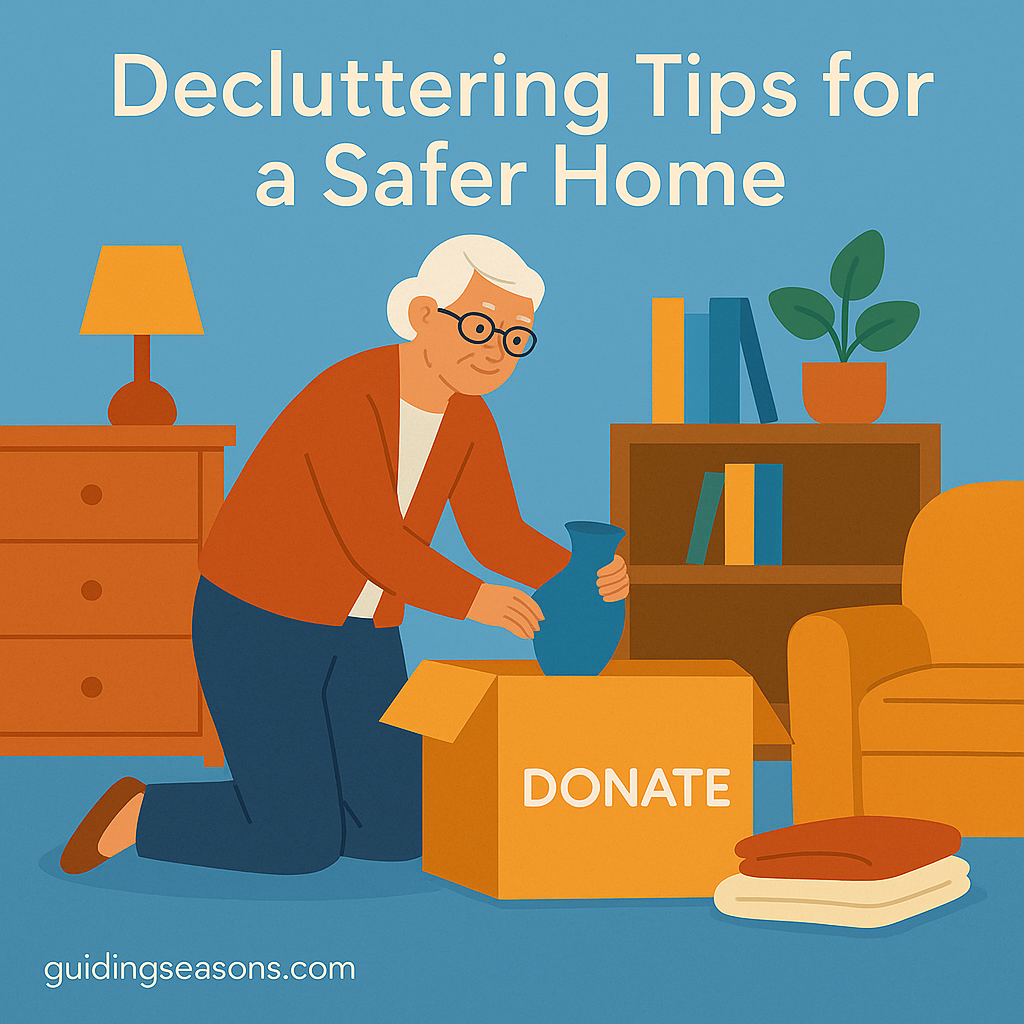
A clutter-free home is about much more than appearance. As we get older, having clear floors, easy-to-reach belongings, and well-organized living spaces can make everyday activities safer and more comfortable.
Items that once seemed harmless—a stack of magazines beside a chair, shoes near the doorway, an extension cord running across the floor, or a small table in a hallway—can gradually become obstacles. Clutter can make it harder to move around with confidence, especially for someone who uses a cane, walker, or other mobility aid.
Home hazards such as clutter and throw rugs are among the factors that can contribute to falls in older adults, according to the Centers for Disease Control and Prevention (CDC). The CDC recommends removing tripping hazards and keeping floors clear as part of making the home safer.
The goal, however, is not to create a perfectly empty house. Your home should still feel comfortable, familiar, and personal.
Instead, focus on removing obstacles, organizing the things you use, and making important areas easier to navigate.
Here are practical decluttering strategies for creating a safer and more enjoyable home.
Start With Small, Manageable Areas
One of the biggest mistakes people make when decluttering is trying to tackle an entire house at once.
Looking at decades of belongings can quickly become overwhelming.
Start much smaller.
Choose one:
- Drawer
- Shelf
- Kitchen counter
- Bedside table
- Bathroom cabinet
- Entryway
- Small section of a closet
Completing one small area provides a sense of progress without exhausting you.
For example, instead of deciding, “I’m going to clean the entire kitchen today,” start with the counter beside the refrigerator.
Remove everything from that small area, decide what belongs there, and put only those items back.
Once that area is finished, stop if you want.
Decluttering does not have to be a marathon.
Put Safety Before Appearance
When deciding where to begin, prioritize anything that could interfere with walking.
Take a slow walk through your home and look at the floor rather than the shelves.
Pay attention to:
- Electrical cords
- Shoes
- Bags
- Newspapers
- Boxes
- Pet toys
- Small stools
- Loose rugs
- Low furniture
Ask yourself a simple question:
Could I accidentally step on, trip over, or bump into this item while walking through the room?
If the answer is yes, deal with that item first.
The National Institute on Aging’s home-safety guidance specifically identifies clutter as something that can increase the risk of falling and recommends periodically reevaluating the home as a person’s needs change.
Safety-related decluttering usually offers the greatest immediate benefit.
Create Clear Walking Paths
One of the most useful goals when decluttering is establishing an obvious walking route through every room.
You should be able to move easily:
- From the bed to the bathroom
- From the bedroom to the hallway
- From the living room to the kitchen
- From the front door into the home
- Around frequently used furniture
Avoid requiring yourself to weave between chairs, step around boxes, or squeeze past decorative furniture.
Imagine that your bedroom door is only about 12 feet from your bed.
If that short route includes a laundry basket, a pair of shoes, a small stool, and an electrical cord, you encounter four separate obstacles in just 12 feet.
Moving those four items may take only a few minutes, yet it immediately creates a safer nighttime route.
That is the kind of improvement worth prioritizing.
Remove or Secure Loose Rugs
Area rugs can make a room attractive and comfortable, but unsecured rugs can also create tripping or slipping hazards.
The CDC recommends removing throw rugs or securing them so they do not slide.
Walk around your home and examine each rug.
Ask:
- Does it slide when stepped on?
- Are the corners curling upward?
- Is the edge difficult to see?
- Does a walker or cane catch on it?
- Do I actually need this rug?
Removing unnecessary rugs is often the simplest option.
If you want to keep one, use an appropriate non-slip backing or other secure method suitable for the floor and rug.
Pay particular attention to rugs near beds, bathrooms, kitchens, doorways, and hallways.
Keep Electrical Cords Away From Walking Areas
Lamp cords, charging cables, extension cords, and telephone wires often gradually creep into walking paths.
Whenever possible, route cords along walls rather than across floors.
If you regularly rely on an extension cord because an outlet is inconveniently located, consider whether a qualified electrician could install an additional outlet.
Avoid hiding electrical cords underneath rugs, which can create other safety concerns.
Phone and tablet charging cables can also become nighttime obstacles. A small charging station on a bedside table can keep cables organized and reduce the chance of them ending up across the floor.
Use Three Simple Decluttering Categories
Too many sorting categories can make decisions unnecessarily complicated.
For most household items, start with just three:
- Keep
- Donate or give away
- Discard or recycle
If necessary, add a fourth temporary category for items you genuinely need time to think about.
Try not to create a huge “maybe” pile. That simply moves clutter from one location to another.
When evaluating an item, ask:
- Do I use this?
- Do I need it?
- Is it important to me?
- Would someone else benefit from it?
- Is it broken or expired?
There is no need to get rid of meaningful possessions just because you are decluttering.
The objective is to distinguish belongings that contribute something to your life from objects that simply occupy space.
Reduce Duplicates
Duplicates are one of the easiest places to make progress because letting go of extras often requires less emotional decision-making.
Check for duplicate:
- Kitchen utensils
- Coffee mugs
- Towels
- Blankets
- Cleaning supplies
- Storage containers
- Tools
- Electronics
- Chargers
For example, if you regularly use four coffee mugs but own 20, consider keeping your favorites and donating some of the extras.
The same idea applies to kitchen tools. If you own three can openers but consistently use only one, keeping all three may not be necessary.
Reducing duplicates creates more storage space for items you actually use.
Simplify Furniture Layouts
Decluttering is not limited to small belongings.
Furniture can create obstacles too.
Look around each room and ask whether every table, chair, footstool, plant stand, or decorative piece still serves a useful purpose.
Small furniture is especially important to evaluate because it may be difficult to see in dim lighting.
Consider removing or repositioning:
- Small side tables
- Decorative stools
- Floor lamps in walking paths
- Plant stands
- Unused chairs
- Footstools
The room does not need to look empty.
The objective is to create straightforward walking routes and reduce unnecessary obstacles.
If you use a walker or other mobility device, make sure furniture placement provides enough room to turn comfortably.
Declutter the Bedroom With Nighttime Safety in Mind
The bedroom deserves special attention because people often move around it while sleepy or in low light.
Keep the route between your bed, doorway, bathroom, and light switch as clear as possible.
Avoid leaving:
- Shoes beside the bed
- Clothing on the floor
- Laundry baskets in walking paths
- Books stacked beside the bed
- Charging cables across the floor
Keep important nighttime items in a consistent location.
A bedside table might contain:
- Phone
- Glasses
- Water
- Flashlight
- Necessary medications
- Remote controls
Using one designated location makes important belongings easier to find without creating clutter throughout the room.
Make the Bathroom Simple and Uncluttered
Bathrooms often have limited floor space, so unnecessary objects can quickly interfere with movement.
Keep the bathroom floor as clear as possible.
Store personal-care products in cabinets, shelves, or organizers rather than along the floor.
Remove empty containers and products you no longer use.
Check under the sink for old:
- Toiletries
- Cleaning products
- Cosmetics
- Towels
- Containers
Frequently used items should be easy to access without excessive bending or reaching.
Avoid placing baskets or decorative objects where someone could accidentally step into them while entering or leaving the shower.
Organize the Kitchen Around What You Actually Use
Kitchen cabinets can accumulate an impressive amount of unused equipment over the years.
Start by identifying the items you use most frequently.
These might include:
- Favorite pots and pans
- Everyday plates
- Coffee cups
- Cooking utensils
- Common ingredients
Store these items within comfortable reach.
Items that have not been used for years can be evaluated separately.
You may discover:
- Broken appliances
- Duplicate utensils
- Expired food
- Storage containers without lids
- Lids without containers
- Dishes you rarely use
Reducing these items can make the kitchen considerably easier to manage.
Review Papers and Mail Regularly
Paper clutter can accumulate surprisingly quickly.
Mail, newspapers, catalogs, receipts, and appointment reminders frequently end up on counters and dining tables.
Create one location for incoming mail.
When possible, sort it shortly after it arrives.
You might divide it into:
- Action needed
- File
- Recycle or shred
Dispose of obvious junk mail immediately.
Important financial, legal, tax, insurance, or medical records may need to be retained, so do not discard documents simply because they are old. When uncertain, check appropriate record-retention guidance or consult the relevant professional.
The objective is to prevent everyday mail from becoming stacks that gradually spread across the home.
Review Expired and Unnecessary Items
Some household clutter should be reviewed because it may no longer be safe or useful.
Periodically check:
- Pantry foods
- Refrigerator contents
- Personal-care products
- Household supplies
- Batteries
- Broken appliances
Medications deserve special care.
Do not simply throw prescription drugs into household trash or flush them unless the product instructions or official disposal guidance specifically directs you to do so. Drug take-back programs and other approved disposal methods may be available in your community.
Keep current medications clearly organized and separate from products that need proper disposal.
Put Frequently Used Items Within Easy Reach
A well-organized home should reduce unnecessary bending, reaching, and climbing.
Frequently used objects are generally more convenient when stored between comfortable waist and shoulder height.
That might include:
- Everyday dishes
- Towels
- Clothing
- Toiletries
- Cleaning supplies
- Pantry staples
Avoid storing commonly used items on very high shelves if accessing them requires a step stool.
Similarly, avoid putting everything into low cabinets if reaching the floor is difficult.
Decluttering often creates enough storage space to relocate important items to more convenient locations.
Use Storage That Is Easy to Understand
Storage systems should make your life easier, not create a complicated organizational project.
Simple solutions often work best.
Consider:
- Clear containers
- Large labels
- Drawer organizers
- Open baskets
- Shelf dividers
- Hooks
- Easy-to-open containers
Clear containers can be particularly useful because you can see what is inside without opening every box.
Avoid creating so many categories that putting things away becomes inconvenient.
If you use something every day, its storage location should be quick and easy to access.
Try a 20-Minute Decluttering Session
Long cleaning sessions can be tiring.
Instead, try setting aside 20 minutes for one specific area.
For example:
First 5 minutes: Remove obvious trash and recycling.
Next 5 minutes: Pick up objects from the floor.
Next 5 minutes: Put items that belong elsewhere into a basket.
Final 5 minutes: Organize the remaining items.
Then stop.
You can carry the basket to the appropriate rooms afterward or handle it during your next session.
Using a short, defined period makes the job feel manageable and reduces the temptation to pull everything out at once.
Three 20-minute sessions during a week add up to a full hour of focused decluttering without requiring an exhausting afternoon.
Be Careful With Heavy or Hard-to-Reach Items
Decluttering itself should not create a new safety problem.
Avoid climbing onto chairs, carrying heavy boxes down stairs, or stretching into high cabinets if doing so feels unsafe.
Ask for help with:
- Heavy furniture
- Attic storage
- High shelves
- Large boxes
- Garage storage
- Items on stairs
- Furniture rearrangement
There is no benefit in preventing future accidents if the decluttering process itself puts you at risk.
Ask for Help Without Giving Up Control
Decluttering can be emotionally demanding because belongings often represent memories, family history, hobbies, or important periods of life.
A trusted helper can make the physical work easier while allowing you to remain in control of decisions.
Possible helpers include:
- Family members
- Friends
- Professional organizers
- Community organizations
- Senior-support services
Be clear about what kind of help you want.
You might ask someone to carry boxes or move furniture without asking them to decide what should be discarded.
You should remain comfortable with what leaves your home.
Focus on High-Traffic Areas First
Some parts of the home matter more for everyday safety than others.
Prioritize areas you use repeatedly, such as:
- Entryways
- Hallways
- Bedroom pathways
- Bathrooms
- Kitchens
- Stairways
- Living-room walkways
Decluttering a storage room that you enter twice a year may be less urgent than clearing the hallway you walk through ten times every day.
Think about frequency.
The spaces you travel through most often usually deserve attention first.
Maintain Your Progress With Small Habits
Decluttering works best when it becomes an ongoing habit rather than a once-a-year project.
Try a few simple routines:
- Put shoes in the same location.
- Deal with mail when it arrives.
- Return items after using them.
- Keep walkways clear.
- Spend a few minutes tidying surfaces each evening.
- Do a weekly safety walkthrough.
You can also adopt a simple rule: when a new item enters the home, consider whether an older item in the same category can leave.
This does not need to be rigid. It is simply a way to prevent storage spaces from gradually filling again.
A Simple Room-by-Room Safety Check
Every few months, take another walk through the home.
Entryway
Check for:
- Shoes
- Packages
- Bags
- Loose mats
Living room
Check for:
- Furniture blocking pathways
- Electrical cords
- Unstable tables
- Stacks of newspapers
Kitchen
Check for:
- Objects on the floor
- Crowded counters
- Expired food
- Frequently used items stored too high
Bedroom
Check for:
- Clothing on the floor
- Shoes beside the bed
- Blocked pathways
- Charging cables
Bathroom
Check for:
- Slippery or unsecured mats
- Unnecessary floor storage
- Crowded counters
- Difficult-to-reach essentials
Hallways and stairs
Check for:
- Boxes
- Shoes
- Decorative objects
- Poor lighting
- Loose rugs
You do not need to correct everything at once. Use the walkthrough to identify your next few priorities.
Final Thoughts
Decluttering for safety is not about throwing away everything you have accumulated or transforming your home into an empty space.
It is about making the home easier to live in.
Start with the areas that have the greatest effect on everyday safety: floors, walkways, stairs, bedrooms, bathrooms, and frequently used living spaces.
Remove tripping hazards. Secure or eliminate loose rugs. Move cords away from walking paths. Simplify furniture arrangements. Keep frequently used objects within comfortable reach.
Then work gradually through less urgent areas.
A single drawer today, one countertop tomorrow, and a hallway later in the week can eventually make a significant difference.
Most importantly, move at a pace that feels manageable. Your home should contain the belongings and memories that matter to you while still providing clear, comfortable space for everyday life.
A safer home does not have to be a perfect home. It simply needs to make moving, reaching, relaxing, and living a little easier.