Good lighting does much more than make a home look inviting. It can help you see obstacles, judge steps and changes in floor level, complete everyday tasks more comfortably, and move through your home with greater confidence.
Lighting becomes especially important as we get older. Changes in eyesight can make it harder to adjust between bright and dark spaces, notice objects with low contrast, or see clearly in dim rooms. A hallway that once seemed bright enough may gradually become harder to navigate, particularly at night.
That matters because poor visibility can contribute to falls and other household accidents. The Centers for Disease Control and Prevention (CDC) specifically recommends making homes brighter with additional lighting or brighter bulbs as part of older-adult fall prevention. It also recommends good lighting in rooms and hallways, along with easily accessible switches or motion-sensor lights.
Fortunately, improving home lighting does not require replacing every fixture or undertaking a major renovation.
Small changes—such as adding a bedside lamp, replacing a dim bulb, installing motion-activated nightlights, or improving stairway illumination—can make everyday movement much easier.
Here is how to create a brighter, safer, and more comfortable home.
Start With a Lighting Safety Walkthrough
Before buying new bulbs or fixtures, walk through your home and pay attention to how each space looks at different times of day.
Check your home:
- During daylight
- Around sunset
- After dark
- With only the lights you normally use
Look for areas that feel:
- Dim
- Shadowy
- Unevenly lit
- Too bright or glaring
- Difficult to navigate
- Hard to enter before finding a switch
Pay particular attention to the routes you use most often.
These may include:
- Bedroom to bathroom
- Living room to kitchen
- Front door to living room
- Hallways
- Stairways
- Garage to house
- Porch to driveway
The National Institute on Aging recommends checking the home room by room and correcting immediate safety concerns such as poor lighting and loose stair railings first.
A simple lighting walkthrough can reveal problems that are easy to overlook during the day.
For example, you may discover that the bedroom itself is well lit, but the five-step walk from the bed to the hallway is almost completely dark at night.
Increase Lighting in High-Traffic Areas
Start improvements where you spend the most time and where you move most frequently.
High-priority areas often include:
- Hallways
- Entryways
- Living rooms
- Bedrooms
- Kitchens
- Bathrooms
- Stairs
The goal is not simply to make every room as bright as possible.
Instead, aim for lighting that is consistent enough that your eyes do not have to constantly adjust between a brightly illuminated room and a very dark hallway.
For example, imagine leaving a brightly lit kitchen at 8:30 p.m. and stepping into a hallway that has only one weak bulb at the far end. For a few seconds, obstacles such as a pair of shoes or a small table may be more difficult to see.
Adding a second light or brighter bulb to the hallway may create a smoother visual transition.
Consistency can be just as important as overall brightness.
Add Task Lighting Where You Need It
A single ceiling fixture may provide general illumination, but it may not provide enough light for specific activities.
Task lighting focuses light exactly where you need it.
Good places for task lighting include:
- Reading chairs
- Kitchen counters
- Desks
- Hobby tables
- Sewing areas
- Bathroom mirrors
- Workbenches
- Bedside tables
For example, if you regularly read in one chair, position a lamp nearby rather than depending entirely on the room’s ceiling fixture.
In the kitchen, under-cabinet lighting can help illuminate counters where you prepare food.
Bathroom mirror lighting can make grooming tasks easier to see without requiring the entire room to be extremely bright.
Task lighting is particularly useful because it allows you to improve visibility without flooding an entire room with intense light.
Understand Lumens Instead of Relying Only on Watts
When replacing bulbs, it helps to understand the difference between watts and lumens.
Watts measure energy use.
Lumens measure brightness.
Older incandescent bulbs were commonly described by wattage, so many people still think of a “60-watt bulb” as a measure of brightness.
With modern LEDs, two bulbs can use similar amounts of electricity while producing different levels of light.
A typical LED replacement for an old 60-watt incandescent bulb may provide around 800 lumens, although actual products vary.
Rather than automatically buying the highest-lumen bulb available, think about the room and the fixture.
A bedside lamp may need less brightness than a kitchen work area, while a stairway may benefit from more uniform illumination.
Also check the maximum bulb specifications for your fixture and follow the manufacturer’s instructions.
Choose a Comfortable Color Temperature
Light bulbs are often labeled with a color temperature measured in Kelvin, or K.
Lower Kelvin numbers usually create warmer, more yellow-toned light.
Higher numbers appear cooler or more blue-white.
Common household ranges include:
- About 2700K — warm, soft appearance
- About 3000K — warm white
- About 3500K to 4000K — more neutral or cool appearance
- 5000K and above — brighter daylight-like appearance
There is no single correct color temperature for every person or every room.
Many people find warmer lighting comfortable in bedrooms and living rooms, while slightly cooler light may work well in kitchens, bathrooms, or work areas.
The most important consideration is whether you can see comfortably without excessive glare.
Try one bulb before replacing every light in a room.
Consider Color Rendering Quality
Color Rendering Index, usually abbreviated CRI, describes how accurately colors appear under a light source compared with a reference source.
The scale generally runs up to 100.
A higher-CRI bulb can make it easier to distinguish colors and contrasts.
That can be helpful when:
- Preparing food
- Reading labels
- Matching clothing
- Identifying medication colors
- Doing crafts
- Seeing edges and objects more clearly
Many modern household LEDs are available with a CRI of 80 or higher, while some offer 90 or above.
CRI alone does not determine whether a bulb will be comfortable or safe, but it can be one useful factor when comparing options.
Install Nightlights Along Important Routes
Nighttime movement deserves special attention.
The CDC’s home fall-prevention guidance specifically recommends putting a nightlight along the path from the bedroom to the bathroom when that route is dark.
Useful locations include:
- Bedrooms
- Hallways
- Bathrooms
- Stairways
- Kitchens
- Entryways
Plug-in nightlights are inexpensive and easy to install.
Some automatically activate when a room becomes dark.
Motion-sensor lights can be even more convenient because they illuminate a pathway only when someone approaches.
If you regularly wake during the night, think about the entire route rather than just one room.
For example, a bedside nightlight is helpful, but it will not solve the problem if the hallway or bathroom remains completely dark.
Keep a Light Within Reach of the Bed
A bedside lamp is one of the simplest safety improvements you can make.
The CDC recommends placing a lamp close to the bed when the bedroom light is difficult to reach.
Ideally, you should be able to turn on a light before getting out of bed.
Avoid placing the lamp switch somewhere that requires stretching, twisting, or standing first.
Other options include:
- Touch-controlled lamps
- Wireless switches
- Smart bulbs
- Voice-controlled lighting
- Motion-activated bedside lighting
The best solution is the one you will use consistently.
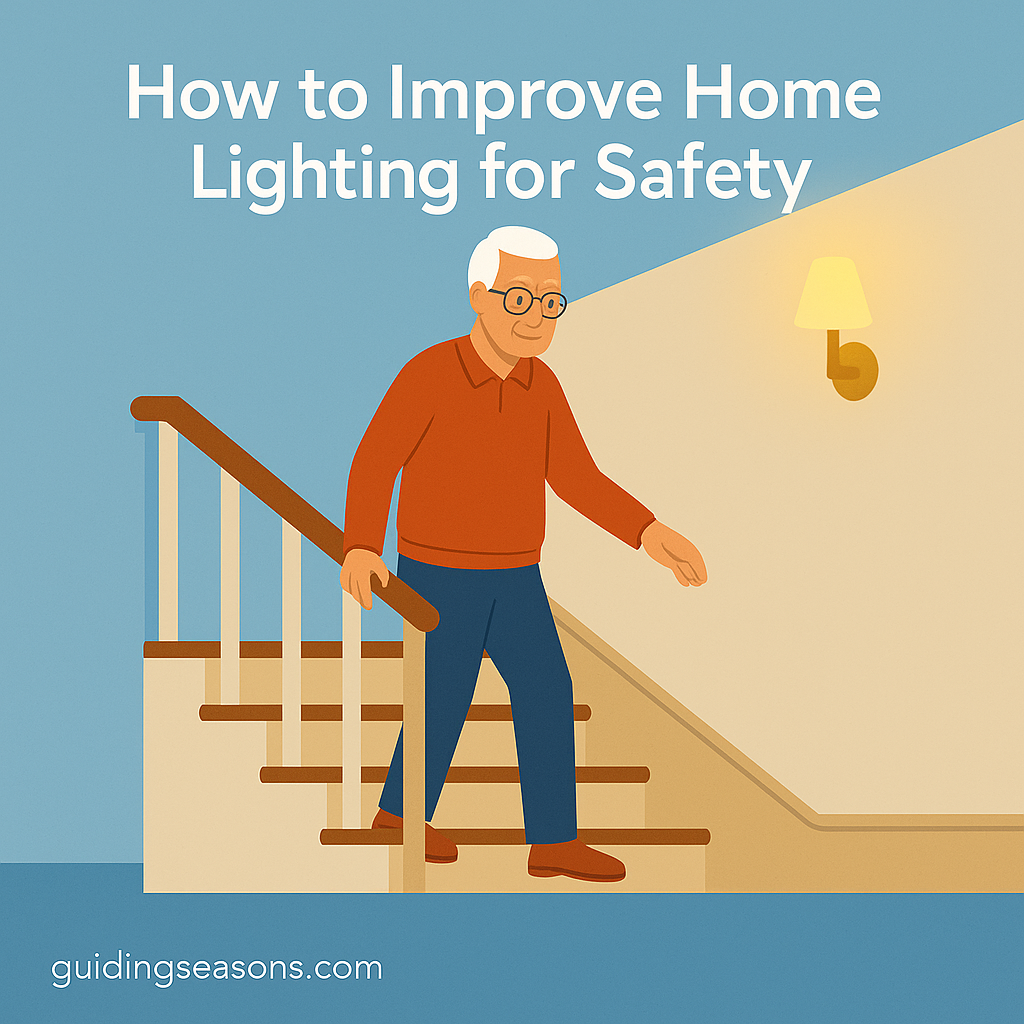
Make Stairways a Lighting Priority
Stairs are one of the most important places to improve visibility.
A poorly illuminated stairway can make it difficult to see:
- The first step
- The last step
- Step edges
- Objects left on stairs
- Changes in floor level
The National Institute on Aging specifically recommends good lighting at the top and bottom of stairs.
The CDC’s fall-prevention checklist also recommends having a light and light switch at both the top and bottom of a staircase.
Consider:
- Overhead stairway lighting
- Switches at both ends
- Illuminated or glowing switches
- Step or riser lights
- Motion-activated stair lighting
Also replace burned-out stairway bulbs promptly.
If reaching the fixture requires climbing a ladder or balancing on a step stool, ask someone else to change it.
Lighting helps, but stairs should also remain clear of books, shoes, laundry, and other objects.
Improve Contrast on Steps
Lighting works even better when combined with good visual contrast.
If stairs, floor edges, and surrounding surfaces are nearly the same color, it may be difficult to tell exactly where one step ends and the next begins.
Contrasting stair-edge strips can sometimes improve visibility.
Choose products designed for the surface and make sure they do not themselves create a loose edge or tripping hazard.
Avoid glossy materials that create glare under overhead lights.
Contrast can also help around:
- Thresholds
- Changes in floor level
- Doorways
- Bathroom fixtures
The objective is to make boundaries easier to identify at a glance.
Reduce Glare
More light is not always better.
Excessively bright or poorly positioned lighting can create glare that makes it harder to see.
Glare can come from:
- Bare bulbs
- Glossy countertops
- Highly polished floors
- Mirrors
- Windows
- Bright sunlight
- Computer or television screens
Reduce glare by:
- Using shades or diffusers
- Adjusting blinds and curtains
- Positioning lamps away from direct eye level
- Choosing matte rather than highly reflective surfaces where practical
- Using multiple moderate light sources instead of one extremely bright source
The goal is even illumination rather than intense spots of light surrounded by shadows.
Watch for Deep Shadows
Shadows can also make it harder to judge depth and notice obstacles.
A single overhead fixture may create dark areas behind furniture or in corners.
Layering different types of lighting can help.
A room might combine:
- Ceiling lighting
- Floor lamps
- Table lamps
- Task lighting
You do not necessarily need all of these.
The idea is simply to eliminate the darkest areas where obstacles may become difficult to see.
Pay particular attention to corners near walking paths.
Position Light Switches Where They’re Easy to Reach
You should not have to cross a dark room to turn on the light.
Check whether switches are available near entrances to:
- Bedrooms
- Bathrooms
- Hallways
- Stairways
- Kitchens
If a switch is inconveniently located, alternatives may include:
- Wireless wall switches
- Motion sensors
- Smart bulbs
- Voice-controlled lighting
- Plug-in remote switches
Permanent electrical work should be handled by a qualified electrician when appropriate.
The CDC also recommends easily accessible switches or motion-sensor lighting as part of making the home safer for people with vision concerns.
Improve Bathroom Lighting
Bathrooms deserve special attention because they often contain wet surfaces.
Make sure the room is well illuminated before entering.
Helpful lighting may include:
- Ceiling fixtures
- Vanity lights
- Nightlights
- Motion-activated lighting
Try to avoid creating glare on mirrors or shiny tile.
A low-level nightlight can provide enough illumination for a nighttime bathroom visit without requiring you to search for a switch in darkness.
Lighting should complement other bathroom safety features such as grab bars and nonslip surfaces.
Improve Kitchen Lighting
Kitchens require both general and task lighting.
Good visibility helps when:
- Chopping food
- Reading labels
- Handling hot cookware
- Measuring ingredients
- Cleaning
- Identifying spills
Under-cabinet lights can be useful over work surfaces.
Make sure frequently used counters are not hidden in shadows created by your body or overhead cabinets.
Also keep light switches accessible and replace burned-out bulbs quickly.
Improve Entryway and Exterior Lighting
Outdoor lighting can reduce the chance of tripping on:
- Steps
- Curbs
- Uneven pavement
- Garden edges
- Hoses
- Packages
- Debris
Useful areas to illuminate include:
- Front porch
- Back door
- Driveway
- Garage entrance
- Walkways
- Outdoor stairs
Motion-activated fixtures are useful in locations where you do not want lights operating continuously.
Make sure outdoor fixtures are intended for outdoor use and installed appropriately.
The National Institute on Aging’s home safety checklist recommends making sure the home is well lit both inside and outside, particularly around stairs.
Consider Smart Lighting
Smart lighting can make a home easier to manage, particularly when reaching switches is inconvenient.
Options may allow you to:
- Turn lights on with your voice
- Schedule lights automatically
- Control them from a phone
- Activate them with motion
- Turn several lights on at once
For example, you might program a hallway light to turn on automatically at sunset and switch off after bedtime.
Or you could create a “night” routine that turns on the bedroom, hallway, and bathroom lights at low levels.
Smart technology is helpful only if it makes life simpler.
You do not need a complicated system to improve safety.
A basic motion-sensor nightlight may be more useful than an elaborate smart-home setup if it meets your needs.
Keep Lamp Cords Out of Walking Paths
Adding lamps can improve lighting while unintentionally creating another hazard: electrical cords.
Never run cords across normal walking paths if you can avoid it.
Instead:
- Position lamps near outlets
- Route cords along walls
- Secure loose cords
- Use appropriate cord covers
- Consider having additional outlets professionally installed if necessary
The CDC’s home fall-prevention checklist recommends moving or securing cords so people do not have to walk over or around them.
A well-lit floor is not safer if a new lamp cord becomes a tripping hazard.
Clean Fixtures and Replace Aging Bulbs
Lighting quality can gradually decline without you noticing.
Dust on fixtures and lampshades reduces the amount of usable light.
Periodically:
- Clean lampshades
- Dust fixtures
- Wipe bulbs when they are cool and the fixture is safely turned off
- Replace flickering bulbs
- Replace failed bulbs promptly
- Check that fixtures are securely mounted
Flickering can also indicate a problem with a bulb, fixture, switch, or electrical system.
If replacing the bulb does not solve the problem, consider having the fixture inspected by a qualified electrician.
Have Your Vision Checked
Lighting improvements work best when combined with appropriate vision care.
The CDC recommends having your eyes checked by an eye doctor at least once a year and updating eyeglasses when necessary as part of fall prevention.
If your home suddenly seems darker than it used to, or you are having difficulty seeing stairs, reading labels, or adjusting between light and dark areas, mention those changes to your eye-care professional.
Do not assume every change in vision is simply something you have to accept.
Make One Room Better at a Time
You do not need to redesign your home’s entire lighting system in one weekend.
Start with the highest-priority area.
For example:
Weekend 1: Add a bedside lamp and hallway nightlights.
Weekend 2: Replace dim stairway bulbs and check switches.
Weekend 3: Improve kitchen task lighting.
Weekend 4: Add motion-activated lighting near the front entrance.
Within a month, you may have improved several of the most important areas without undertaking a major project.
This gradual approach also gives you time to evaluate whether each change actually helps.
Final Thoughts
Improving home lighting is one of the simplest ways to make everyday living safer and more comfortable.
Start by identifying dark hallways, poorly lit stairs, hard-to-reach switches, shadowy work areas, and nighttime walking routes.
Then make targeted improvements.
Add task lighting where you read or prepare food. Keep a lamp within reach of the bed. Install nightlights between the bedroom and bathroom. Improve stairway lighting. Make outdoor entrances easier to see. Reduce glare and deep shadows rather than simply choosing the brightest bulbs available.
The CDC recommends brighter home lighting as one part of reducing fall risk, while the National Institute on Aging emphasizes addressing poor lighting and keeping important areas such as stairways well illuminated.
Remember that lighting should work for you.
Some people need more illumination than others, and your needs may change with time. Reevaluate your home occasionally, especially if you notice changes in vision, mobility, or confidence when moving through darker spaces.
A few carefully placed lights can make a surprisingly large difference.
When switches are easy to reach, stairs are clearly visible, nighttime pathways are illuminated, and everyday work areas have appropriate task lighting, your home becomes easier to navigate—and that can support both safety and independence for years to come.