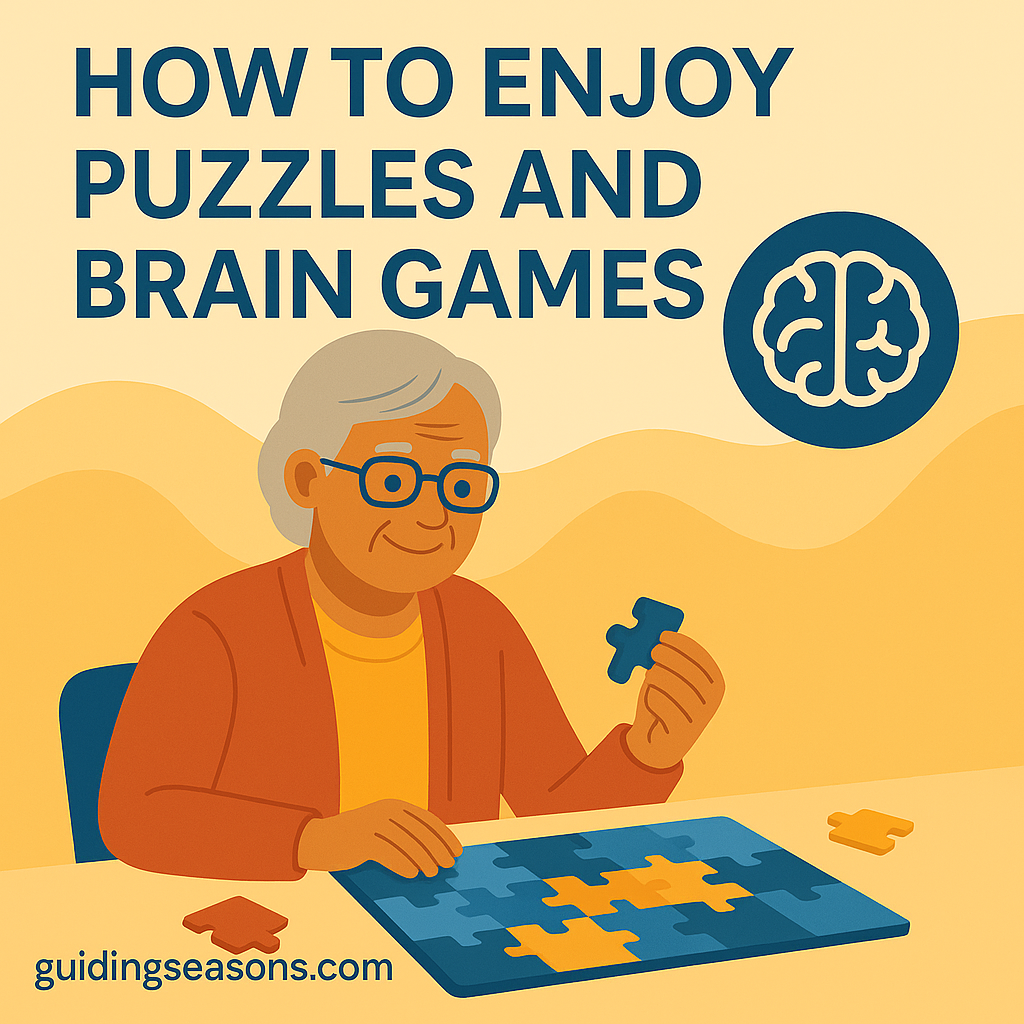
Puzzles and brain games are often promoted as exercises for keeping your mind sharp as you get older. While mental stimulation can be a valuable part of an active lifestyle, there is another, simpler reason to do puzzles:
They’re fun.
A crossword can become part of your morning coffee routine. A jigsaw puzzle can turn a quiet afternoon into a relaxing project. Sudoku can provide a satisfying challenge while you’re waiting for an appointment. A card or board game can bring friends and family together around a table.
You don’t need to treat every puzzle as a test of your intelligence or memory.
In fact, removing that pressure can make puzzles much more enjoyable.
The National Institute on Aging (NIA) says cognitive training designed to improve particular skills has shown some benefits in research involving older adults. However, it also cautions that there isn’t enough evidence to conclude that commercially available computer brain-training programs provide the same kinds of cognitive benefits. The evidence for lasting effects from many mentally stimulating activities is still being studied.
That makes it sensible to view puzzles as one enjoyable form of mental engagement rather than a medical treatment or guaranteed defense against cognitive decline.
Choose games you like, challenge yourself enough to stay interested, and let enjoyment be the main reason you continue.
Why Mental Engagement Matters at Every Stage of Life
Your brain continues to encounter opportunities to learn throughout life.
Mental engagement can come from many different activities, including:
- Reading
- Learning a language
- Playing music
- Taking photographs
- Gardening
- Writing
- Playing games
- Studying a new subject
- Doing puzzles
- Learning new technology
Puzzles are simply one option.
The NIA notes that meaningful and cognitively demanding activities may have benefits for older adults. For example, research it highlights found that older adults learning skills such as digital photography and quilting experienced greater memory improvement than comparison groups participating in less cognitively demanding activities. At the same time, the agency emphasizes that evidence for lasting cognitive benefits from such activities is not definitive.
The practical takeaway is straightforward: keep doing things that require you to think, learn, pay attention, and occasionally solve problems.
Puzzles can fit nicely into that larger lifestyle.
Choose Puzzles You Actually Enjoy
There isn’t one “best” brain game for everyone.
Some people love numbers and hate word games.
Others can spend hours on a crossword but have absolutely no interest in Sudoku.
Your preferences matter.
Experiment with different types.
Crosswords
Crosswords involve vocabulary, general knowledge, word retrieval, spelling, and interpreting clues.
They can be particularly enjoyable if you like language and trivia.
Sudoku
Sudoku is based on logic rather than arithmetic.
You don’t need advanced mathematics. The challenge comes from determining where numbers can and cannot go according to a set of rules.
Jigsaw Puzzles
Jigsaw puzzles offer a different kind of challenge.
You’re looking for:
- Colors
- Shapes
- Patterns
- Edges
- Spatial relationships
- Small visual details
They’re also easy to enjoy socially because several people can work on the same puzzle.
Word Searches
Word searches tend to be less demanding than complicated crosswords or logic puzzles, which can make them ideal when you want something relaxing rather than difficult.
Logic Puzzles
These require you to use clues to eliminate possibilities and reach a conclusion.
If you enjoy mysteries and problem-solving, logic puzzles may be especially satisfying.
Card Games
Games such as solitaire, bridge, hearts, or rummy combine rules, strategy, attention, and decision-making.
Some also provide social interaction.
Board Games
Chess, checkers, Scrabble, dominoes, and many modern board games can provide both mental engagement and an opportunity to spend time with other people.
Digital Games
Tablets, computers, and smartphones offer thousands of puzzle games.
These can be convenient, especially when traveling or when physical puzzle pieces are difficult to handle.
Try several formats before deciding what you enjoy most.
Don’t Assume Harder Is Always Better
A puzzle should challenge you enough to hold your attention without constantly frustrating you.
Imagine a scale from 1 to 10.
A puzzle at difficulty level 2 might become boring.
A puzzle at 10 might be so difficult that you give up.
Your enjoyable range might be around 5 to 7—challenging enough that you have to think but manageable enough that progress still feels possible.
That range will be different for everyone.
It can also change from day to day.
On an energetic morning, you might enjoy a difficult crossword.
In the evening, you may prefer an easy word search.
Both are perfectly reasonable choices.
You don’t earn extra credit for choosing the hardest puzzle.
Stop Treating Speed as the Goal
Many digital games include timers, scores, rankings, streaks, or leaderboards.
Those features can be enjoyable if you like competition.
But they’re optional.
A crossword that takes you 45 minutes isn’t necessarily better or worse than one that takes someone else 15 minutes.
You may even enjoy puzzles more when you stop measuring your performance.
Instead of asking:
“How fast did I finish?”
try asking:
“Did I enjoy solving it?”
or:
“Did I figure out something that initially confused me?”
That shifts your attention from performance to experience.
Create a Relaxing Puzzle Routine
Puzzles can become a pleasant ritual.
Perhaps you enjoy a crossword with breakfast.
Maybe you work on a jigsaw puzzle for 20 minutes after dinner.
You could keep a Sudoku book beside your favorite chair.
Try something simple:
Monday: Crossword
Wednesday: Sudoku
Friday: Jigsaw puzzle
Sunday: Card or board game with someone
If you spend just 20 minutes on puzzles four times per week, that’s 80 minutes of enjoyable mental engagement each week.
Over a year, it amounts to approximately 69 hours.
You don’t need marathon sessions to make puzzles a regular hobby.
Turn Jigsaw Puzzles Into Longer Projects
Jigsaw puzzles are particularly well suited to people who enjoy projects that unfold gradually.
Start with a manageable size.
A 300- or 500-piece puzzle may provide plenty of challenge without becoming overwhelming.
Choose an image you actually enjoy looking at.
It could feature:
- A favorite travel destination
- A garden
- Wildlife
- Famous artwork
- A coastal landscape
- Vintage photographs
- Architecture
Instead of trying to finish the entire puzzle in one sitting, leave it on a dedicated table if you have the space.
Spend 15 or 20 minutes on it whenever you feel like it.
The puzzle becomes something you return to rather than something you must complete.
Try the “One Puzzle With Coffee” Habit
Habits are easier to maintain when connected to something you already do.
Suppose you drink coffee every morning.
Keep a puzzle book nearby.
Your routine might become:
Make coffee → sit down → complete one puzzle → continue with the morning.
The puzzle could take five minutes or 20.
There’s no minimum requirement.
The purpose is simply to associate mental engagement with an enjoyable part of your existing routine.
Make Puzzles Social
Puzzles don’t have to be solitary.
Invite someone to participate.
You could:
- Work on a jigsaw puzzle with your spouse
- Play Scrabble with a friend
- Teach grandchildren a card game
- Join a chess group
- Attend a trivia night
- Join a bridge club
- Complete crosswords together
- Exchange puzzle books with friends
This adds conversation and social interaction to the activity.
The NIA notes that staying socially connected may also support cognitive health. It highlights research involving thousands of older adults in which higher social engagement was associated with better cognitive health later in life, although an association does not by itself prove cause and effect.
A weekly card game, therefore, can offer something a solitary brain-training app cannot: an opportunity to think and spend time with other people simultaneously.
Learn a Completely New Kind of Game
Familiar puzzles are comfortable.
New puzzles require you to learn.
If you’ve completed crosswords for 30 years, consider occasionally trying something different.
You might learn:
- Sudoku
- Chess
- A new card game
- Logic grids
- Mahjong
- A strategy board game
- A new digital puzzle
- Cryptograms
The Global Council on Brain Health recommends engaging in a variety of mentally stimulating activities and increasing challenge or adding new activities rather than relying exclusively on commercial brain-training games. It also notes that evidence for many conventional “brain games” improving overall everyday functioning remains limited.
Novelty can also make the hobby more interesting.
You aren’t just solving a puzzle.
You’re learning how an entirely new system works.
Use Hints Without Feeling Guilty
Some people refuse to use hints because they consider them cheating.
Unless you’re participating in a competition, there is no cheating.
You’re playing for yourself.
If you’ve stared at the same crossword clue for 15 minutes and frustration is replacing enjoyment, look up a hint.
For a jigsaw puzzle, look at the picture on the box.
For a digital game, use the built-in clue system.
Then continue.
A hint can teach you something and keep the activity moving.
The objective isn’t to prove that you can solve everything independently.
Know When to Take a Break
Sometimes your brain simply feels tired.
You might read the same crossword clue repeatedly without understanding it.
Or you may stare at a Sudoku grid and stop seeing possibilities.
That’s a good time to stop.
Get up.
Drink some water.
Go outside.
Do something else.
Come back later.
Interestingly, something that seemed impossible earlier may suddenly look obvious after a break.
Taking a break isn’t quitting.
It’s part of keeping the activity enjoyable.
Don’t Compare Your Performance With Other People
Puzzles can become discouraging when they turn into measurements of intelligence.
Someone else may complete Sudoku faster than you.
You may know more crossword vocabulary than they do.
Neither result says much about your overall intelligence or cognitive health.
People develop different skills based on experience.
Someone who has solved crosswords for 20 years will probably be better at recognizing crossword conventions than a beginner.
That’s practice—not proof that one person’s brain is healthier.
Measure progress against your own experience if you want to measure it at all.
Be Careful With “Brain Training” Claims
Commercial brain-training programs sometimes make impressive claims about memory, intelligence, mental speed, or protection against age-related decline.
Approach those claims cautiously.
The NIA specifically warns that there isn’t enough evidence to conclude that commercially available computer brain-training applications produce the same cognitive effects observed in structured research interventions.
Similarly, the Global Council on Brain Health has concluded that evidence for the long-term benefits of what people commonly call brain games is weak, particularly when companies suggest that getting better at their games will broadly improve everyday functioning.
That doesn’t mean you shouldn’t play them.
If you enjoy a brain-training app, play it.
Just don’t feel that you need to purchase expensive subscriptions because you’re afraid that skipping them will harm your brain.
There are many ways to remain mentally engaged.
Mix Puzzles With Other Activities
Brain health isn’t built around one activity.
A varied lifestyle can include:
- Physical activity
- Social connection
- Adequate sleep
- Healthy eating
- Managing medical conditions
- Learning
- Hobbies
- Mentally stimulating activities
The NIA describes cognitive health as only one part of overall brain health and emphasizes a broader combination of physical health, activity, social engagement, and meaningful mental stimulation.
So instead of spending three hours every day doing brain games because you believe more must be better, consider variety.
You might spend 20 minutes on a crossword, then take a walk.
Another day, play cards with friends.
The next day, work in the garden.
Later in the week, learn something new.
Variety can make life more interesting as well.
Adjust Puzzles to Your Comfort
Physical comfort matters too.
If small print is difficult to see, choose large-print puzzle books.
If small jigsaw pieces are frustrating to handle, look for puzzles with larger pieces.
If writing for long periods is uncomfortable, try a tablet.
Useful adaptations might include:
- Large-print crosswords
- Large-piece jigsaw puzzles
- Adjustable tablet text
- Good lighting
- Comfortable seating
- Pencil grips
- Puzzle boards that can be moved
Changing the format isn’t making the puzzle “easier” in a negative sense.
It’s removing unnecessary barriers so you can enjoy the actual challenge.
Try a Seven-Day Puzzle Experiment
If you aren’t sure which type of puzzle you like, spend one week experimenting.
Monday: Crossword
Tuesday: Sudoku
Wednesday: Jigsaw puzzle
Thursday: Word search
Friday: Logic puzzle
Saturday: Card or board game
Sunday: Repeat your favorite
Spend only 15 or 20 minutes on each.
At the end of the week, ask yourself:
Which activity made time pass quickly?
Which one made me curious?
Which one frustrated me?
Which would I voluntarily do again?
Your answers matter more than which activity is supposedly the best brain exercise.
When Puzzles Stop Feeling Fun
Pay attention to how the hobby makes you feel.
Consider changing your approach if you regularly experience:
- Frustration
- Pressure to perform
- Anxiety about scores
- Embarrassment about mistakes
- Mental exhaustion
- Obsession with maintaining streaks
- Constant comparison with other people
Try an easier puzzle.
Remove the timer.
Change formats.
Play with someone else.
Or take a week off.
Puzzles are optional entertainment.
They should not become another source of anxiety.
Don’t Use Puzzle Performance to Diagnose Yourself
Everyone forgets words, makes mistakes, and occasionally struggles with something that used to feel easy.
A difficult crossword is not a medical test.
Neither is Sudoku.
If you’re concerned about persistent or worsening changes in memory, thinking, language, judgment, or your ability to handle everyday tasks, don’t try to evaluate yourself based on puzzle scores.
Discuss those concerns with a healthcare professional.
The NIA defines cognitive health in terms of abilities such as thinking, learning, and remembering clearly enough to carry out everyday activities. Many different medical, lifestyle, medication, sensory, and emotional factors can affect those abilities.
A game can’t provide that evaluation.
Keep the Purpose Simple
You don’t need to optimize every hobby for health.
Sometimes a crossword can simply be a crossword.
A jigsaw puzzle can be something pleasant to work on while listening to music.
A card game can be an excuse to spend Wednesday afternoon laughing with friends.
A Sudoku puzzle can make a 20-minute wait feel shorter.
Those are worthwhile reasons to play.
Mental stimulation can be part of the benefit, but enjoyment is what makes you want to return.
Final Thoughts
Puzzles and brain games can be an enjoyable way to bring curiosity, challenge, and focused attention into everyday life.
But they don’t need to become tests.
You don’t need the hardest crossword.
You don’t need to finish Sudoku faster than yesterday.
You don’t need a perfect score on a brain-training app.
And you don’t need to purchase a program that promises dramatic improvements in memory or protection from cognitive decline.
Choose activities you genuinely enjoy.
Work on a 500-piece jigsaw puzzle for 20 minutes in the afternoon. Complete a crossword with your morning coffee. Learn a new card game. Try Sudoku for the first time. Invite a friend over for Scrabble.
If something becomes frustrating, make it easier or switch activities.
If you love competition, keep score.
If you hate competition, don’t.
The most sustainable mental activities are often the ones you voluntarily return to because they’re interesting, satisfying, or simply fun.
That’s a healthier way to think about puzzles: not as homework for your brain, but as another enjoyable way to remain curious and engaged with life.