Most of us understand how to show compassion to another person.
When a friend makes a mistake, we usually don’t tell them they’re a failure. When someone we love is exhausted, we don’t criticize them for needing rest. When a family member is going through a difficult transition, we often remind them to give themselves time.
Yet many people struggle to extend that same understanding to themselves.
You might forget an appointment and immediately think, “What’s wrong with me?”
You may need more time to complete something and tell yourself, “I should be faster.”
Or perhaps retirement, changes in health, family responsibilities, financial concerns, or simply getting older have created a life that looks different from what you expected.
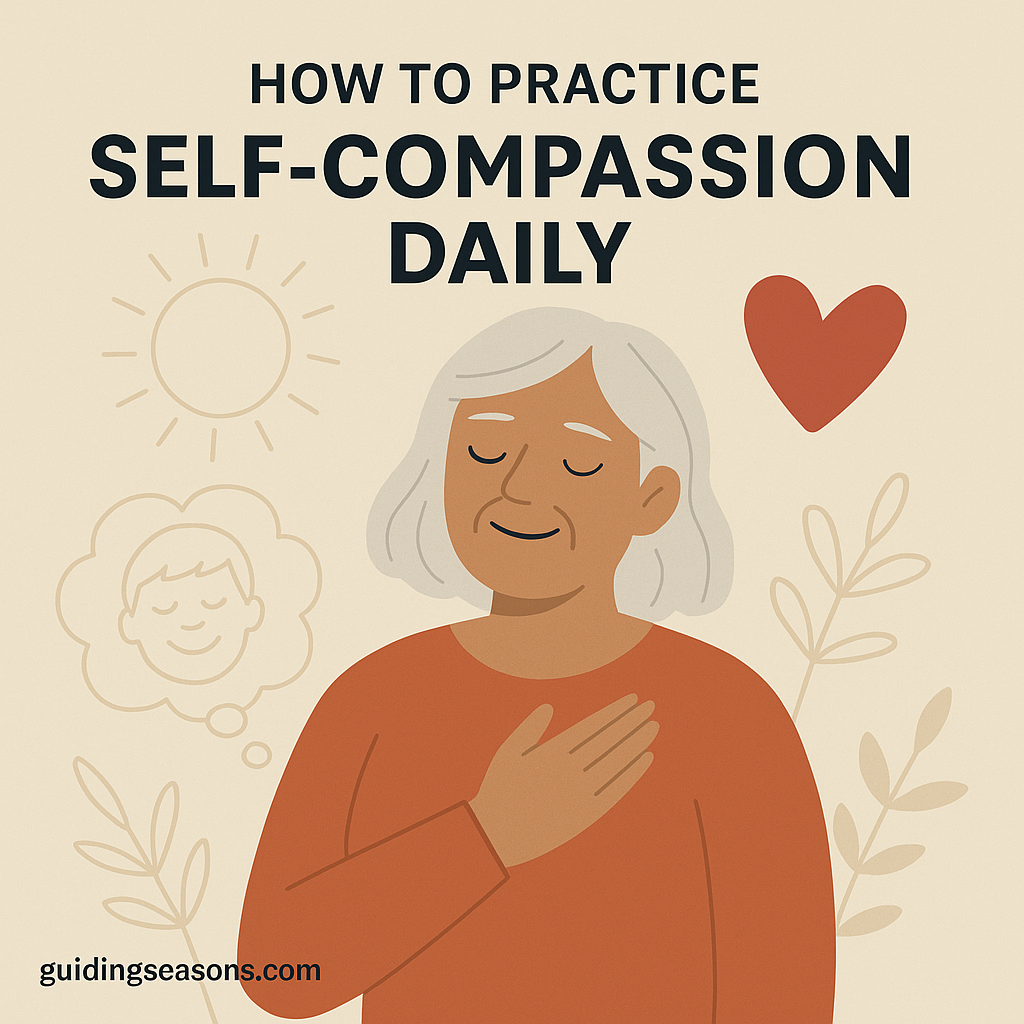
Self-compassion offers another way to respond.
It means recognizing that you’re having a difficult moment and treating yourself with the same patience and basic kindness you would offer someone else.
That doesn’t mean ignoring mistakes, avoiding responsibility, or pretending that everything is fine. In fact, self-compassion can make it easier to acknowledge a problem because you don’t have to attack yourself in the process.
Research increasingly supports this distinction. A 2025 systematic review indexed by the National Library of Medicine examined 113 studies involving self-compassion and psychological outcomes. It found that repetitive negative thinking, including worry and rumination, was an important process connecting self-compassion with psychological health, while mindfulness also appeared to play a role. The researchers cautioned that stronger studies are still needed to establish cause and effect.
Self-compassion doesn’t need to become another complicated self-improvement project.
It can begin with how you respond to yourself during the next difficult five minutes.
1. Notice How You Speak to Yourself
Self-talk can become so automatic that we barely notice it.
You spill something.
“Why am I so clumsy?”
You forget someone’s name.
“My memory is terrible.”
You don’t finish everything you planned.
“I wasted the whole day.”
None of these thoughts may seem particularly important on their own. But when harsh self-criticism becomes your normal response to everyday difficulties, it can add unnecessary emotional pressure.
Start by simply noticing your language.
You don’t have to immediately replace every negative thought with something cheerful.
Instead, ask:
“Would I say this to someone I care about?”
If your friend forgot where they put their glasses, would you tell them they were incompetent?
Probably not.
You might laugh with them and help look.
Try offering yourself the same courtesy.
Instead of:
“I’m so stupid for forgetting that.”
Try:
“I forgot. Let me figure out what I need to do next.”
This isn’t unrealistic positivity.
It’s a more useful response.
2. Use the Friend Test
One of the simplest self-compassion exercises requires no meditation, journal, book, or special technique.
Imagine that someone you care about is experiencing exactly what you’re experiencing.
What would you say?
Suppose you promised yourself you’d exercise three times this week but managed only one walk.
Your immediate thought might be:
“I never stick with anything.”
Now imagine your closest friend tells you the same thing.
Would you respond:
“You’re hopeless. You always fail.”
Almost certainly not.
You might say:
“You had a difficult week. You still got out once. Try again next week.”
Now turn that response toward yourself.
This doesn’t lower your standards.
You’re still acknowledging that you wanted to exercise more.
You’re simply separating accountability from self-punishment.
You can recognize something you want to change without attacking yourself.
3. Give Yourself a Few Seconds Before Reacting
Self-criticism often happens immediately.
Something goes wrong, and the internal reaction arrives almost instantly.
Creating even a brief pause can interrupt that pattern.
Try what you might call the 10-second reset.
When something frustrating happens:
Pause.
Take one slow breath.
Notice what you’re thinking.
Then ask:
“What’s the most helpful thing I can say to myself right now?”
Perhaps you accidentally scheduled two appointments at the same time.
Your first thought might be:
“I can’t believe I did this again.”
Pause.
Then replace the criticism with action:
“I made a scheduling mistake. I’ll call and move one appointment.”
The problem hasn’t disappeared.
But now you’re solving it instead of making yourself feel worse about it.
4. Allow Yourself to Experience Difficult Emotions
Self-compassion doesn’t mean feeling good all the time.
Some days you’ll be disappointed.
Other days you may feel angry, worried, lonely, embarrassed, frustrated, or sad.
You don’t have to immediately talk yourself out of those emotions.
Sometimes a compassionate response is simply:
“This is difficult.”
Or:
“I’m disappointed that this happened.”
Acknowledging an emotion is different from allowing it to control the entire day.
You can be disappointed and still make dinner.
You can feel worried and still take your afternoon walk.
You can feel lonely and decide to call someone.
You can be frustrated and give yourself an hour to rest.
Emotions are experiences, not instructions.
Self-compassion allows you to notice them without automatically judging yourself for having them.
5. Practice Small Moments of Mindfulness
Mindfulness and self-compassion work naturally together.
Mindfulness involves paying attention to your current experience without immediately judging it.
That might sound complicated, but it can be remarkably ordinary.
Try sitting quietly for two minutes.
Notice your breathing.
Listen to the sounds around you.
Feel your feet against the floor.
Notice the temperature of your coffee or tea.
If your mind wanders, notice that too.
You haven’t failed at mindfulness because you started thinking about tomorrow’s grocery list.
Simply bring your attention back.
A large 2025 systematic review found growing evidence that mindfulness may be one of the processes involved in the relationship between self-compassion and psychological well-being.
You don’t necessarily need a 30-minute meditation session.
Two quiet minutes while drinking your morning coffee can be a reasonable place to start.
6. Stop Expecting Yourself to Be Perfect
Perfection can hide inside surprisingly ordinary expectations.
“I should keep the house cleaner.”
“I should exercise every day.”
“I should be more social.”
“I should have saved more money.”
“I shouldn’t need help.”
“I should be able to do what I did 20 years ago.”
Notice how often the word should appears.
Some expectations are useful. Others may be outdated or unrealistic.
Your circumstances change.
Your body changes.
Your priorities change.
Your responsibilities change.
Self-compassion means allowing your expectations to change too.
Perhaps you once cleaned your entire house in one afternoon.
Now you’d rather divide it across several days.
That’s not necessarily failure.
It may simply be a better approach for your current life.
7. Adjust the Goal Instead of Abandoning It
Self-compassion isn’t an excuse to stop trying.
It can actually provide a more sustainable way to keep going.
Suppose your goal is a 30-minute walk, but you’re having a particularly low-energy day.
You could decide:
“If I can’t do 30 minutes, there’s no point.”
Or you could adjust:
“I’ll walk for 10 minutes today.”
You haven’t abandoned the goal.
You’ve adapted it.
This approach can apply to many areas of life.
Can’t organize the entire garage? Organize one shelf.
Can’t read for an hour? Read for 15 minutes.
Don’t feel like attending a three-hour social event? Stop by for 45 minutes.
A smaller step is still a step.
8. Recognize Small Wins
People often overlook what they accomplish because they’re focused on what remains unfinished.
Suppose your list contained six tasks.
You completed four.
Which gets your attention?
Many people immediately focus on the two unfinished tasks.
Try deliberately noticing what you did accomplish.
Perhaps today you:
- Took a walk
- Prepared a healthy meal
- Made an appointment
- Called a friend
- Organized one drawer
- Rested when you needed to
- Tried something unfamiliar
- Asked someone for help
- Completed a task you’d been avoiding
None of these accomplishments needs a celebration.
Simply acknowledge:
“I’m glad I did that.”
Small recognition can help you build a more balanced picture of yourself.
9. Create a Two-Minute Self-Compassion Ritual
Habits become easier when they’re attached to something you already do.
Choose one activity that happens every day.
Maybe it’s making coffee.
Brushing your teeth.
Taking medication.
Getting into bed.
Then attach a two-minute self-compassion ritual to it.
For example, after making your morning coffee, sit down for two minutes and ask:
How am I feeling today?
What do I need today?
What is one kind thing I can do for myself?
That’s it.
Two minutes a day adds up to roughly 12 hours over a year.
You don’t need to dramatically change your schedule to create meaningful time for reflection.
Consistency often matters more than intensity.
10. Let Rest Be Part of a Healthy Life
Rest can produce surprising amounts of guilt.
You sit down in the afternoon and immediately think about everything you could be doing instead.
There’s laundry.
The garage needs organizing.
You haven’t exercised.
You could answer emails.
You should call someone.
But rest isn’t necessarily laziness.
Your body and mind need periods of lower activity.
Instead of accidentally spending three hours on the couch while feeling guilty about it, try choosing rest deliberately.
Tell yourself:
“I’m going to read and rest for the next hour.”
Intentional rest feels different because you’ve decided that it belongs in your day.
When the hour is finished, you can decide what comes next.
11. Be Careful With Comparison
Comparison makes self-compassion difficult.
Someone your age runs marathons.
Someone else travels constantly.
Another person seems to have a perfect relationship with their adult children.
A former coworker appears to have considerably more retirement savings.
It’s easy to look at someone else’s circumstances and turn them into evidence against yourself.
But you’re comparing different lives.
Different health.
Different finances.
Different histories.
Different responsibilities.
Different opportunities.
And often, you’re comparing your complete reality with the small portion of another person’s life that you can see.
When comparison appears, redirect the question.
Instead of:
“Why aren’t I doing as well as they are?”
Ask:
“What would doing well look like for me?”
That answer is far more useful.
12. Forgive Yourself for Past Decisions
Self-compassion becomes especially important when thinking about the past.
Perhaps you made a financial decision you regret.
Stayed too long in a job.
Ended a relationship badly.
Missed an opportunity.
Didn’t spend enough time with someone.
You can learn from those experiences without sentencing yourself to decades of self-criticism.
Try remembering something important:
You’re evaluating your past decisions using knowledge you gained afterward.
The person making the original decision didn’t necessarily have that information.
Ask:
“What did I know at the time?”
“What pressures was I facing?”
“What have I learned since?”
Self-forgiveness doesn’t mean declaring that every choice was correct.
It means accepting that imperfect decisions are part of being human.
Take the lesson.
Use it.
Then allow yourself to continue living.
13. Spend Time With People Who Make Compassion Easier
Our environment influences how we speak to ourselves.
Some relationships leave us feeling supported and understood.
Others leave us constantly questioning ourselves.
Pay attention to the difference.
Supportive people don’t have to agree with everything you do.
A good friend may tell you when they think you’re making a mistake.
But they can do so without making you feel worthless.
Look for relationships characterized by:
- Mutual respect
- Encouragement
- Honest conversation
- Healthy boundaries
- Humor
- Patience
- Listening
- Reliability
You don’t necessarily need dozens of relationships.
A few dependable people can provide tremendous emotional support.
14. Remember That Difficulty Is Part of Being Human
One reason mistakes feel so painful is that we often interpret them as evidence that something is uniquely wrong with us.
Everyone else seems to have things figured out.
They don’t.
Everyone makes poor decisions.
Everyone forgets things.
Everyone experiences rejection.
Everyone has awkward conversations.
Everyone gets older.
Everyone eventually encounters circumstances they cannot completely control.
Recognizing this doesn’t make your difficulty unimportant.
It simply reminds you that struggling occasionally doesn’t separate you from everyone else.
It connects you with them.
15. Understand What the Research Can—and Cannot—Tell Us
Self-compassion has become a substantial area of psychological research, but it’s important not to exaggerate the evidence.
A 2023 meta-analysis indexed by the National Library of Medicine examined 56 randomized controlled trials of self-compassion-focused interventions. Researchers found small-to-medium reductions in depressive symptoms, anxiety, and stress immediately following interventions compared with control conditions, with smaller effects for some outcomes at follow-up. However, the researchers also rated the overall risk of bias across the included trials as high and emphasized the need for better-quality research.
In other words, self-compassion is a promising practice—not a miracle cure.
It’s also not a replacement for professional care when someone is experiencing persistent depression, anxiety, trauma-related symptoms, or other significant mental-health concerns.
Think of self-compassion as one useful part of caring for yourself.
Try a Seven-Day Self-Compassion Experiment
If you’d like to make these ideas practical, try a simple experiment for one week.
Each morning, ask:
“What do I need today?”
During the day, notice at least one harsh thought and rewrite it more fairly.
Each evening, identify one thing you handled reasonably well.
That’s three small actions.
For example:
Morning:
“I’m tired today, so I’ll give myself a slower morning.”
Afternoon:
Instead of “I can’t believe I forgot that,” try “I forgot something. I’ll write it down so I remember next time.”
Evening:
“I didn’t finish everything, but I went for my walk and called my sister.”
Do this for seven days.
The goal isn’t to become endlessly positive.
The goal is simply to become more aware of how you treat yourself.
Once you notice the pattern, you can begin changing it.
When Self-Compassion Means Asking for Help
Sometimes the kindest thing you can do for yourself is recognize that you need additional support.
Consider reaching out to a healthcare provider or qualified mental-health professional if emotional difficulties are persistent, worsening, interfering with daily life, or making it difficult to enjoy activities you normally value.
Self-compassion doesn’t mean handling everything alone.
It includes recognizing when a problem deserves more attention than you can reasonably give it yourself.
Final Thoughts
Practicing self-compassion daily doesn’t require becoming a completely different person.
You don’t have to eliminate self-criticism.
You don’t have to meditate for an hour.
You don’t need to feel positive every morning.
Start smaller.
Notice how you speak to yourself.
Pause before turning a mistake into a judgment about your character.
Give yourself permission to rest.
Adjust goals when circumstances change.
Recognize small accomplishments.
Forgive yourself for decisions made by an earlier version of you.
And when something difficult happens, ask one simple question:
“How would I respond if someone I loved were going through this?”
Then try offering yourself some of the same patience.
You will still make mistakes.
You’ll still have frustrating days.
You’ll occasionally say something you regret, forget something important, or fail to accomplish what you intended.
Self-compassion doesn’t eliminate those experiences.
It changes what happens next.
Instead of adding criticism to an already difficult moment, you acknowledge what happened, decide what you can learn, and continue forward.
Practiced repeatedly, that small change can become a very different way of relating to yourself—not with perfection, but with patience, fairness, and respect.